
Let’s build your chatbot today!
Launch a no-code WotNot agent and reclaim your hours.
*Takes you to quick 2-step signup.
Not so far in the past, chatbots were no more than just scripted pop-ups, rigid, limited, and often frustrating. But now, they’ve evolved into versatile, intelligent, and conversational systems that understand and solve real problems people face.
This, in turn, has caused businesses of all sizes to swiftly adopt chatbots and AI agents into their workflow. And now, some of the most important aspects of these businesses, such as lead generation and customer support, are handled mainly by chatbots.
And, customers have also become accepting of the overwhelming presence of automated chatbots, from SaaS and e-commerce to banking and healthcare.
For this article, I’ve tried to curate all the data and interesting points about the current state of the chatbot industry, along with its usage and engagement trends.
Some of these figures might even prove to be eye-openers for you.
Global Market Size and Revenue Forecast
1. The chatbot market size was estimated to be $9.56 billion in 2025
Source: Grand View Research
The projections indicate that it is growing at a CAGR of 19.6% and will reach $41.2 billion by 2033.
2. North America held over 31.27% of the global chatbot market
The region’s dominance highlights its early adoption of AI, strong enterprise presence, and continued investment in automation technologies.
3. The market grew from $8.7 billion in 2024 to $9.56 billion in 2025
The YoY jump in the industry size has been caused by increased enterprise deployment. Industries such as customer service, eCommerce, and banking. The market size for chatbots has more than doubled from 2020 to 2024, going from $4.8 billion to $8.7 billion in 2024.
4. The Asia Pacific chatbot industry is outpacing global CAGR at 24.71%
Source: Research and Markets
With the expansion led by India, China, and Japan, a CAGR of 24.71% has been projected through the year 2031.
China invested $2.1 billion in AI initiatives supporting chatbot industry growth.
India’s chatbot market is growing at approximately 25% annually.
Let’s build your chatbot today!
Launch a no-code WotNot agent and reclaim your hours.
Let’s build your chatbot today!
Launch a no-code WotNot agent and reclaim your hours.
AI Chatbot Marketshare Worldwide
Chatbots and AI have become inseparable, and every chatbot is powered by one or the other AI model. Here is the global market share of the major AI models used in chatbots:
ChatGPT | Perplexity | Google Gemini | Microsoft Copilot | Claude | Deepseek |
78.15% | 7.06% | 8.64% | 3.19% | 2.93% | 0.02% |
Source: Statcounter
ChatGPT holds nearly four-fifths of the global AI chatbot market, according to data from Feb 2025 to Feb 2026, with a 78.15% share of global chatbot traffic.
Google Gemini is the fastest-growing challenger with 8.64% market share as of Feb 2026.
Specific to the USA, the top three contenders of the AI chatbot market are ChatGPT, Google Gemini, and Microsoft Copilot, with shares of 68.5%, 11.71%, and 8.26%, respectively.
Industrial Trends in the Chatbot Market
With so many market trends, growth rates, and adoption figures to compare, presenting the data visually can make it much easier to identify patterns and communicate insights. An infographic maker is a practical way to turn chatbot statistics into engaging visuals for reports, presentations, or blog content.
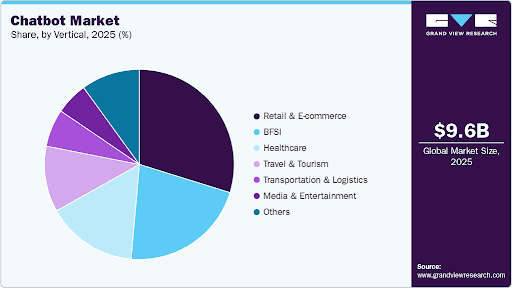
Source: Grand View Research
Vertical | Estimated Share (%) | Market Value (USD Billion) |
Retail & E-commerce | 30.0% | $2.88 |
BFSI | 21.5% | $2.06 |
Healthcare | 15.5% | $1.49 |
Travel & Tourism | 11.5% | $1.10 |
Others | 10.0% | $0.96 |
Transportation & Logistics | 6.5% | $0.62 |
Media & Entertainment | 5.0% | $0.48 |
Retail and e-commerce are the largest segments among all the other industries. This might be driven by the vital demand of 24x7 customer service and personalized shopping assistance.
BFSI, i.e., Banking, Financial Services, and Insurance, is the second-largest sector, where companies utilize chatbots for account queries, fraud alerts, and loan processing.
1. As per offerings, the Solution segment captured over 61.84% of the market share last year
The solutions include integrated chatbot platforms enhanced with machine learning and multilingual features. Solution-based chatbots win over services due to their focus on efficiency, which leads to easy scaling and smoother integration.
2. Among types, Standalone chatbots held more than 58.26% of the market
The chatbots that operate independently are capturing more businesses, offering greater flexibility. They are used in industries that need specific, customized solutions, such as customer support and retail.
3. Chatbot services are growing at a CAGR of 24.12% through 2031
As implementation complexity rises, businesses increasingly rely on consulting, integration, and managed services to unlock full value from chatbot investments.
4. Customer support held 41.82% of the chatbot market share in 2025
Source: Mordor Intelligence
High query volumes and clear cost-saving benefits make customer service the most mature and ROI-proven chatbot use case.
5. HR and recruiting chatbot use cases are growing at a CAGR of 24.86%
Organizations are rapidly adopting chatbots for candidate screening, interview scheduling, and internal queries—freeing up human teams for strategic tasks.
6. Healthcare is seeing a 36.8% CAGR in AI adoption
Source: Precedence Research
Chatbots handle initial patient inquiries in 42% of major healthcare networks. The market size of Artificial Intelligence in the healthcare industry is projected to reach $512.20 billion in 2026.
7. 47% of enterprises are building generative AI chatbots in-house
Despite having 30%-50% higher costs, well-known enterprises like HSBC, KPMG, and JP Morgan prefer to build their AI chatbots internally rather than getting them off the shelf.
8. Retail and eCommerce lead chatbot adoption with 27.95% market share
Use cases like order tracking, product discovery, and promotions make chatbots a natural fit for online retail.
9. Operations and supply chain conversational AI is growing at 21.5% CAGR through 2031
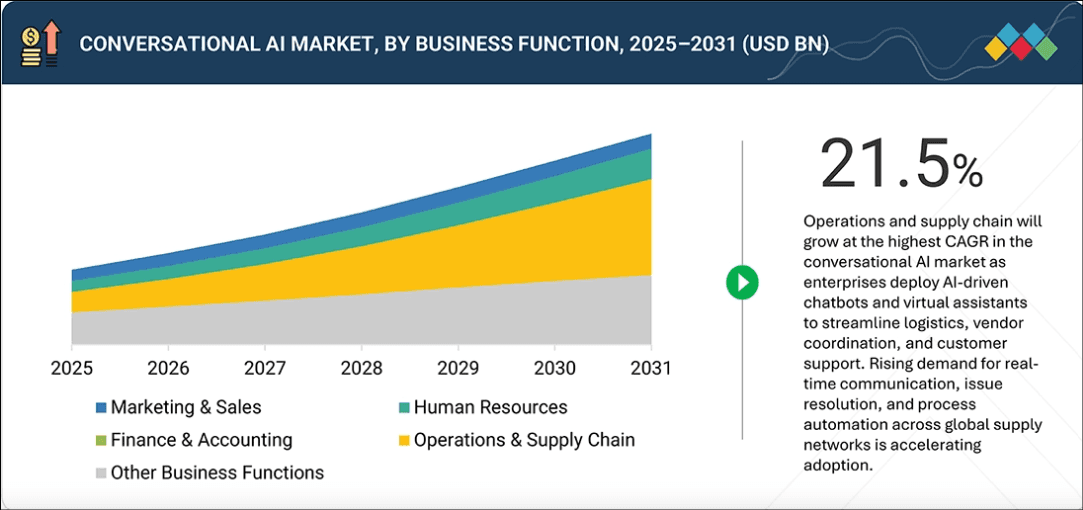
Source: Market and Markets Report
Enterprises are deploying AI-driven chatbots and virtual assistants increasingly to streamline logistics, vendor coordination, and customer support across global supply networks. The primary drivers behind this trend are real-time communication, issue resolution, and process automation.
Here are the expected growth rates of conversational AI usage for other business functions:
Finance and accounting: 18.4% CAGR
Human resource: 15.8% CAGR
Marketing and sales: 12.5% CAGR
Other business functions: 8.2% CAGR
Start building, not just reading
Build AI chatbots and agents with WotNot and see how easily they work in real conversations.

Start building, not just reading
Build AI chatbots and agents with WotNot and see how easily they work in real conversations.
Start building, not just reading
Build AI chatbots and agents with WotNot and see how easily they work in real conversations.

Industrial Chatbot Adoption Statistics
1. 88% of organizations report regular AI use in at least one business function
McKinsey’s Global Survey indicated that 88% of businesses are at different stages of AI adoption across at least one of their major functions. This has increased by 10% as compared to 78% in the previous year.
2. Larger companies are 1.7x more likely to have reached the AI scaling phase
Nearly half of respondents from companies with more than $5 billion in revenue have reached the scaling phase, compared with just 29% of those with revenues under $100 million.
Note: Company size is currently the single strongest predictor of whether AI has moved beyond pilots into enterprise-level impact.
3. 62% of organizations are at least experimenting with AI agents
Of those experimenting, 23% have already scaled agentic AI in at least one function, while 39% are still in experimentation mode.
4. Nearly two-thirds of organizations have not begun scaling AI Agents
Despite widespread awareness and experimentation, a majority of organizations are still in the experimentation phase in adopting and scaling with AI. This means the gap between adoption and transformation remains large.
5. Chatbots and AI Agents are the most adopted tools by organizations
According to G2, virtual assistants are the tools that are the most widely used and are integrated into tech stacks. This adoption can be explained by their low implementation difficulty compared to other systems.
6. 60% of brands are expected to use agentic AI by 2028
Source: Demand Gen Report
This is the clearest adoption metric in your snippet. It signals a major shift from basic chatbots to agentic AI systems tools that don’t just respond, but proactively manage conversations across marketing, sales, and support.
7. Small teams saw a 159.6% surge in AI agent chat handling
Source: Comm100
Comm100's 2026 benchmark data found that organizations with 1–5 agents dramatically increased AI automation, jumping from 20.9% to 54.3% of chats handled by AI.
8. By 2027, half of the incoming customer support queries will be handled by AI chatbots
This number was 30% in the year 2025. The figure has been presented by the Salesforce State of Service report, which indicates the YoY prioritized adoption of AI chatbot implementation for customer support.
9. Service leaders expect AI agents to reduce costs and resolution times by 20% on average
Other than that, they also think AI bots will help people make informed decisions, provide better product suggestions, and make human handoffs smoother.
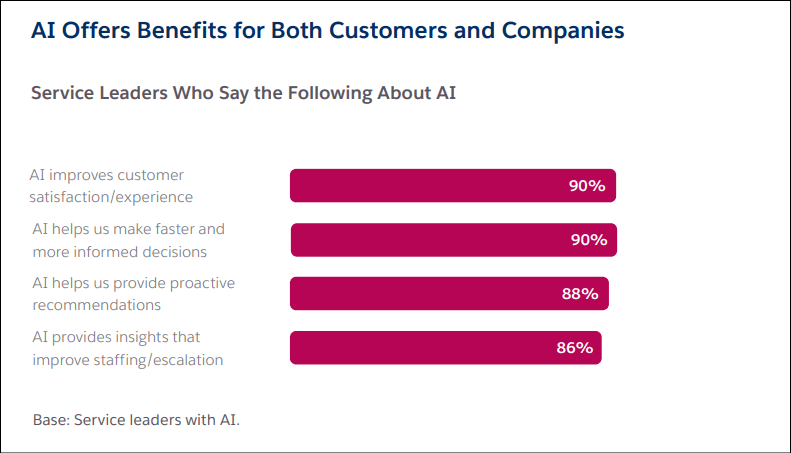
Source: Salesforce Report
Curious what that kind of saving would look like for your own support volume? Estimate chatbot ROI here instead of relying on the industry average.
10. 764 million WhatsApp Business accounts are driving chatbot adoption
Massive user bases and high engagement rates make messaging platforms a suitable space for chatbots. With 98% open rates compared to email’s 20%, businesses are shifting customer journeys directly into chat-based platforms.
Consumer Chatbot Adoption Trends
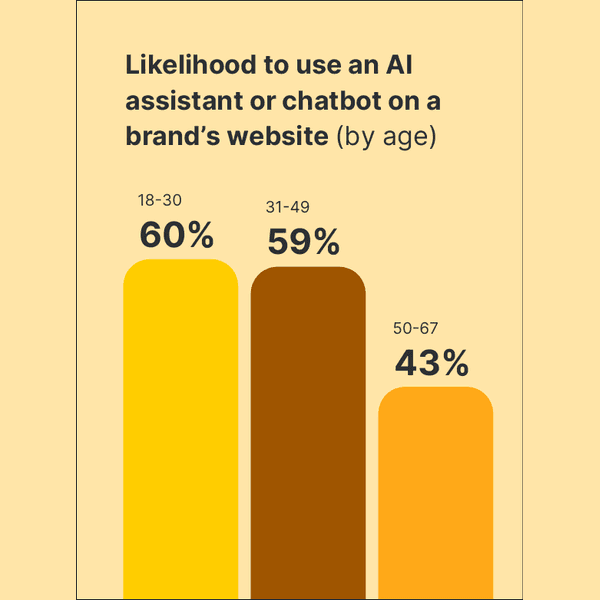
1. 54% of consumers are likely to engage with an AI assistant or chatbot on a brand's website
Source: Attest
Among the top countries, the UK population is most likely to use AI chatbots on a brand website, up to 57%.
2. 60% of consumers aged 18–30 are likely to use an AI chatbot on a brand's website
3. 66% of global respondents have used an AI tool in the last 12 months
Source: Google Public Policy
The Google/Ipsos 21-country survey published in January 2026 found this figure up 18 percentage points from 2024.
4. 35.1% of US adults will use AI-powered banking chatbots by the end of 2026
Source: EMarketer
AI chatbots are becoming a mainstream channel in banking, signaling growing consumer comfort with automated financial interactions.
Sentiment Toward AI Chatbots
1. 31% of consumers now believe AI can improve the customer experience
A further 29% believe AI means better personalization.
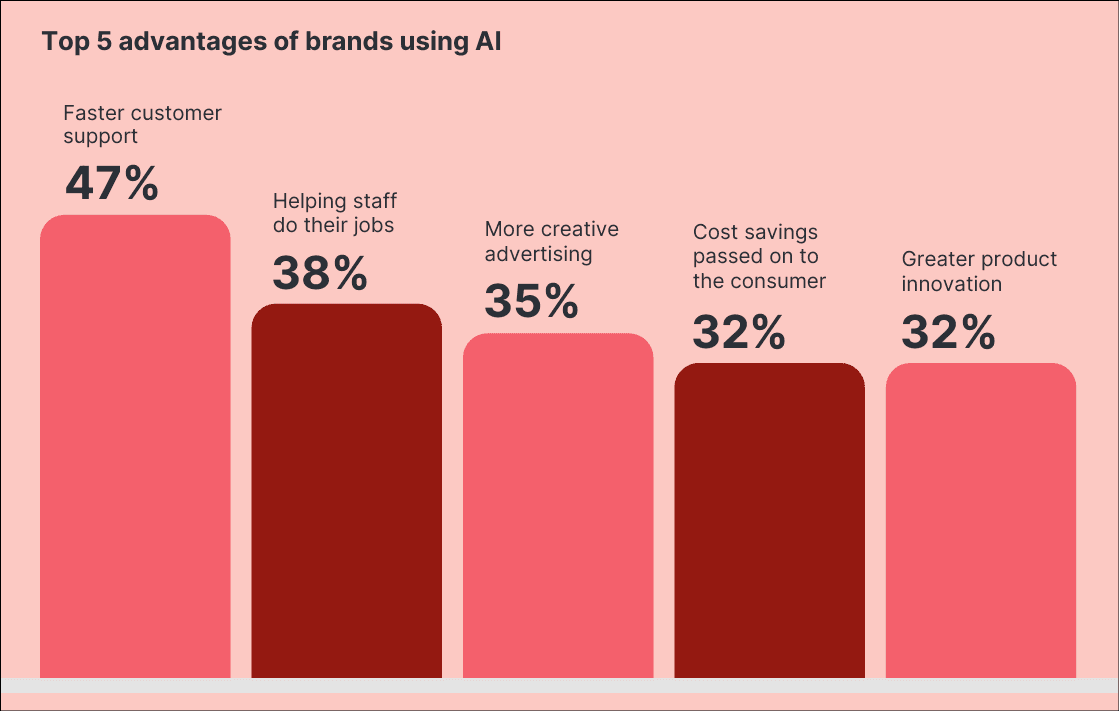
2. 47% of consumers say faster customer support is the top advantage of brands using AI
Speed and efficiency remain the clearest value proposition that consumers actually believe AI delivers.
3. 45% of US adults find customer service chatbots unfavorable
Source: Civic Science
CivicScience's 2024 data shows negative sentiment has grown alongside awareness. However, among people who have actually used chatbots, 44% agree they are at least somewhat helpful.
4. 88% of consumers prefer human interaction over chatbots for understanding their needs
Source: The Indian Express
This figure from Verizon’s latest CX Annual Insights report represents the persistent human preference. Notably, 60% have admitted to getting satisfying results by talking to AI agents.
5. 81% of customers prefer fast, simple interactions over highly personal ones
This finding appears to validate chatbot use for routine queries.
6. 43% of consumers trust information from an AI chatbot or tool
This figure is going up year after year. About 14% of people said they trust information given by AI tools.
7. Customers are more likely to recommend a business if they’ve had a human-led interaction
A survey by SurveyMonkey showed that customers are way less likely to recommend a service to others if they were faced with an AI-led customer support experience. The given score measured in NPS is +6 and -66, where +100 is most likely to recommend, and -100 says no recommendation at all.
8. 46% men are more likely to trust AI chatbots as compared to 40% women
This gender-gap trend is consistent in the case of AI implementation across the board, showing the baseline of AI tool adoption itself.
9. 43% of consumers are concerned about privacy or security weaknesses related to AI chatbots
People are not against chatbots using AI, but they strongly express the need for regulatory measures in place to control the misuse of personal data.
10. 38% of marketers say chatbots are the most impactful AI use case
Past surveys have revealed that marketers worldwide share the opinion that chatbots are one of the most successful and prevalent ways AI is being used in a commercial aspect.
On a closing note
Not too long ago, chatbots were considered no more than perfunctory pop-ups, mostly to be ignored. Now they’ve almost become the go-tos for people seeking any kind of instant assistance. From handling support queues to qualifying leads and even helping internal teams, they’ve become business imperatives.
What’s interesting is the evolving functionalities and the diversification of chatbot use cases. They’re everywhere, including sales, HR, operations, and customer support.
Now, pair this with the AI integrations, and chatbots have become smarter, faster, and more intuitive. And now they are trustworthy enough to perform functions that a human agent would do.
However, people still need human support when things get complex, and trust doesn’t come automatically. The winning formula still consists of the right balance of chatbot efficiency and human intelligence.
Hence, we can say that chatbots aren’t replacing experiences, they’re reshaping them. And the businesses that get the balance right are the ones that’ll make it feel effortless.
FAQs
FAQs
FAQs
Which industry uses chatbots the most?
What is a key challenge with chatbots?
What percentage of companies use AI chatbots?
How much money do chatbots save for companies?
How big is the chatbot industry?
ABOUT AUTHOR

Hardik Makadia
Co-founder & CEO, WotNot
Hardik leads the company with a focus on sales, innovation, and customer-centric solutions. Passionate about problem-solving, he drives business growth by delivering impactful and scalable solutions for clients.

Start building your chatbots today!
Curious to know how WotNot can help you? Let’s talk.
Start building your chatbots today!
Curious to know how WotNot can help you? Let’s talk.


