17 min read
Best Ada CX Alternatives in 2026

Hardik Makadia

Let’s build your chatbot today!
Launch a no-code WotNot agent and reclaim your hours.
*Takes you to quick 2-step signup.
Ada CX is one of the most recognized names in enterprise AI customer service. Specifically among large contact centers with the budget, the timeline, and the technical resources, it earns that reputation.
The platform's reasoning engine, compliance certifications, and omnichannel depth are genuinely impressive.
The benefits are real, but so are the tradeoffs. Now, which side outweighs the other depends on the size and complexity of your operation.
If you are reading this, you have probably already felt the friction.
Teams running 150,000+ monthly conversations in regulated industries often find the investment justified. Teams below that threshold, or those needing faster deployment and more predictable costs, increasingly do not.
I have spent time working with support teams across industries, and this pattern I see with Ada churners is consistent.
That tension is what drives most of the searches for Ada alternatives.
After going through dozens of CX platforms, I have curated the ones most likely to serve those teams better — each selected because it closes a specific gap Ada leaves open.
TL;DR: Top Ada Alternatives Compared
Platform | Best For | G2 Rating | Starting Price |
LivePerson | Enterprise omnichannel messaging at scale | 4.6/5 | Custom (est. $40+/mo) |
Genesys Cloud CX | Contact centers needing voice + digital + workforce management | 4.4/5 | $75/user/month |
HubSpot Service Hub | Teams already in the HubSpot ecosystem | 4.3/5 | $20/seat/month |
Intercom | SaaS companies wanting in-app messaging + AI support | 4.2/5 | $39/seat/month |
TARS | Lead generation and conversion through conversational landing pages | 4.5/5 | $499/month |
Aissist.io | Budget-conscious teams experimenting with multi-agent AI | 4.8/5 | $0.09/interactions |
Tidio | E-commerce stores and small businesses needing live chat + basic AI | 4.5/5 | Free ($29/mo paid) |
WotNot | SMBs and mid-market teams wanting no-code AI agents with transparent pricing | 4.4/5 | $29/month |
Why Users Look for Alternatives: The Real Reasons
Opaque, Expensive Pricing: No public pricing, with reported costs of $30K–$300K+ per year. The per-resolved-conversation model plus platform fee can easily double what you expected to pay.
Months-Long Implementation: Ada is not self-serve. Setup involves professional services, playbook design, and integration configuration — reviewers commonly describe it as a lengthy, time-consuming project.
No Free Trial or Self-Serve Testing: You cannot test Ada on your own data before signing an enterprise contract. Evaluation means going through the full sales process first.
Limited Knowledge Sources: Ada learns primarily from formal help center docs. Knowledge sitting in Confluence, Notion, Slack, or Google Drive cannot be fed into the system.
Narrow Scope (CX Only): Ada is built for customer support and nothing else. Teams needing to automate sales, HR, or IT operations will need a separate platform.
Resolution Billing Ambiguity: Per-resolution billing doesn't distinguish between solved tickets and abandoned chats. Support managers often end up manually auditing logs just to verify invoices.
Let’s build your chatbot today!
Launch a no-code WotNot agent and reclaim your hours.
Let’s build your chatbot today!
Launch a no-code WotNot agent and reclaim your hours.
The Best Ada Alternatives for Enterprises
1. LivePerson
Rating: 4.6/5 (G2)
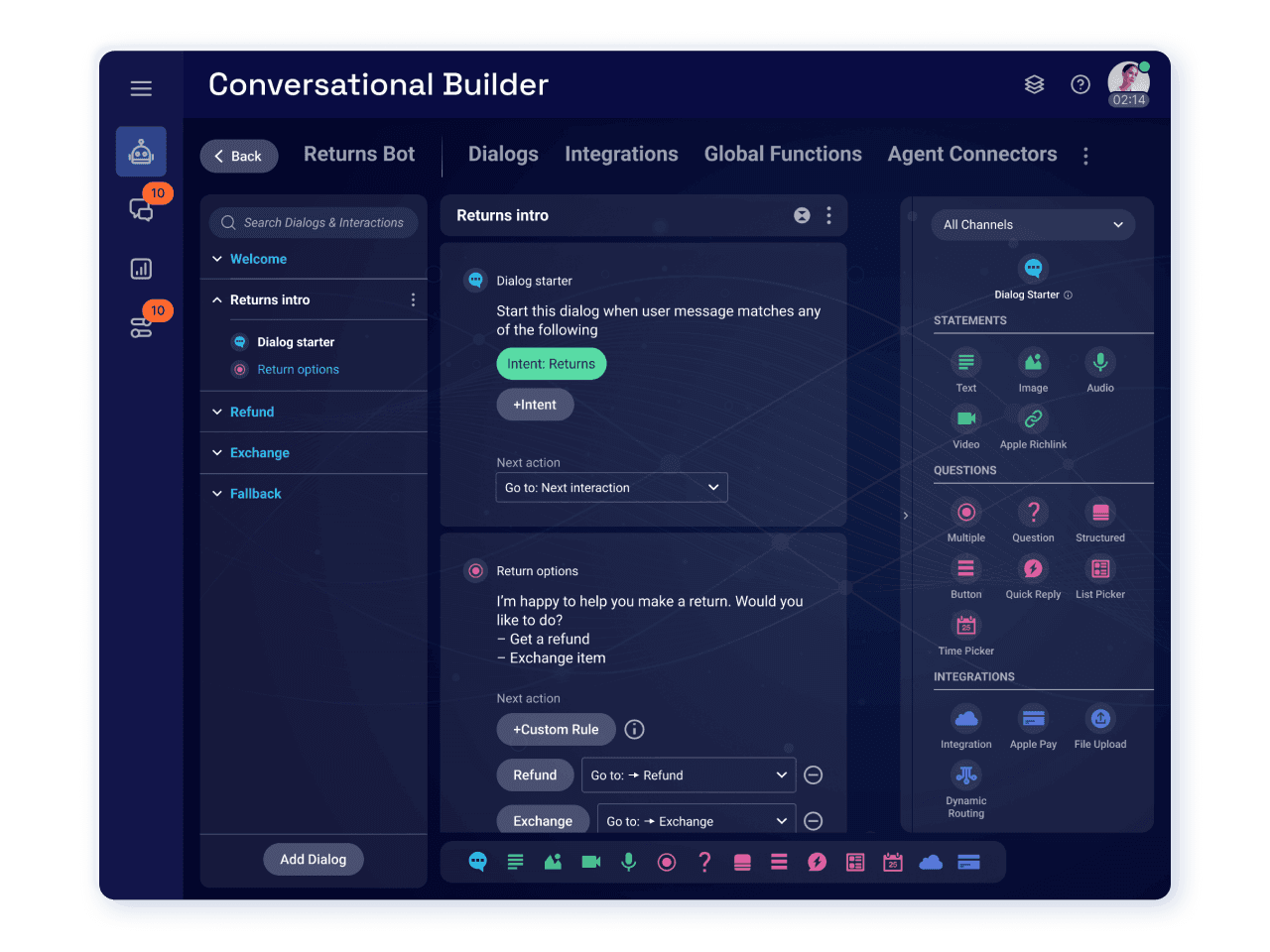
LivePerson is an enterprise conversational AI platform trusted by HSBC, Burberry, and Virgin Media, powering nearly a billion conversations monthly.
Where Ada automates individual conversations, LivePerson orchestrates entire customer journeys with AI agents, human agents, and analytics all running from one workspace. But its real competitive edge is the dataset.
A billion monthly conversations train an AI that smaller platforms can’t match. Reviewers consistently surface real-time monitoring and analytics as standout strengths. It competes at the top of the enterprise tier and prices accordingly.
Capabilities:
Omnichannel messaging, including SMS, web, WhatsApp, Apple Business Chat, social
AI chatbots with intent recognition, multi-turn context, and seamless agent handoff
Voice AI with speech recognition and sentiment analysis
Proactive engagement triggered by visitor behavior
Real-time analytics with resolution rates, agent performance, and customer sentiment
Unified workspace for AI and human agent collaboration
13+ contact center integrations including Salesforce, Zendesk, HubSpot
SOC 2, HIPAA, GDPR, CCPA, PCI compliance; 15+ languages with global data residency
How it compares to Ada:
Ada requires Salesforce or Zendesk for full functionality, whereas LivePerson works across most enterprise stacks natively.
Ada automates support conversations, but LivePerson orchestrates the full customer engagement process.
LivePerson's agent workspace gets stronger reviews for handoff quality, while Ada causes end-user frustration with loops.
Ada charges per resolution, but LivePerson uses custom enterprise pricing without the per-resolution penalty.
The honest trade-off: LivePerson’s implementation requires dedicated technical resources, and the learning curve is steep enough that Gartner reviewers flag it as the primary friction point.
If your team is under 500 people or under 10,000 conversations monthly, the architecture is disproportionate to the problem. Smaller organizations will pay enterprise prices for the complexity they will not fully use.
Best for: Large enterprises managing high-volume, multi-channel customer engagement. Teams that need AI and human agents in a single, orchestrated workspace.
Pricing:
Custom enterprise pricing: no public pricing page
2. Genesys Cloud CX
Rating: 4.4/5 (G2)
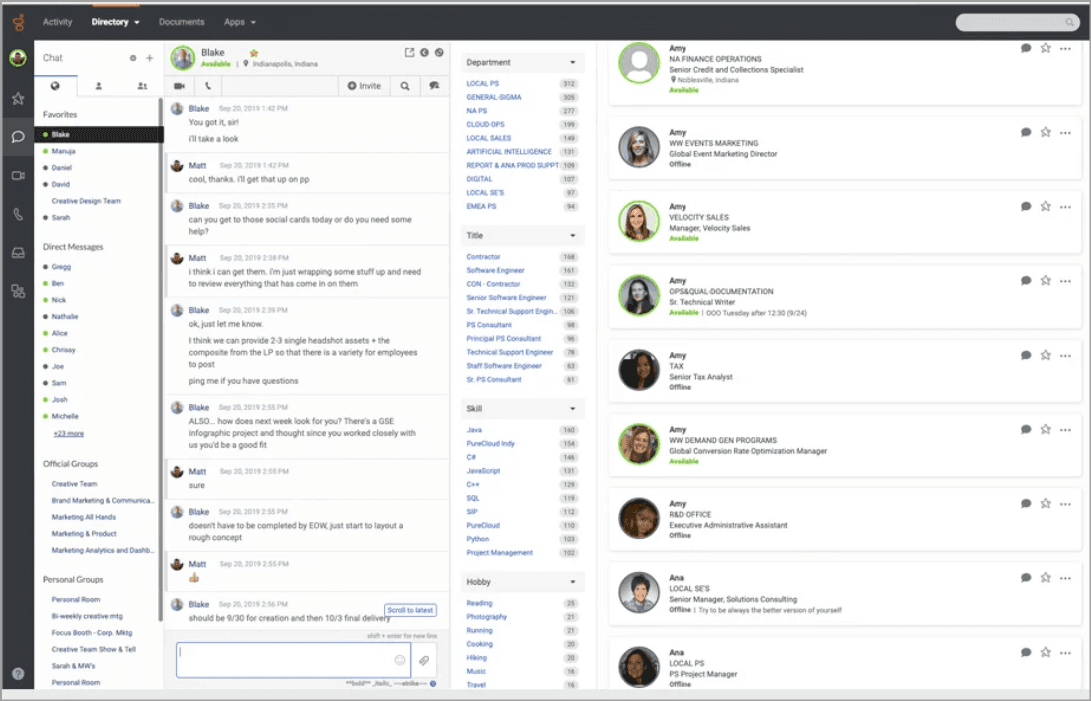
Genesys Cloud CX is a full contact center operating system with voice, email, chat, SMS, social, workforce management, and AI routing in a single platform.
It was built by contact center operators, not AI researchers, and that shows in its voice capabilities, IVR systems, and agent scheduling tools. The AI sits on top of infrastructure.
Genesys is designed for enterprises that need every detail of the customer journey managed and measurable.
For inbound call centers where voice is still the dominant channel, this platform is perhaps the best suited.
Capabilities:
Omnichannel: voice, email, chat, SMS, social in one platform
AI-powered virtual agents and conversational IVR
Predictive routing that matches customers to the best-qualified agents using historical data
Workforce management with AI-driven forecasting, scheduling, and coaching
Speech and text analytics for compliance, trend detection, and coaching
Journey organization with cross-channel context preservation
Native integrations with Salesforce, ServiceNow, Microsoft Teams, Zoom
How it compares to Ada:
Ada automates chat conversations, whereas Genesys runs your entire contact center, including voice, routing, and workforce.
Ada's pricing is opaque and consumption-based, but Genesys publishes four transparent per-seat tiers.
Ada lacks workforce management, whereas Genesys CX 3 includes AI-driven forecasting and scheduling natively.
Ada requires no telecom, but Genesys charges separately for voice minutes, adding 20–40% to base licensing.
Ada deploys faster for single-channel chat, and Genesys requires IT commitment and longer implementation for full WFM rollout.
The honest trade-off: A 200-agent deployment on Genesys CX 4 costs $576,000/year in licensing alone, before telecom and implementation. Smaller teams pay enterprise prices for capabilities they may never use.
The mobile version lags the desktop experience, and CRM integrations (Salesforce, Zendesk) are add-ons, not included.
If your operation is primarily chat-based, the voice-first architecture means you are overpaying for infrastructure you do not need.
Best for: Large enterprise contact centers (200+ agents) running high-volume inbound operations across voice and digital channels. Organizations already invested in Salesforce or ServiceNow. Contact centers needing intelligent routing, workforce management, and speech analytics as integrated capabilities.
Pricing:
CX 1: $75/user/month — voice + basic routing
CX 2: $115/user/month — voice, chat, email, SMS, social
CX 3: $155/user/month — adds workforce management, AI scheduling, coaching
CX 4: $240/user/month — full AI suite, journey orchestration, premium analytics
3. HubSpot Service Hub
Rating: 4.3/5 (G2)
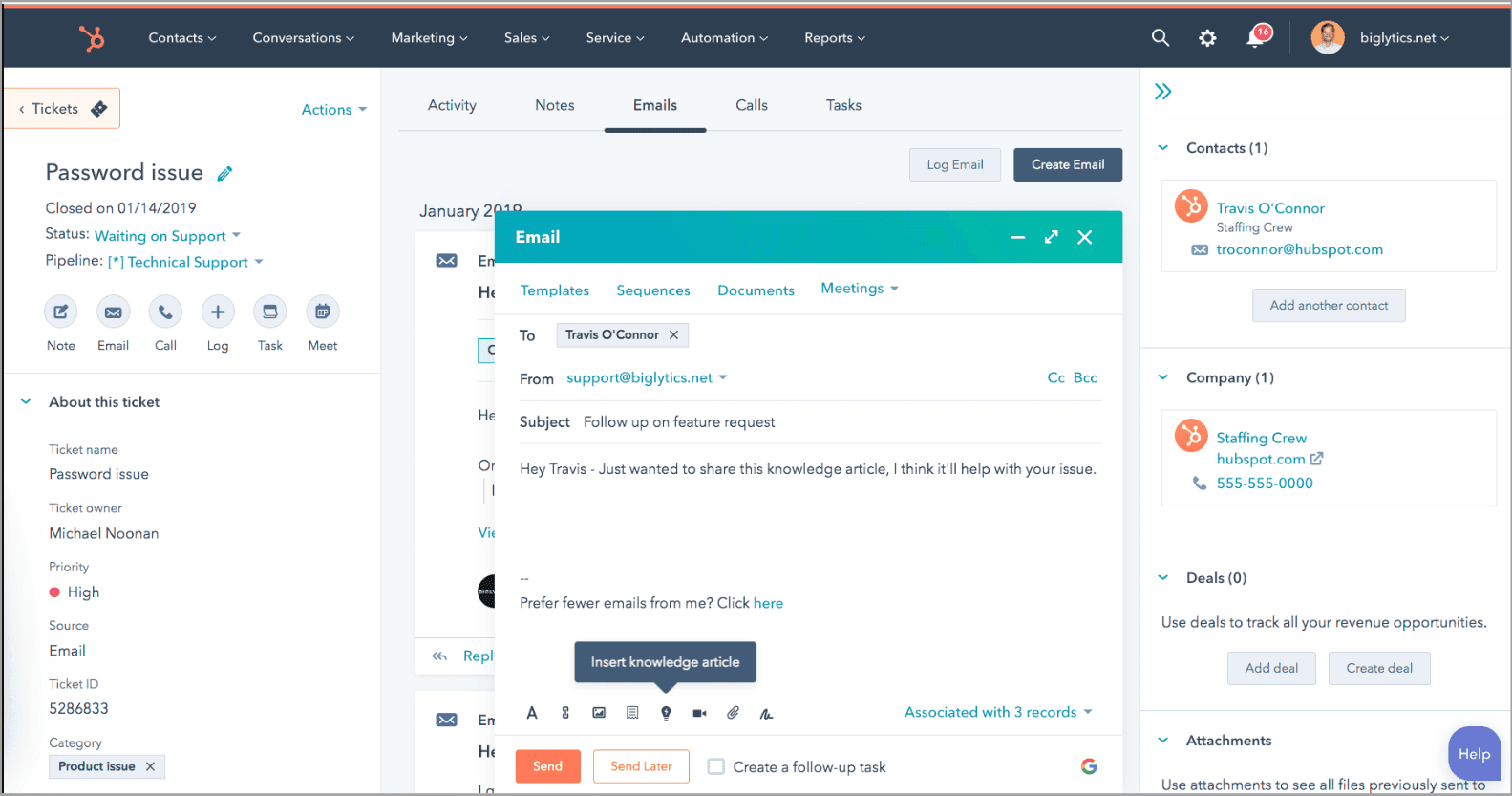
HubSpot Service Hub is customer support software built inside HubSpot's CRM platform. This makes it the natural choice for teams whose marketing, sales, and customer data already live in HubSpot.
Its AI Customer Agent (Breeze) is not the most sophisticated on this list, but it knows things Ada does not. It tracks the customer's deal stage, last marketing touchpoint, NPS score, and renewal date.
HubSpot recently repriced Breeze to $0.50 per resolved conversation with a 28-day free trial. For HubSpot-native teams, this is the lowest-friction Ada alternative available.
Capabilities:
Unified help desk with email, chat, phone, WhatsApp, SMS, forms
Breeze AI Customer Agent with outcome-based pricing, $0.50/resolution, 28-day free trial
Knowledge base with AI-powered search and article suggestions
Conversation intelligence, including call transcription, sentiment analysis, and AI-generated summaries
Intelligent ticket routing with custom SLA views
Full CRM context: marketing, sales, and service data in one record
How it compares to Ada:
Ada's per-resolution cost runs $1–$3.50, while Breeze charges $0.50 with a trial before you commit.
Ada needs months of Playbook configuration and in comparison, HubSpot's Breeze trains on your existing content and launches in days.
Ada integrates across 13+ help desks and HubSpot creates a data silo if your stack runs on Salesforce or Freshdesk.
Ada's AI handles complex multi-system workflows but Breeze is optimized for FAQ deflection and basic ticket routing.
The honest trade-off: HubSpot's AI handles knowledge base answers and tickets well. However it will not execute multi-step workflows involving real-time API calls or compliance-aware processes.
The pricing escalates fast with too mandatory onboarding fees for higher plans, seat-based billing that increases with team size, and credits purchased separately for advanced AI usage make the total cost less predictable than it first appears.
Best for: Companies already running HubSpot for marketing and sales who want to extend AI support without adding a new vendor. Mid-market teams (50–200 people) prioritizing speed-to-launch and CRM-connected support. Teams where customer retention metrics matter as much as ticket deflection.
Pricing:
Free: basic ticketing, email, live chat
Starter: $20/seat/month
Professional: $100/seat/month (knowledge base, AI ticket enrichment, Breeze access)
Enterprise: $150/seat/month (SSO, advanced analytics, custom objects)
Breeze AI Customer Agent: $0.50/resolved conversation; 28-day free trial included
Onboarding fees: $1,500 (Professional), $3,500 (Enterprise) - mandatory
4. Intercom

Rating: 4.2/5 (G2)
Intercom has led in-app messaging for SaaS companies and has since built Fin. This is one of the most technically capable AI agents in the market, said to have resolved 40–50% of support conversations autonomously.
The platform's core strength is the full-stack product engagement layer: live chat, AI support, product tours, behavioral messaging, and proactive campaigns all in one place.
For SaaS companies where onboarding and retention matter as much as ticket resolution, they can go for Intercom. However, the thing about Intercom is that it can raise the monthly spend on customer service platforms to twice what you currently do, which is a common consensus.
Capabilities:
In-app messaging with behavioral triggers, product tours, surveys, push notifications
Fin AI Agent for autonomous resolutions
AI Copilot for drafting replies, surfaces articles, and assists human agents in the inbox
Shared multi-channel inbox
Workflow automation
Conversation intelligence including CX Score, sentiment analysis, topic clustering
350+ native integrations: Salesforce, Stripe, Zendesk, Jira, Shopify
Multi-language supported, more than 45+
How it compares to Ada:
Ada is support-only while Intercom covers product engagement, onboarding, and proactive messaging too.
Both use per-resolution pricing but Ada charges $1–$3.50 while Fin charges $0.99 and both penalize automation success.
Ada requires Salesforce/Zendesk for full functionality but Intercom's 350+ integrations work more broadly.
Ada has no product tour or in-app messaging capability but Intercom's engagement layer is uniquely suited to SaaS.
The honest trade-off: Intercom's per-resolution billing is the same risk as Ada, just with a visible price tag. As Fin improves and resolves more, your bill grows. Seat costs , Fin resolutions, outbound messaging, and SMS charges stack into a 2–3 times the advertised base price for growing teams.
Best for: SaaS companies needing in-app messaging, proactive engagement, and AI support in a single platform. Product-led growth teams where customer onboarding and feature adoption matter alongside support. Mid-market companies (100–500 employees) that can model and manage usage-based billing.
Pricing:
Essential: $39/seat/month (Fin AI, Messenger, shared inbox, ticketing)
Advanced: $99/seat/month (multiple inboxes, Workflows, multilingual help center)
Expert: $139/seat/month (SSO, HIPAA, SLAs, multibrand, 50 lite seats)
Fin AI Agent: $0.99/resolved conversation (minimum commitment applies)
Proactive Support Plus: $99/month (500 outbound messages; overage charges apply)
5. TARS
Rating: 4.5/5 (G2)
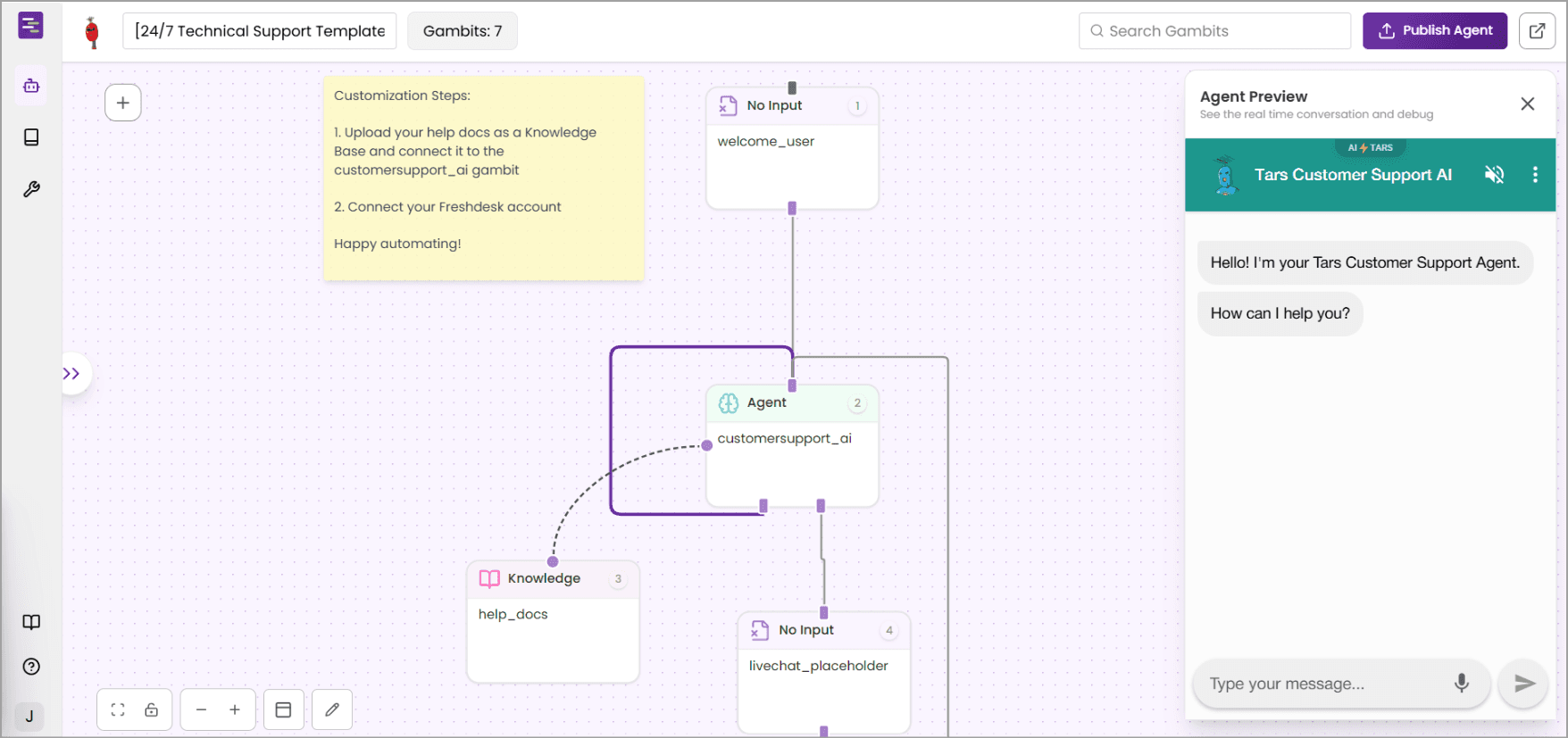
TARS is a conversational AI agent platform built and used by over 700 brands. The primary use cases include lead qualification, appointment scheduling, and customer onboarding across websites and WhatsApp.
TARS is not competing with Ada on support automation; it solves the top-of-funnel problem Ada does not even try to address. Insurance companies, real estate agencies, education institutions, and legal firms are its ideal users because these industries depend on information collection that web forms handle poorly.
Reviewers repeatedly single out TARS's team for understanding client needs beyond the brief, and one government deployment reduced inbound call volume by over 4,000 calls per month.
Capabilities:
Drag-and-drop conversation builder with pre-built industry templates
AI agents trained on knowledge bases
300+ built-in tool integrations
Multi-channel: websites, WhatsApp, SMS, Slack, custom APIs
Live chat handover to human agents
Analytics with helpfulness metrics and full conversation transcripts
25+ language support
SOC 2, GDPR, ISO, HIPAA compliance
How it compares to Ada:
Ada is built for support deflection, while TARS is built for lead capture and qualification at the top of the funnel.
Ada charges $30K+ annually with no trial, compared to which, TARS starts at $499/month with a free plan included.
Ada's knowledge engine handles complex support queries, but TARS's AI is more capable in case of structured lead qualification flows.
Ada cannot be used for sales or marketing automation but TARS opens lead gen, onboarding, and campaign workflows.
Ada requires months of implementation however, TARS bots can launch within days using pre-built templates.
The honest trade-off: TARS is not a customer support platform. There is no ticket management, no SLA tracking, and no deep help desk integration. If your primary need is resolving support tickets at volume, TARS will not replace Ada.
Best for: Marketing and sales teams running lead generation through PPC, organic, or email campaigns. Insurance, real estate, education, financial services, and legal firms that qualify prospects through conversation. Businesses wanting to automate appointment scheduling without hiring additional headcount.
Pricing:
Free: 50 conversations per month, basic LLM models, only 5 knowledge bases
Paid: from $499/month onwards, depending on volume and channels
Enterprise: custom pricing, unlimited conversations, dedicated support
6. Aissist.io
Rating: 4.8/5 (G2)
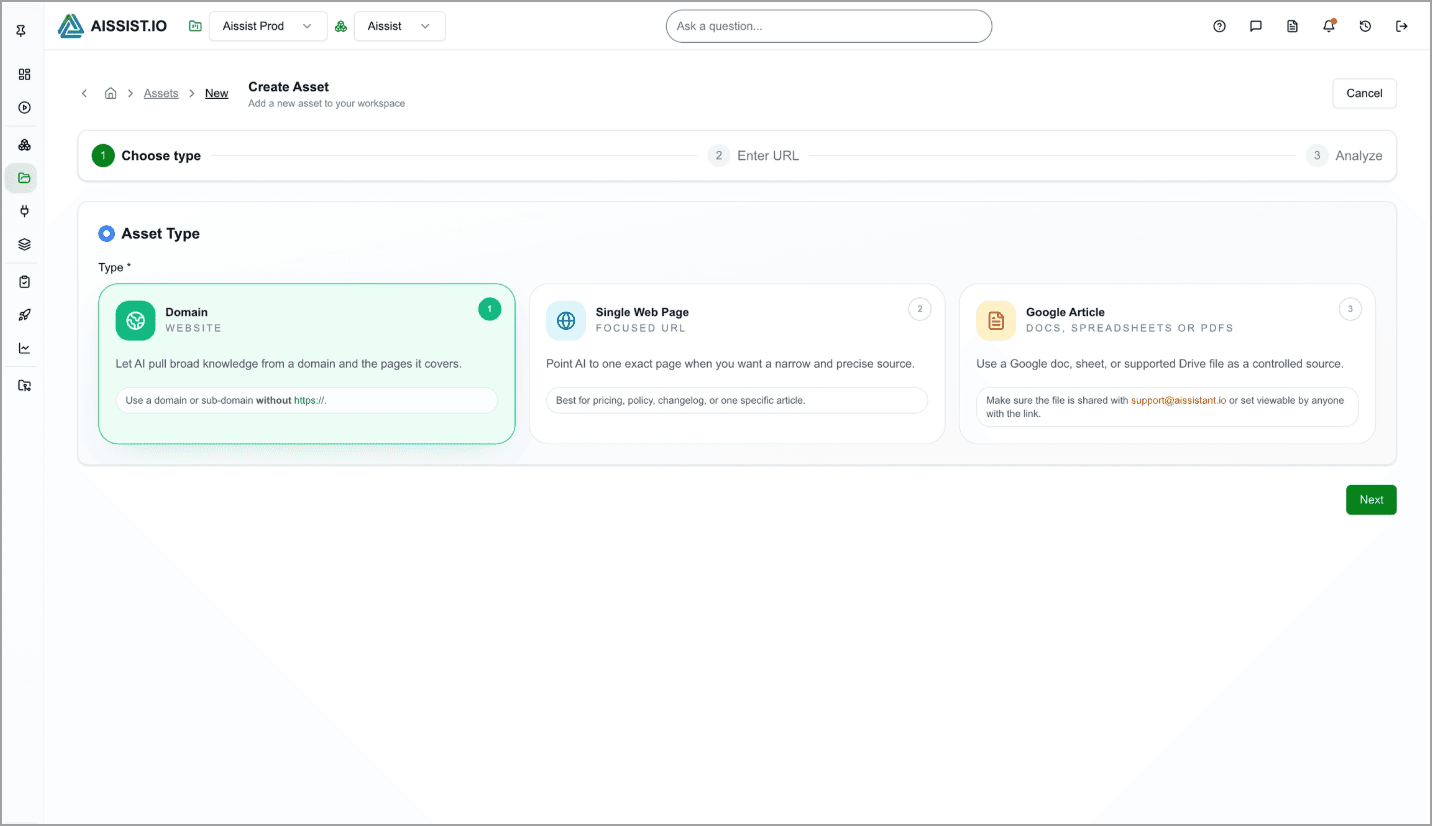
Aissist.io is an agentic AI platform designed for large sales and service teams. Unlike traditional chatbots, it is a multi-agent AI platform that deploys specialized sub-agents. So, rather than routing every question through a single monolithic AI, it uses dedicated agents for returns, technical support, and pre-sales.
Its three main components include Digital Employee, Aissistant, and AI Manager. All of these agents work together to automate workflows, assist human agents, and provide oversight through analytics.
The platform integrates with major help desks and CRMs like Zendesk, Intercom, and Salesforce, and supports omnichannel communication across SMS, WhatsApp, and email. Pricing follows a pay-per-interaction model.
Capabilities:
Multi-Agent Platform (MAP) with specialized sub-agents
Digital Employee - fully autonomous conversation handling
AI Assistant - copilot for human agents with in-note commands
AI Manager - analytics, QA, and continuous learning dashboard
Multimedia support
Omnichannel support with WhatsApp, SMS, web chat, email, and social
API-driven workflows: order lookups, refunds, appointment booking
65+ language support
How it compares to Ada:
Ada charges $70K+ annually while Aissist starts free and scales at $0.08–$0.12 per interaction.
Ada uses a single generalist reasoning engine, but Aissist routes to domain-specific sub-agents, theoretically improving accuracy.
Ada has 350+ enterprise customers and years of production data — Aissist was founded in 2024 with unverifiable scale claims.
Ada charges per resolution, and Aissist charges per interaction a 4-message conversation costs $0.48, not $0.12
The honest trade-off: Aissist.io is a seed-stage software competing against platforms with billions of conversations of training data. The per-interaction pricing (not per-conversation) means costs inflate with increasing AI conversations.
For teams willing to take the risk in non-regulated environments, the cost advantage over Ada is real.
Best for: Early-stage companies and SMBs in non-regulated industries willing to experiment with AI-first support at low cost. Teams wanting to prove ROI before committing to enterprise contracts.
Pricing:
Free: 3,000 AI interactions/month, base engine, up to 10 sub-agents (no credit card required)
Starter: $0.09/interaction (up to 30,000 interactions, advanced engine, 5 sub-agents)
Growth: unlimited interactions, unlimited sub-agents, full AI Assistant
7. Tidio
Rating: 4.5/5 (G2)
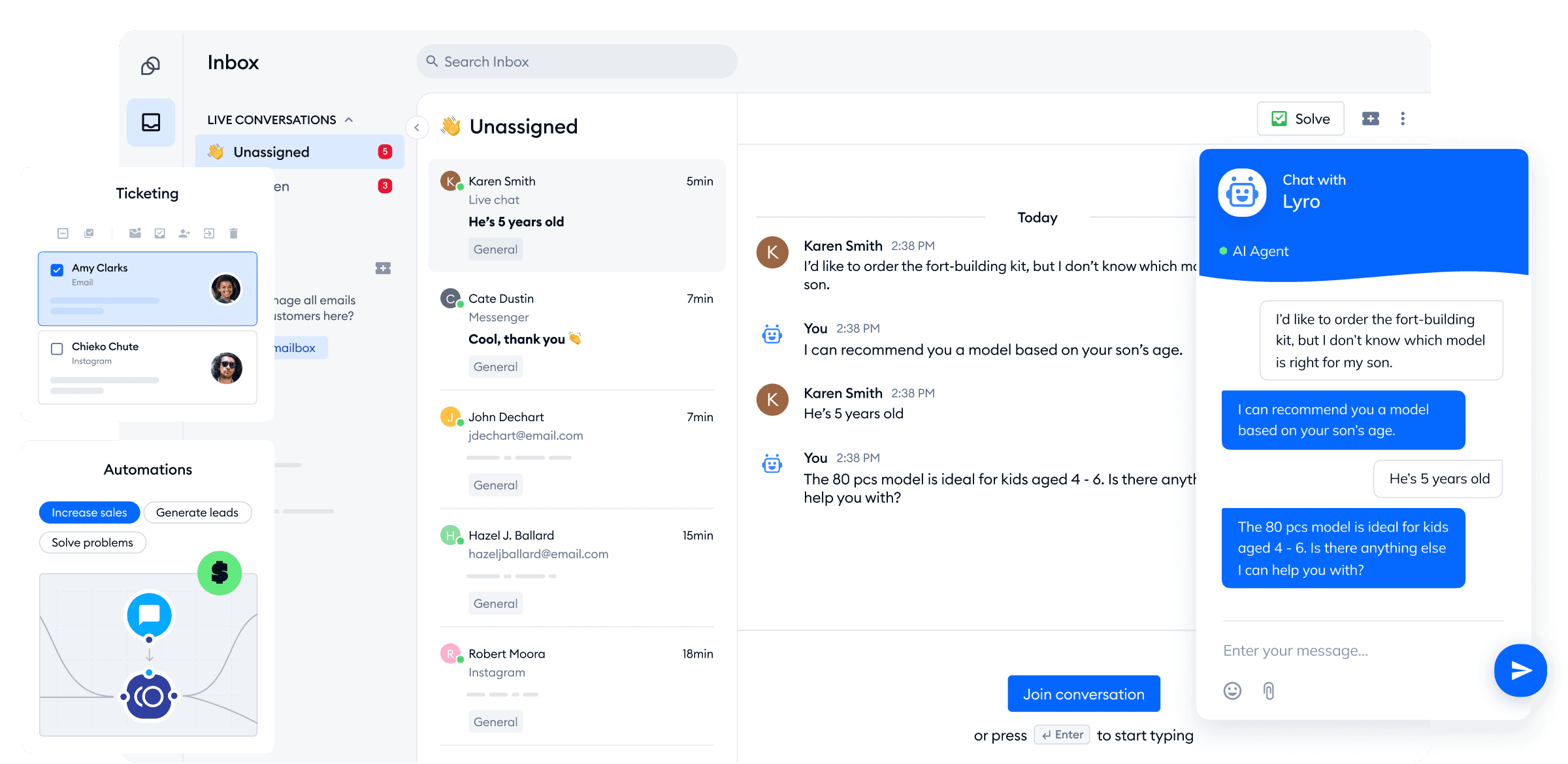
Tidio is a customer support platform combining live chat, AI automation (Lyro), and help desk ticketing. Trusted by 300,000+ businesses, Tidio users include primarily small e-commerce stores and service businesses that need to handle website visitors without enterprise overhead.
Lyro AI learns from your FAQ content and knowledge base, handles common questions automatically, and escalates to a human agent when it cannot resolve. Setup takes under an hour, and it integrates natively with Shopify, WordPress, and WooCommerce.
The advertised starting price is $29/month, but in December 2024, Tidio doubled prices for existing customers without sufficient notice. The real monthly cost, once you add Lyro AI, Flows, and branding removal, typically runs $150–$200/month for a mid-sized store.
Capabilities:
Live chat with real-time visitor tracking and typing previews
Lyro AI
Flows, a visual, rule-based chatbot builder for lead capture, booking, and FAQs
Shared inbox
AI ticket enrichment
Conversation analytics and operator performance dashboards
Integrations: Shopify, WordPress, WooCommerce, Zapier, HubSpot, Stripe
GDPR, SOC 2 compliance
How it compares to Ada:
Ada charges $30K+ annually while Tidio starts free, with paid plans from $29/month.
Ada's reasoning engine handles complex multi-step workflows, but Lyro is strong on FAQ automation, weaker on nuanced support.
Both have hidden cost problems, Ada's is per-resolution pricing, Tidio's is layered add-ons (AI, Flows, branding, overages)
Ada deploys in months, whereas Tidio launches in under an hour; what you gain in speed, you trade in AI depth.
The honest trade-off: The self-service plans cap at 10 agent seats. To add more, the price jumps from $59 to $749 a month — a 12x increase overnight. Lyro also hard-stops when its monthly conversation limit is reached, leaving customers mid-interaction with no fallback.
Best for: E-commerce stores and small businesses (5–50 people) managing 100–2,000 conversations monthly. Service businesses needing appointment scheduling and basic FAQ automation. Startups that need live chat and simple AI without enterprise complexity or price.
Pricing:
Free: 50 conversations, basic chat, 50 Lyro AI conversations (one-time)
Starter: $29/month (up to 100 conversations, 10 agents max)
Growth: $59/month (scaling conversation volume)
Plus: $749/month (unlimited conversations, unlimited agents, dedicated success manager)
Premium: Contact sales for pricing (managed AI deployment, SLAs, custom solutions)
Lyro AI: $39–$149/month add-on (50–1,000 AI conversations)
WotNot
Rating: 4.4/5 (G2)
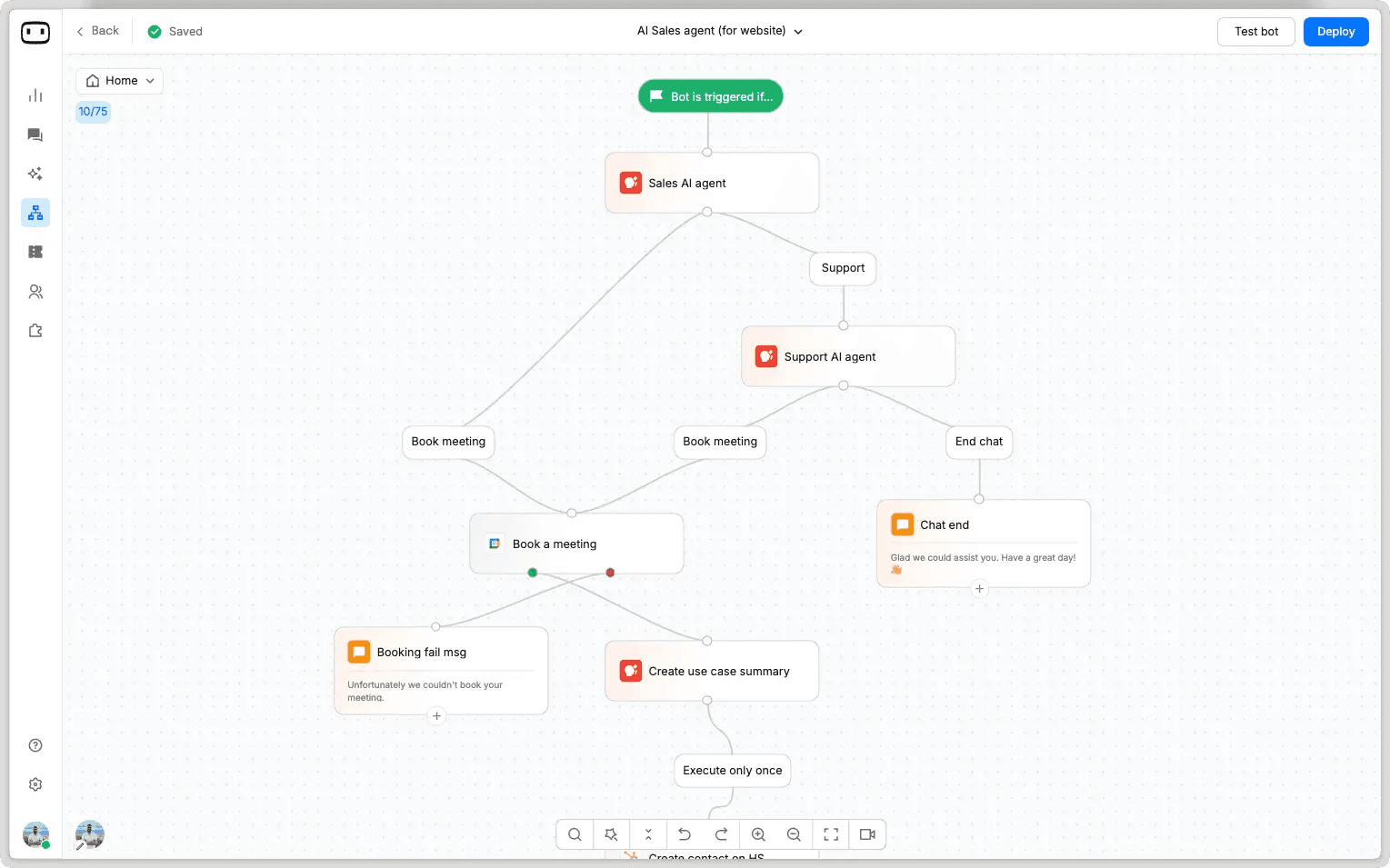
WotNot is a full-stack AI agent platform that handles the entire customer conversation lifecycle. Right from the first automated response triggered by a query to a human handoff to deal with a complex issue, WotNot makes it a seamless experience for the users.
Its omnichannel presence makes it a highly valuable platform for businesses that have a varied user base spread across all available networks, including web, email, WhatsApp, SMS, and social media.
It uses RAG-based retrieval across multiple LLMs to generate responses grounded in your actual business content, not generic AI output.
The platform is more capable than entry-level chatbot builders, but it does not require the $30K+ annual contracts and months-long implementations that Ada demands.
Users who are looking to switch look for a few primary things in the Ada alternative they consider. They need a platform that gives them AI-powered support automation, transparent pricing, and the ability to go live in days instead of months. WotNot does all three.
Capabilities:
No-code visual bot builder with drag-and-drop flow design
AI Studio with multi-LLM support (OpenAI, Anthropic, Gemini, Mistral)
RAG-based training on your own knowledge base
Live chat with human handoff with complete data preservation
Omnichannel deployment: websites, WhatsApp Business API, Facebook Messenger, Instagram, SMS
Outbound bots and proactive campaign messaging
Built-in analytics with business-centric KPIs
Integrations with Salesforce, HubSpot, Zoho CRM, Zendesk, Freshdesk, Slack, Zapier, Google Calendar, Calendly
Enterprise features: SSO, on-premise deployment, HIPAA compliance, custom integrations
How it compares to Ada:
Ada's knowledge engine learns from help documentation while WotNot's AI Studio trains on websites, PDFs, internal docs, and FAQs simultaneously, with version management and automatic re-syncing.
WotNot integrates natively with Zendesk, Freshdesk, HubSpot, Zoho, and Salesforce with no platform dependency, but Ada requires Salesforce or Zendesk for full feature functionality.
Ada's handoff transfers a conversation, whereas WotNot's handoff transfers the full context, with conversation history, collected user data, identified intent, and channel origin, so agents never start blind.
Ada has no agent-side AI assistance, but WotNot's AI Copilot helps out with responses for human agents mid-conversation.
Ada's per-resolution billing scales costs with automation success as compared to WotNot, which uses flat monthly pricing.
WotNot deploys in days with a 14-day free trial, but Ada's implementation takes months with professional services.
The honest trade-off: WotNot is not Ada's replacement for businesses managing 500,000+ conversations monthly across highly regulated channels. Its AI reasoning is solid for FAQ automation, lead qualification, and appointment scheduling. However, teams with deeply custom compliance requirements (financial services with PCI-level Playbook enforcement) will find Ada's specialization a necessity.
Best for: SMBs and mid-market companies that need AI-powered customer support without enterprise contracts. Marketing and operations teams wanting lead generation and appointment scheduling bots. Non-technical teams that need to deploy chatbots in days, not months, across web and messaging channels.
Pricing:
Lite: $29/month (1,000 chats, 1,000 AI credits, no-code builder, Zapier integration)
Starter: $99/month (5,000 chats, 5,000 AI credits, AI Studio, all LLM models, integrations, ticketing)
Premium: $299/month (10,000 chats, 10,000 AI credits, Live Chat, HTTP requests, hide branding)
Enterprise: Custom (unlimited chats, unlimited credits, professional services, SSO, on-premise, HIPAA)
14-day free trial, no credit card required. Annual billing saves 20%.
Start building, not just reading
Build AI chatbots and agents with WotNot and see how easily they work in real conversations.

Start building, not just reading
Build AI chatbots and agents with WotNot and see how easily they work in real conversations.
Start building, not just reading
Build AI chatbots and agents with WotNot and see how easily they work in real conversations.

Before You Replace Ada: Six Things to Get Right
Are you leaving Ada or outgrowing it?
If your conversation volume never justified Ada's enterprise pricing in the first place, a lighter platform will serve you better at a fraction of the cost.
What does your monthly bill actually look like at your volume?
You have to dig deeper than just comparing pricing plans. Every pricing model will add to a different monthly spend for you. So pull up your usage data for the last 3 months and weight it for each platform’s pricing model you are considering.
Where is your support knowledge housed?
Ada works best when your knowledge is clean, structured, and centralized in a help center. If it is scattered across Notion, Confluence, resolved tickets, and internal docs, pick a platform whose AI can train on those sources directly.
What happens when the AI cannot answer?
Ask vendors to show you a failed conversation in production instead of a scripted one. See if it escalates cleanly and if the human agent get full context or only partial information. How your alternative handles the edge cases will determine your CSAT more than anything else.
Does it connect to the tools your team already uses?
Ada's full feature set requires Salesforce or Zendesk. Whatever you move to will have its own dependencies. Check native integrations for your CRM, help desk, and e-commerce platform before signing.
Pick the Ada Cx Alternative that fits your business
The most common mistake when leaving Ada is optimizing for the wrong thing. Chasing the lowest advertised price, the highest automation rate, or the longest list of integrations. None of that tells you what you will actually spend or whether the platform will hold up in your stack.
Do the math and find out how much the platform is actually going to cost you per month from your previous 90-day data.
If your needs are genuinely enterprise-scale, managing high volume, a regulated industry, and complex multi-system workflows, the investment in a sophisticated platform may be justified.
But if you are not there yet, a flat, transparent pricing model like the one WotNot has will serve you better than a consumption-based one that penalizes you for growth.
Know which category you are in before you sign anything.
FAQs
FAQs
FAQs
What is the main reason companies switch from Ada CX?
Can smaller businesses use Ada CX alternatives effectively?
Which Ada CX alternative is best for e-commerce?
How does Ada CX's AI compare to Intercom's Fin or HubSpot's Breeze?
Is there an Ada CX alternative that handles both voice and chat?
ABOUT AUTHOR
Hardik Makadia
Co-founder & CEO, WotNot
Hardik leads the company with a focus on sales, innovation, and customer-centric solutions. Passionate about problem-solving, he drives business growth by delivering impactful and scalable solutions for clients.

Start building your chatbots today!
Curious to know how WotNot can help you? Let’s talk.
Start building your chatbots today!
Curious to know how WotNot can help you? Let’s talk.