
Let’s build your chatbot today!
Launch a no-code WotNot agent and reclaim your hours.
*Takes you to quick 2-step signup.
A year ago, the conversation was about chatbots and chatbot platforms. Whether they could answer questions, qualify leads, or handle a return without frustrating the customer. We covered that ground in our chatbot statistics roundup, and the numbers were already compelling.
But AI agents' statistics show that they are a different category.
They set goals, plan steps, use tools, and take actions across systems with minimal hand-holding. They book meetings, triage support tickets, write and test code, reconcile invoices, and monitor supply chains. Some coordinate with other agents to run entire workflows end-to-end.
The shift from chatbot to AI agent is not incremental. It is architectural. And the data backs that up.
We went through 30 research reports, surveys, and market analyses from McKinsey, Deloitte, Stanford HAI, Gartner, PwC, Capgemini, Google Cloud, IBM, Accenture, Anthropic, Microsoft, and others to pull together the most comprehensive set of AI agent statistics available right now.
Every stat in this article is sourced and attributed.
AI Agent Market Size and Growth
1. The AI agents market is projected to grow at nearly 50% CAGR this decade
Studies project growth from $7.84 billion in 2025 to $52.62 billion by 2030 at a 46.3% CAGR. While forecasts differ slightly by sources and time horizon, every major report points toward exponential enterprise adoption.
2. AI agents could generate up to $450B in economic value by 2028
Beyond software spending, AI agents are expected to significantly reshape enterprise productivity, consumer surplus, and corporate profitability.
Source: Cap Gemini
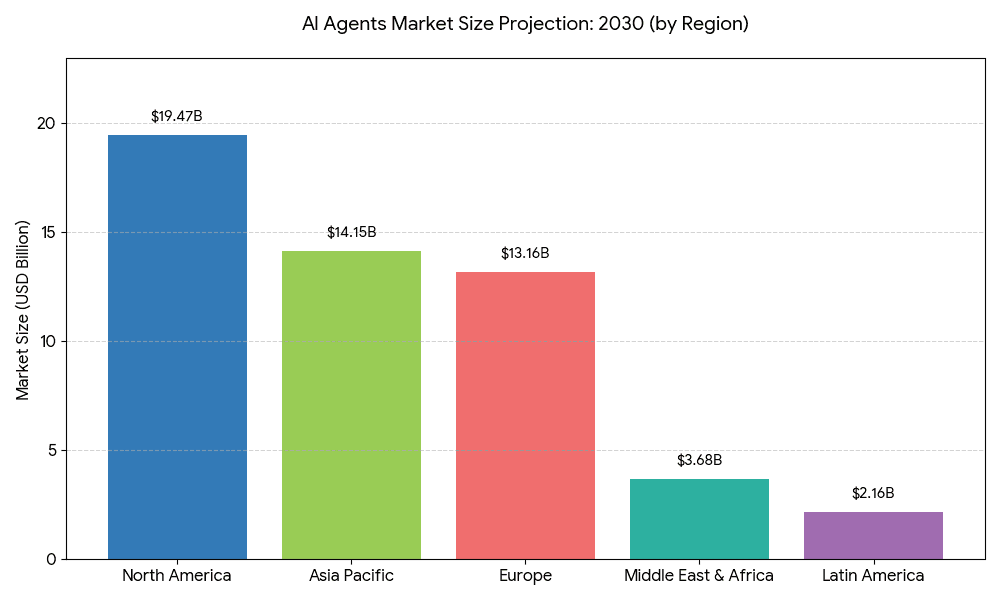
3. North America currently dominates the AI agents market
North America accounted for 39.63% of the global AI agents market revenue in 2025.
Asia Pacific is projected to register the highest regional CAGR during the forecast period.
Source: Market and Market
4. Multi-agent and vertical AI systems are emerging as the fastest-growing segments
Although single-agent systems currently dominate deployments, collaborative and specialized agent systems are growing rapidly.
Single-agent systems held 59.24% market share in 2025. (Grand View Research)
The industry-specific AI agents’ segment is expected to grow at a 62.7% CAGR (2025–2030).
Multi-agent systems are projected to grow at a 48.5% CAGR.
Coding and software development agents are projected to grow at a 52.4% CAGR.
Industrial end-use is expected to grow at the fastest CAGR of 49.2% (2026–2033).
Let’s build your chatbot today!
Launch a no-code WotNot agent and reclaim your hours.
Let’s build your chatbot today!
Launch a no-code WotNot agent and reclaim your hours.
How Businesses Are Adopting AI Agents
1. Most enterprises are already experimenting with AI agents
AI agents are moving from experiments to real-world business use, with companies deploying them across teams and workflows.
62% of organizations are at least experimenting with AI agents.
79% of senior executives say AI agents are already being adopted in their companies. (PwC)
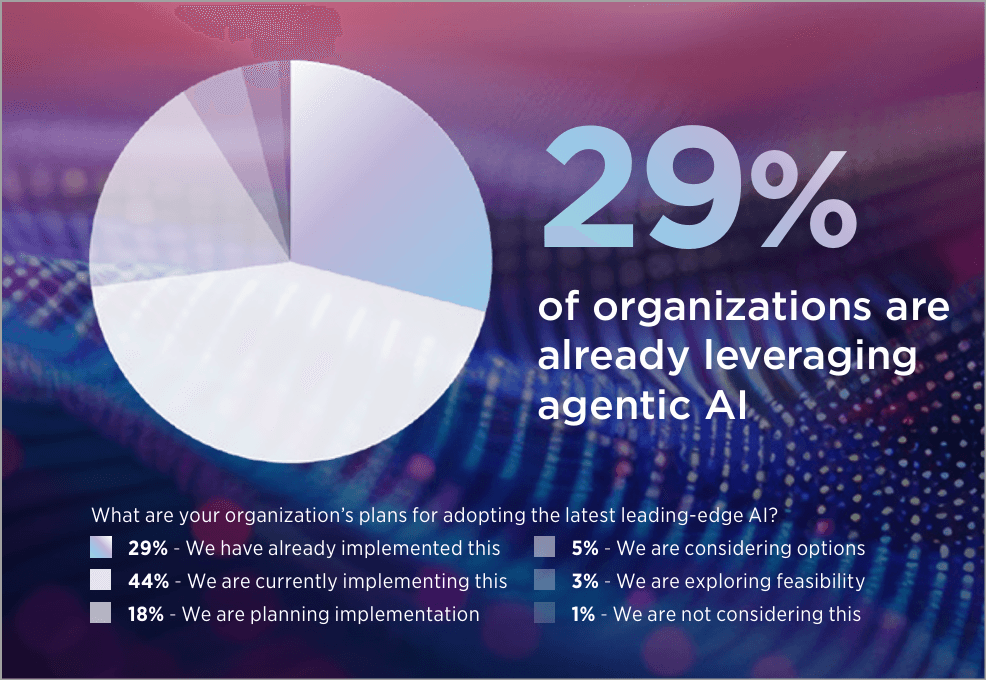
29% of organizations say they are already using agentic AI, while 44% plan implementation within the next year.
Only 2% say they are not considering agentic AI at all.
Source: SS&C Blue Prism
2. AI agent adoption is rapidly moving from pilots to production
Organizations are increasingly operationalizing AI agents, though large-scale deployment is still far from being complete.
52% of gen AI-using organizations already have AI agents in production.
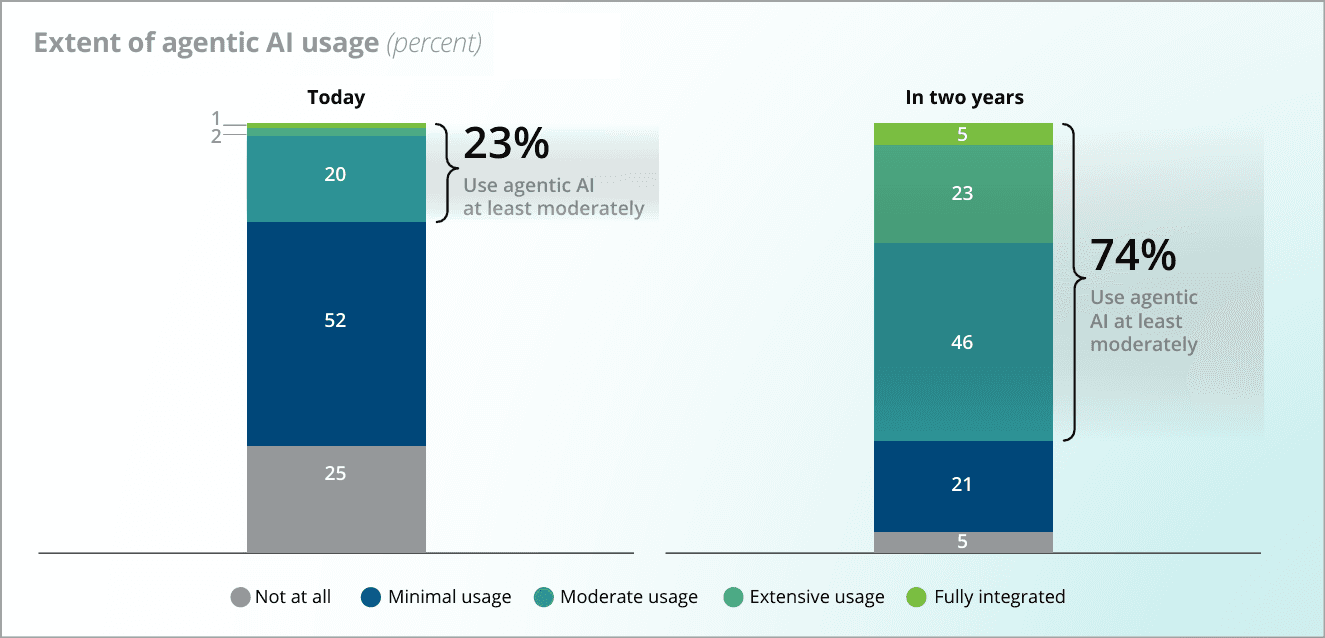
According to Deloitte, 74% of companies plan to deploy agentic AI within 2 years.
3. Enterprises still struggle to scale AI agents organization-wide
Despite growing adoption, many organizations remain stuck in pilot mode and struggle to scale agents across business functions.
More than 50% of companies remain stuck in narrow pilot phases and limited use cases.
Deloitte found that only 25% of organizations have moved over 40% of AI experiments into production.
4. Indian enterprises are among the fastest adopters of agentic AI
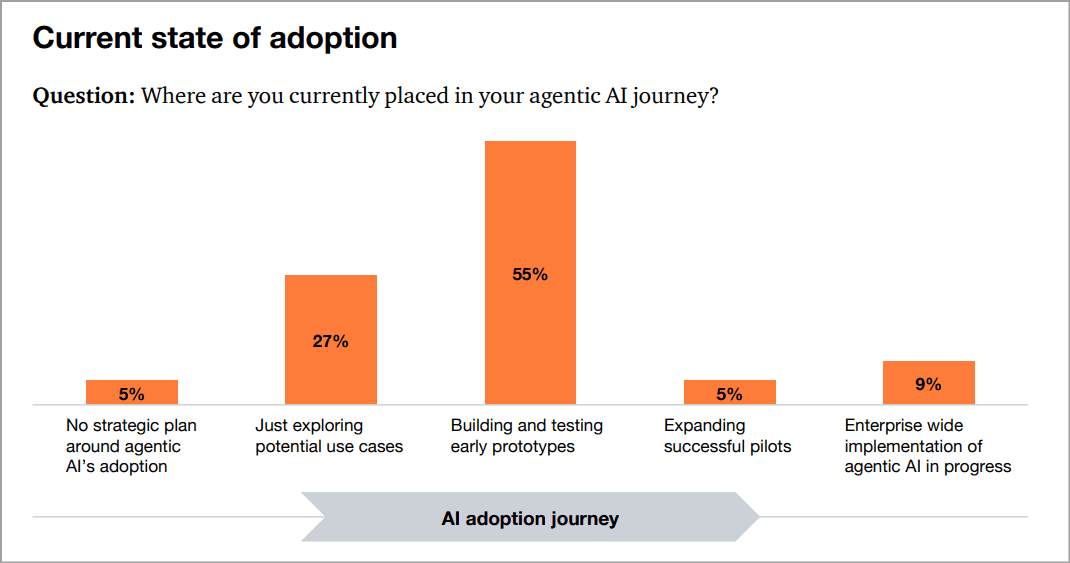
Indian organizations are aggressively exploring AI agents, though most remain in early implementation stages. PwC India conducted a survey in September of 2025, and these were some of their findings:
95% of Indian organizations have begun their agentic AI journey.
55% are building or testing early prototypes.
Only 14% have progressed beyond early validation stages.
42% expect enterprise-wide agentic AI adoption within 6–12 months.
Source: PwC India
5. AI agents are becoming a competitive necessity
93% executives believe organizations that scale AI agents within the next 12 months will gain a competitive advantage. Aligning with this assumption, workforce access to AI expanded by 50% in one year. (Deloitte “State of AI in the Enterprise” Jan 2026)
Microsoft’s AI agent ecosystem Microsoft has become one of the largest platforms for agent deployment worldwide. Active agents in the Microsoft 365 ecosystem grew 15x YoY, and 18x in large enterprises. More than 230,000 organizations, including 90% of the Fortune 500, have used Copilot Studio to build AI agents. |
Where AI Agents Are Being Deployed
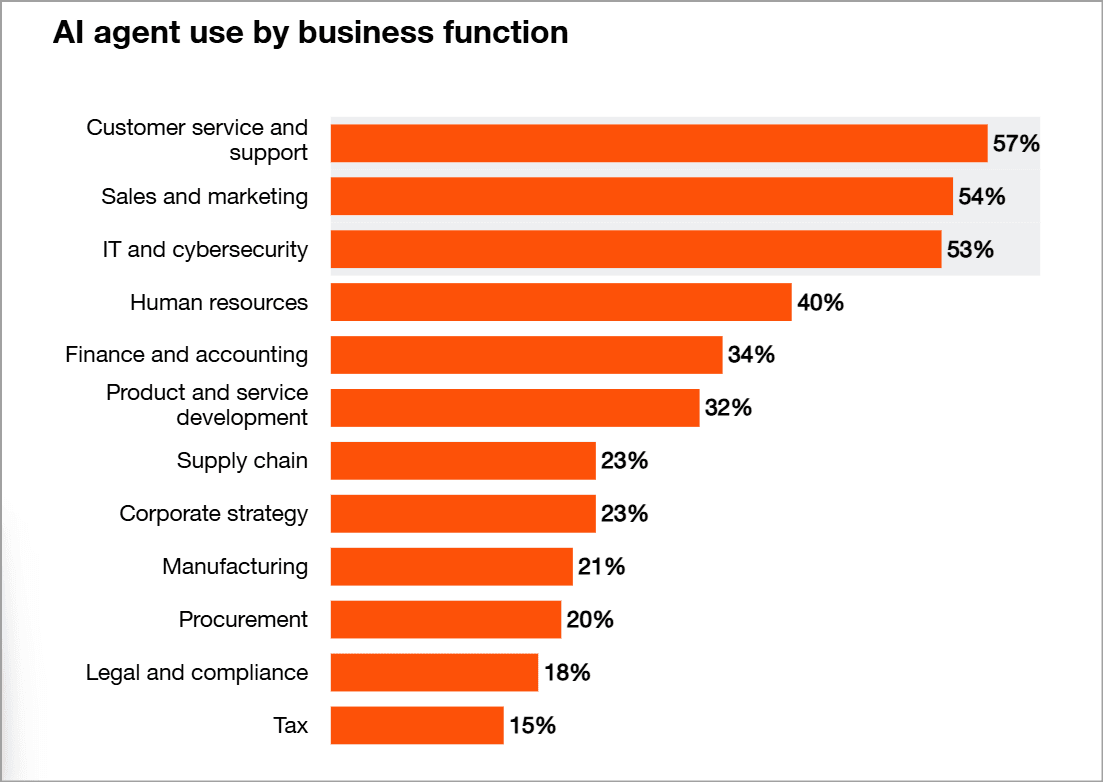
1. Customer service remains the leading AI agent use case
57% of companies are using or planning to use agents for customer service within 6 months.
2. AI agents are increasingly being used for IT operational automation
Operational automation is emerging as one of the biggest enterprise AI agent categories, especially across technical workflows. 53% of companies are using or planning to use agents for IT and cybersecurity.
3. Sales, marketing, and innovation teams are rapidly adopting AI agents
Commercial and growth-focused teams are becoming major adopters of AI-powered automation. 54% of companies are using or planning to use agents for sales and marketing.
Source: PwC
4. Tech and telecom industries are leading enterprise AI agent adoption
Technology-heavy industries are adopting AI agents faster than highly regulated sectors.
Industry | AI Agent Adoption Rate |
Technology, Media, and Telecommunications (TMT) | 28% |
Life Sciences and Health Care (LSHC) | 25% |
Consumer Industry | 24% |
Financial Services | 21% |
Energy, Resources, and Industrials (ER&I) | 20% |
Source: Deloitte
Start building, not just reading
Build AI chatbots and agents with WotNot and see how easily they work in real conversations.

Start building, not just reading
Build AI chatbots and agents with WotNot and see how easily they work in real conversations.
Start building, not just reading
Build AI chatbots and agents with WotNot and see how easily they work in real conversations.

The ROI and Business Impact of AI Agents
1. Most AI agent adopters are already seeing measurable ROI
Organizations actively deploying AI agents are increasingly reporting productivity and efficiency improvements.
88% of agentic AI early adopters report positive ROI on at least one gen AI use case. (Google Cloud ROI of AI 2025)
83% expect process efficiency improvements, while 67% cite cost reduction as a top benefit. (IBM)
85% of CEOs expect positive ROI from AI agents by 2027.
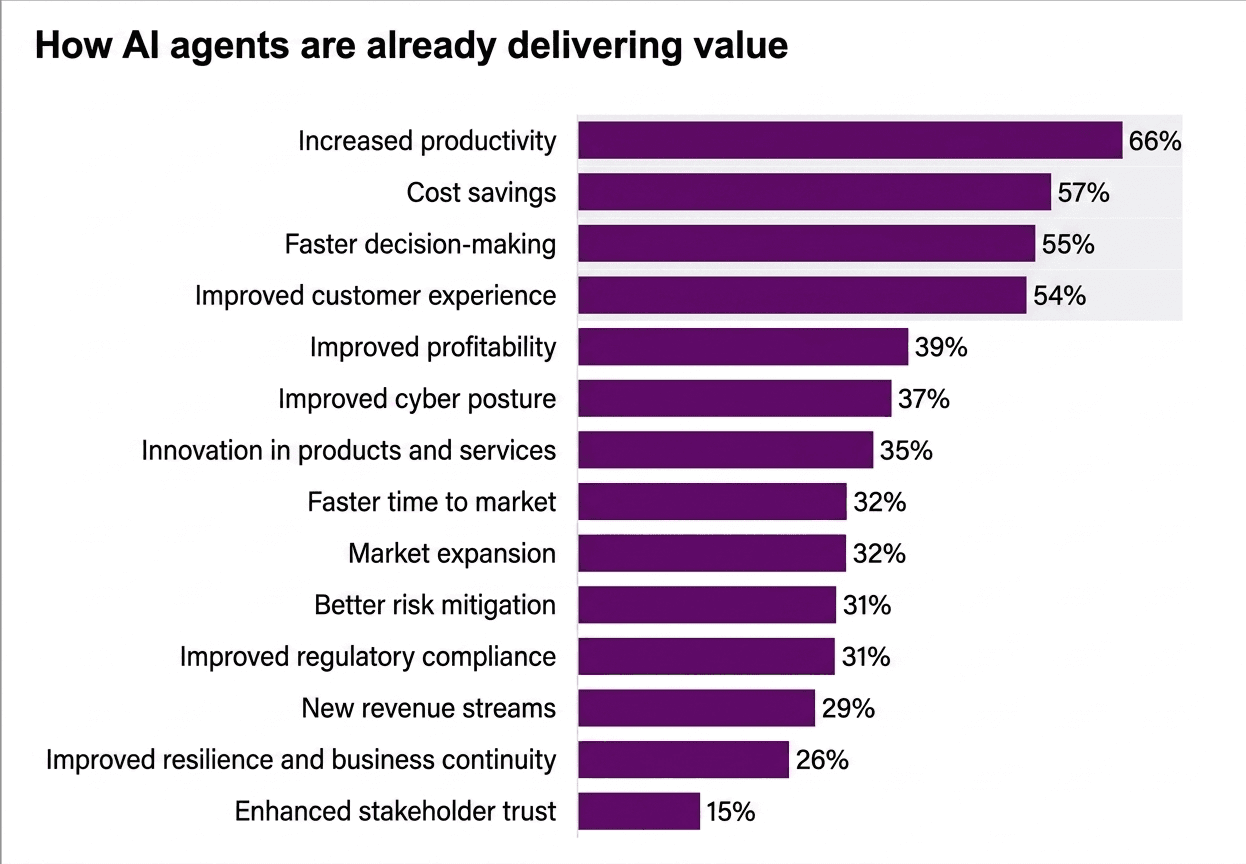
2. AI agents are dramatically reducing operational costs and response times
Some real-life examples of how AI Agents are making a difference and giving measurable results:
Source: PwC
Curious what this looks like for your own business instead of the industry average? Estimate your AI agent ROI here.
3. Many organizations still struggle to realize AI value at scale
Despite optimism around AI agents, enterprise-wide ROI remains inconsistent.
IBM reported that only 25% of AI initiatives have delivered expected ROI, and only 16% of AI initiatives have scaled enterprise-wide.
4. Governance and evaluation systems significantly improve AI success rates
AI evaluations and governance frameworks are basically quality checkpoints companies put in place to ensure AI systems are accurate, reliable, secure, and ready for real-world deployment. Companies using AI governance and evaluation frameworks put 12x and 6x more AI projects into production, respectively. (Databricks)
AI Agents and the Workforce
1. Most companies have not restructured their workforces to align with AI adoption
84% of companies have not redesigned jobs around AI capabilities.
36% of companies expect at least 10% of jobs to be fully automated within a year.
A survey by CapGemini says 52% believe AI agents will displace more jobs than they create.
67% of employees fear agentic AI will replace them. (SS&C Blue Prism 2025)
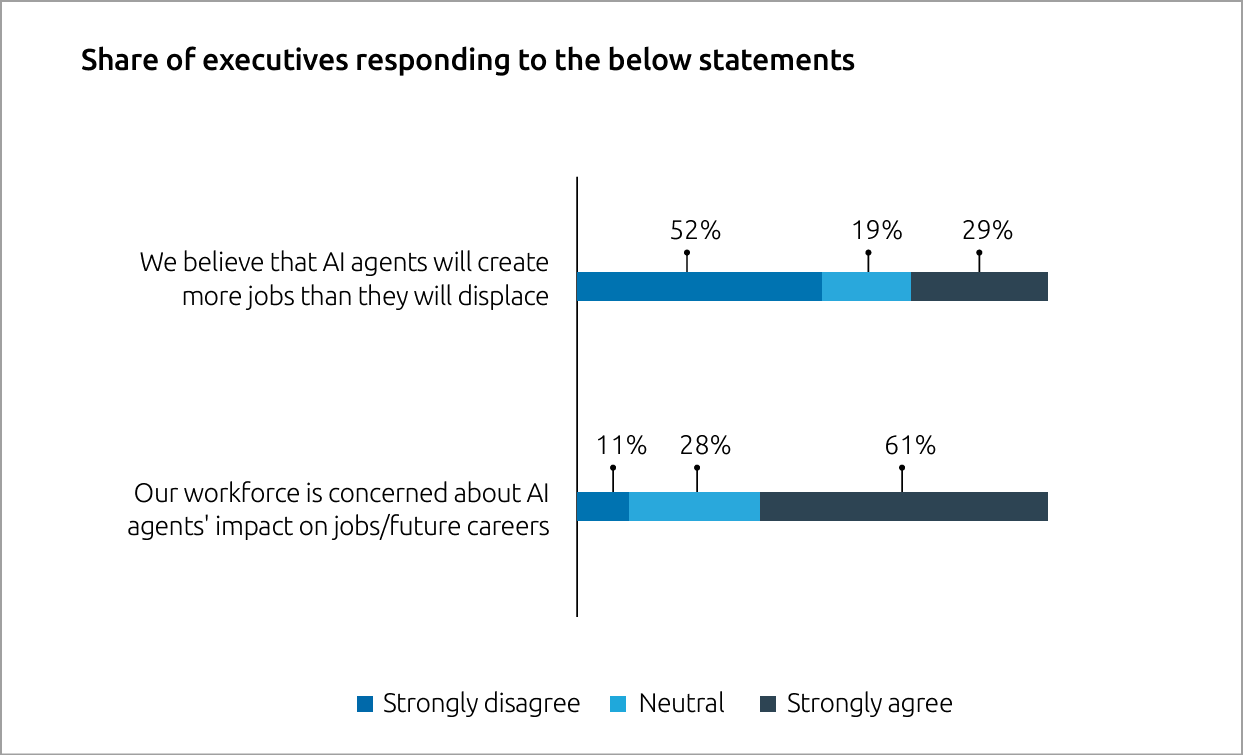
2. Executives think AI agents will transform work rather than replace the workforce
According to PwC, 67% of senior executives believe AI agents will drastically transform existing roles within the next 12 months.
And AI allows employees to spend more time on high-value work, and 58% in a Microsoft survey say that as a result, they are able to deliver work they couldn’t have done a year earlier.
3. Developers are increasingly working alongside AI agents
AI coding assistants are becoming deeply integrated into software engineering workflows. As a result, engineering roles are shifting from implementers to orchestrators.
Developers now use AI in roughly 60% of their work. However, developers can fully delegate only 0–20% of tasks to AI systems.
Source: Anthropic “2026 Agentic Coding Trends Report
Stanford HAI AI Index Report 2026 revealed that employment for software developers ages 22–25 fell nearly 20% from 2024. |
4. Human judgment still remains vital in AI-enabled workplaces
86% treat AI-generated output as a starting point rather than a final answer. To make use of even the finest AI agent, organizations say critical thinking and quality control skills are highly valued in employees.
Source: Microsoft
5. Some organizations have put into process the actions that will ease AI adoption
Here are the initiatives senior executives said they have put into place in their companies:
Initiatives | Percentage of respondents (%) |
Staff training to facilitate working more effectively with the technology | 40% |
Introducing new roles resulting from the adoption of AI | 39% |
Upskilling staff to take on new or extended functions and roles | 39% |
Reward or recognition schemes to support staff efforts to adopt AI | 34% |
Source: SS&C Blue Prism 2025
Multi-Agent Systems and AI Infrastructure
1. Multi-agent systems are seeing explosive growth
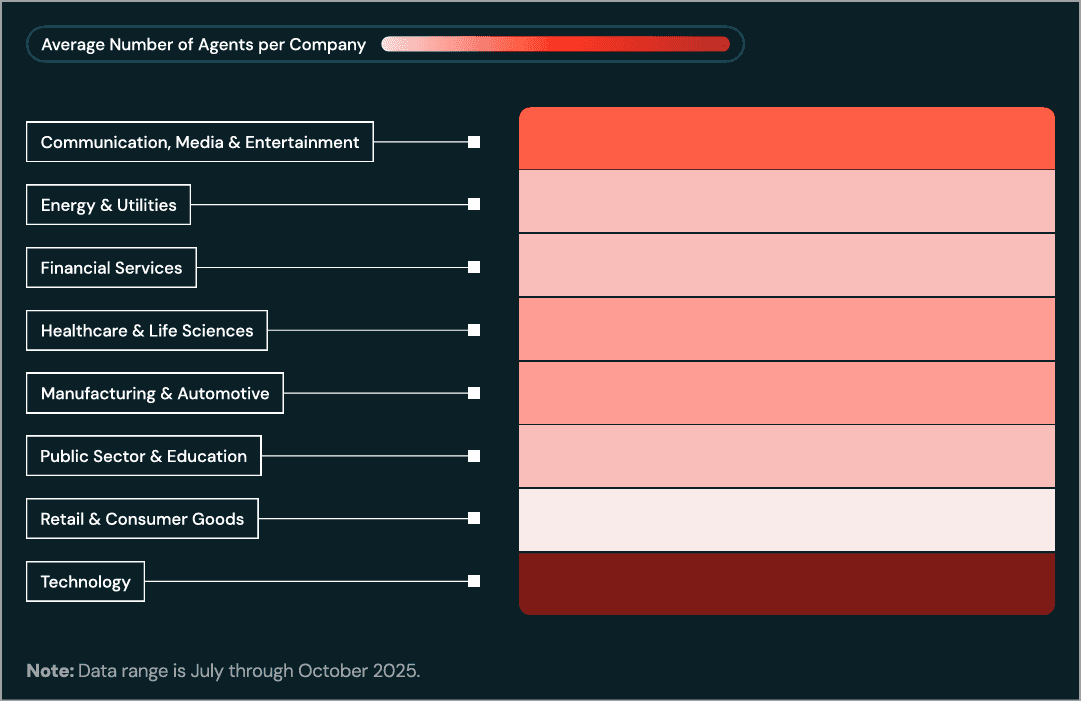
Collaborative AI agent architectures are rapidly becoming mainstream in enterprise AI deployments. Multi-agent system usage grew 327% in four months.
Tech companies in particular build nearly 4x more multi-agent systems than any other industry.
Source: Databricks
2. Enterprises are adopting multi-model AI infrastructure strategies
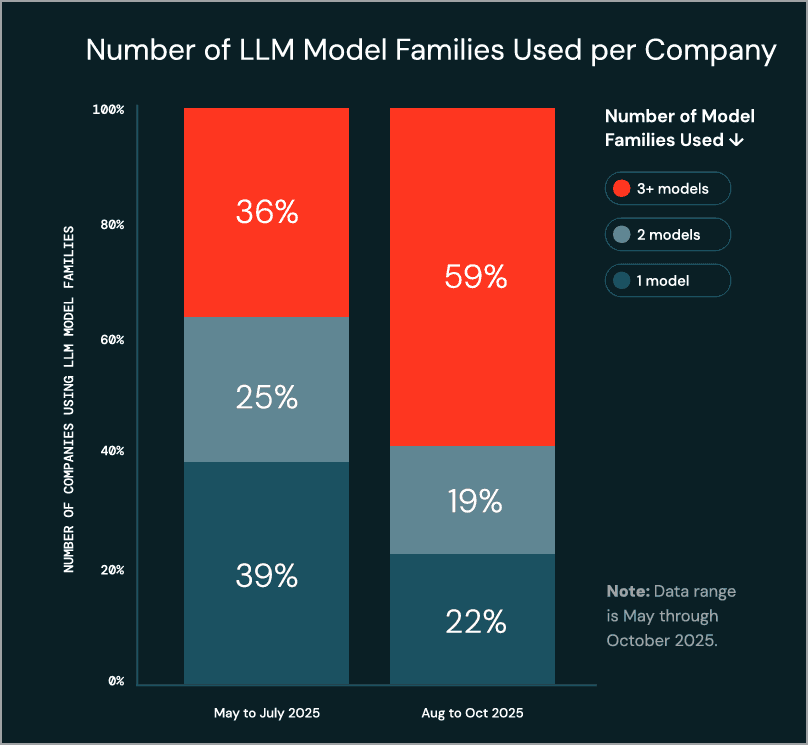
Organizations are increasingly relying on multiple LLM providers and AI infrastructure platforms.
78% of companies use two or more LLM model families. (Databricks)
Companies using three or more model families rose in number, from 36% to 59% in three months.
Source: Databricks
Trust, Governance, and Risk
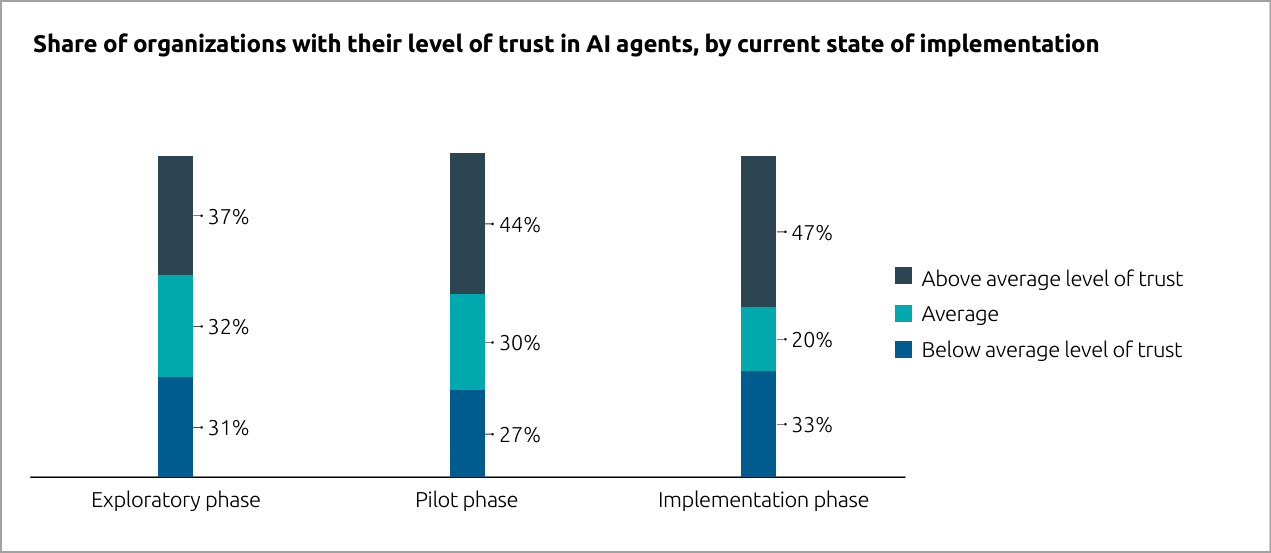
1. Most leaders still do not fully trust autonomous AI agents
Top-level leaders don’t always trust agentic AI to make the right decisions. In fact, trust in fully autonomous AI agents fell from 43% to 22% in one year.
Source: Capgemini
2. Security and data privacy are the top concerns around AI agents
Security, governance, and data readiness continue to slow enterprise AI adoption.
73% identify data privacy and security as the top AI risk concern. (Deloitte)
Capgemini says fewer than 20% organizations report high data readiness for AI agents.
3. AI-related incidents and safety risks continue to rise
As adoption increases, organizations are also facing a growing number of governance and safety failures. Even highly safety-optimized LM agents failed in 23.9% safe simulated testing scenarios.
Source: Stanford HAI
AI Investment and Spending Trends
1. AI investment is accelerating across industries
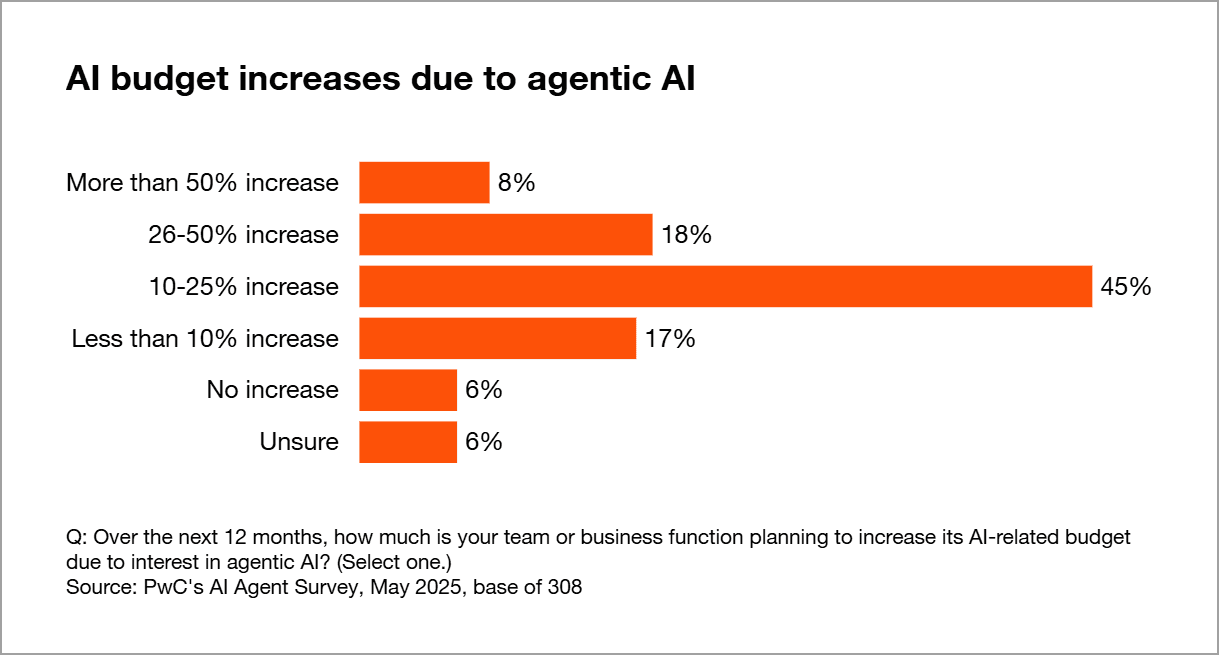
Organizations worldwide are significantly increasing AI spending as agentic AI becomes a strategic priority. According to PwC data, 88% organizations say their teams plan to increase AI-related budgets in the next 12 months because of agentic AI.
Source: PwC
2. Global private AI investment surged in 2025
AI funding and infrastructure investment reached record levels globally.
US private AI investment reached $285.9B in 2025.
US private AI investment grew 160.2% YoY.
Global corporate AI investment doubled in 2025.
Global private investment in generative AI grew by over 200%.
Source: Stanford HAI
Wondering what a similar investment would take for your own team? Estimate your AI agent costs here.
3. High-performing companies are dedicating major portions of their budgets to AI
As per McKinsey’s “State of AI in 2025” report, over one-third of AI high performers allocate more than 20% of their digital budgets to AI.
Consumer products companies allocate roughly 20% of their IT budgets to AI initiatives. (BCG)
Barriers to Scaling AI Agents
1. Workforce resistance and skills gaps are slowing AI adoption
Here are some of the top reasons cited for difficulties in scaling AI adoption by Accenture:
64% cite employee resistance as the biggest barrier to scaling AI.
51% cite insufficient training programs.
47% cite limited training budgets.
Insufficient worker skills are cited as the biggest barrier to integrating AI into existing workflows. (Deloitte)
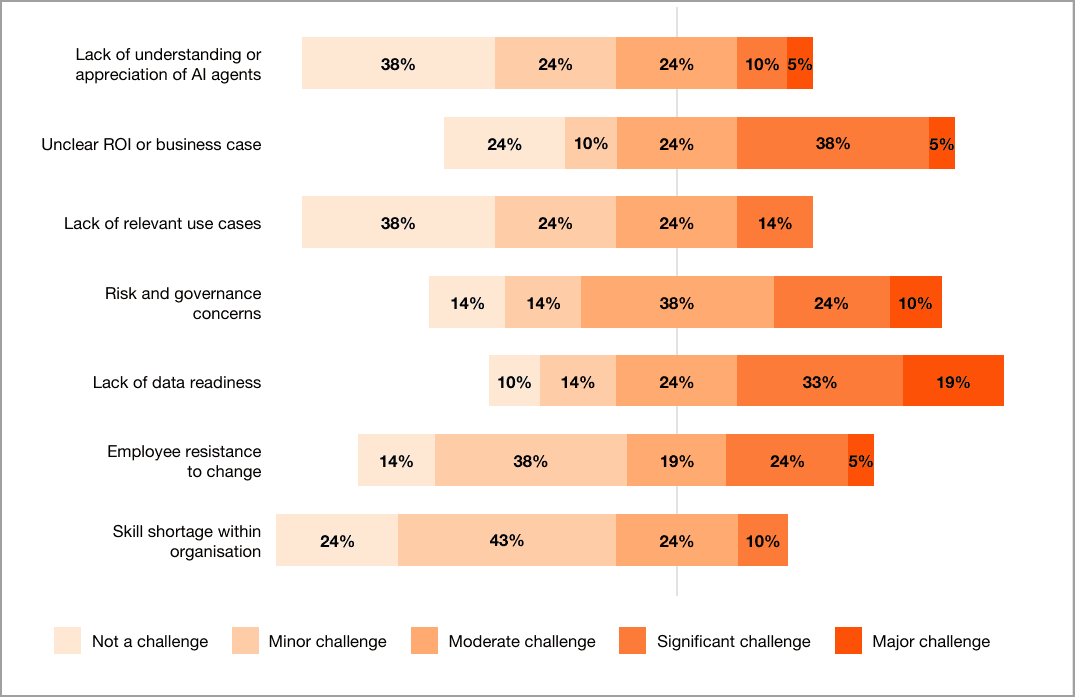
Source: PwC- Challenges in AI Adoption
2. Many enterprises prefer external AI partners over building in-house
Companies increasingly prefer managed AI platforms and external providers rather than fully custom infrastructure. 62% prefer partnering with solution providers instead of building AI systems internally.
AI Agents in Software Development
1. AI coding assistants are becoming mainstream among developers
AI-powered coding tools are rapidly becoming part of everyday software engineering workflows.
More than 15 million developers are already using GitHub Copilot.
Hundreds of thousands of customers are using Microsoft 365 Copilot.
Source: Microsoft Build 2025
2. AI agents are significantly improving developer productivity
Organizations deploying coding agents are reporting measurable gains in output and efficiency.
A study of 4,867 developers found:
26% increase in weekly tasks completed
13.55% increase in code updates
38.38% increase in code compilation
Turing reported 33% developer productivity gains using Gemini Code Assist.
Source: Google Cloud AI Trends Report 2025
3. AI agents are increasingly handling complex engineering tasks autonomously
Advanced coding agents are beginning to complete sophisticated implementation work with limited human intervention.
AI agents improved from 12% to ~66% task success on the OSWorld benchmark.
At Rakuten, Claude Code completed a complex implementation task in 7 hours with 99.9% numerical accuracy.
TELUS teams created over 13,000 custom AI solutions while shipping code 30% faster.
Sources: Stanford HAI, Anthropic
What Comes Next for AI Agents
1. AI agents are expected to become embedded in daily enterprise operations
Organizations expect agentic AI to become deeply integrated into business workflows over the next few years. Gartner predicts that at least 15% of daily work decisions will be made by agentic AI by 2028.
2. AI infrastructure and automation trends will continue accelerating globally
The next phase of AI growth will increasingly involve robotics, industrial automation, and large-scale infrastructure expansion.
China installed 54% of industrial robots globally in 2024.
Robots currently succeed in only 12% of household tasks.
The number of AI researchers moving to the US has dropped 89% since 2017.
Source: Stanford HAI
The Bottom Line
The numbers across these credible sources tell a consistent story.
On one side, the momentum is undeniable. The AI agent market is growing at roughly 45-50% annually. Budgets are surging, and early adopters report real productivity gains, real cost savings, and real competitive advantages.
On the other side, most organizations are stuck between pilots and production. 84% of companies have not redesigned a single job around AI.
The gap between what AI agents can do and what organizations are ready to let them do is the defining challenge of this moment.
The companies gaining the edge are those aligning their AI strategy with their business strategy and redesigning workflows rather than layering AI on top of old ones.
Using AI Agents for your business is very accessible to all niches. There are proficient no-code AI agent-building platforms that enable you, developers, and non-developers to create and deploy agents within hours. Take WotNot’s free 14-day trial to explore your options.
The stats in this article should help you figure out where your organization stands and what to do about it.
ABOUT AUTHOR

Hardik Makadia
Co-founder & CEO, WotNot
Hardik leads the company with a focus on sales, innovation, and customer-centric solutions. Passionate about problem-solving, he drives business growth by delivering impactful and scalable solutions for clients.



Start building your chatbots today!
Curious to know how WotNot can help you? Let’s talk.
Start building your chatbots today!
Curious to know how WotNot can help you? Let’s talk.