
14 min read
Chatbots in Hospitality: A Practical Guide for Hotels

Hardik Makadia

Let’s build your chatbot today!
Launch a no-code WotNot agent and reclaim your hours.
*Takes you to quick 2-step signup.
A guest doesn’t always need a big reason to choose one hotel over another. Sometimes, it’s simply the hotel that answered their question first.
A question about parking, late checkout, or breakfast might seem small. But when a guest is making a booking decision, waiting for an answer can be enough to lose the conversation.
Meanwhile, the front desk spends much of every shift answering the same handful of questions: Wi-Fi password, check-in time, parking, pool hours. Industry estimates put it at up to 75% of guest inquiries being repetitive, the kind that don't need a person to answer them at all. For a property fielding a few hundred calls a day, that's hours of staff time spent on answers a guest could have had in seconds.
This is where chatbots in hospitality have found real footing. Not as a form that collects a message and waits, but as something that answers guests properly, takes their requests to the right team, and pulls in a human when one is actually needed.
Whether that's worth it for your property depends on a few things: your inquiry volume, how much of your business comes through OTAs, and how you'd actually put it to use.
This guide walks through all of it, starting with what a chatbot does across the guest journey.
TL;DR
Guests don't wait for answers. A question about parking or late checkout going unanswered often is enough to lose the booking to whoever replied first.
Up to 75% of guest inquiries are repetitive, the kind that don't need a person: Wi-Fi, check-in times, parking, pool hours.
Chatbots work across the full guest journey: answering pre-booking questions and driving direct bookings, sending pre-arrival details and upsells, routing in-stay requests, and collecting feedback after checkout.
The three places value shows up are staff time saved, OTA commission recovered on direct bookings, and upsell revenue. Weigh those against platform cost to size it for your property.
What separates a good bot from a bad one: it answers only from your content, it connects to your PMS or booking engine, it hands off cleanly to staff, and it works on the channels your guests already use.
Three platforms worth considering: WotNot for all channels from the entry plan with no setup fee, Asksuite for direct-booking conversion at scale, HiJiffy for boutique properties in multilingual markets.
Start with the 20 to 30 questions you're tired of answering. Get the content right before chasing features.
Let’s build your chatbot today!
Launch a no-code WotNot agent and reclaim your hours.
Let’s build your chatbot today!
Launch a no-code WotNot agent and reclaim your hours.
What Chatbots Do Across the Guest Journey
The easiest way to judge whether a chatbot fits your property is to walk the guest journey and see where it would actually step in. Most of what a chatbot does in hospitality is part of one of four stages, and each stage solves a different problem.
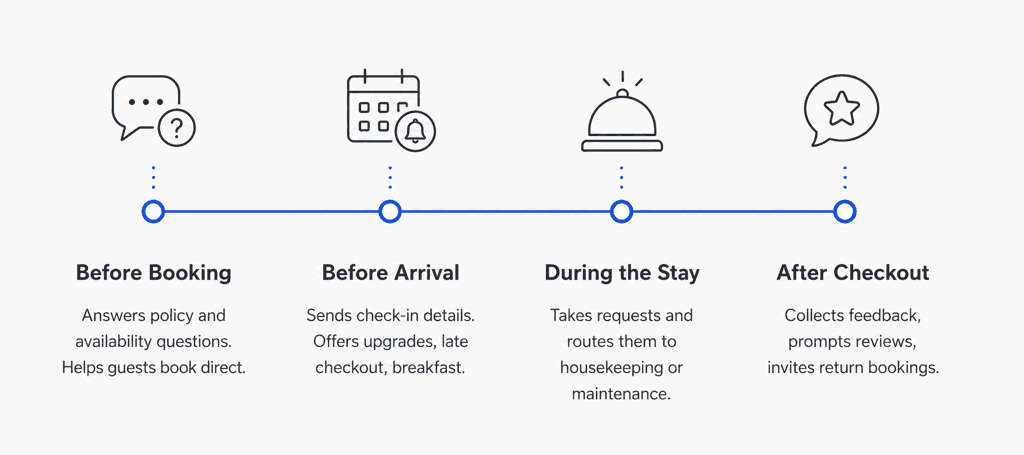
Before Booking
This is where the money is, and where most properties leave the most on the table.
A guest browsing your site has questions before they'll commit.
Is it pet-friendly?
What's the cancellation policy?
Is parking included?
Are there rooms available for those dates?
Every one of those questions is a small hesitation, and every unanswered hesitation is a chance for them to go check the OTA listing instead, or the hotel down the road.
A chatbot handles this layer instantly. It answers the policy questions, checks availability, and can walk the guest through booking directly on your site rather than through a third party. The bot’s there to field inquiries that come in at midnight or even on a Sunday, making the difference between a booking and a missed one.
Before Arrival
Once a guest has booked, there's a window when they'll have another round of questions, and you have a genuine chance to enhance their stay.
A chatbot can send check-in instructions and directions before the guest asks, take special requests (a quiet room, an early arrival, a cot for a child), and offer the things a guest often wants but rarely thinks to ask for. Room upgrades, late checkout, breakfast, a spa slot. Presented at the right moment, these convert far better than a line item on a booking page.
This is also the stage that quietly reduces front-desk pressure. A guest who already knows where to park and what time check-in starts isn't asking at the counter.
During the Stay
Once a guest is in the building, the volume of small requests goes up. Extra towels, a late checkout, restaurant hours, how to get the Wi-Fi working, what's worth seeing nearby.
A chatbot lets guests message rather than call or come down, and if it's connected to your systems, it can route the request to the right team without the front desk relaying it. A towel request goes to housekeeping. A broken air conditioner goes to maintenance. The guest gets confirmation; the desk doesn't become a switchboard.
The other thing that matters here is escalation. A guest with a genuine complaint doesn't want a bot. A good setup recognizes that and gets a person involved fast, with the conversation history already attached.
After Checkout
The stay ending doesn't have to end the conversation.
A chatbot can follow up for feedback while the experience is still fresh, which tends to get better response rates than an email a week later. It can prompt a review, invite the guest into your loyalty program, or nudge a return booking with an offer. Small touches, but they compound across every guest who walks out.
The Benefits of Chatbots in the Hospitality Industry
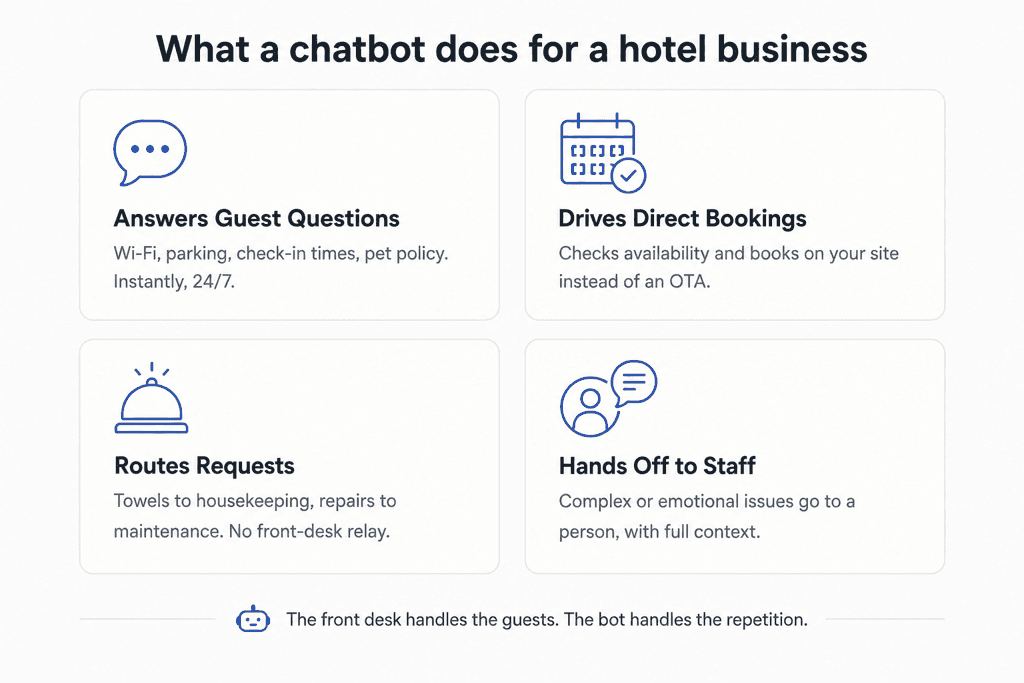
You can see most of the benefits in the journey above, so I won't relist them. But three outcomes are worth naming directly, because they're what actually show up on a P&L.
Your front desk gets time back:
Every routine question a bot answers is a call your team doesn't take or a counter interaction they don't have to pause for. That time goes back to the guest standing in front of them, which is the part of the job that actually differentiates your property.More bookings come direct:
This is the one with real money attached. OTA commissions typically run 15 to 25% of the booking value. A chatbot that answers a guest's questions on your own site and helps them book there keeps that margin with you instead of having to hand it to a third party. Even a modest shift in booking mix adds up quickly.You cover the hours and languages you otherwise can't:
Guest inquiries don't stop at 6 pm, and they don't all arrive in your staff's language. A chatbot covers overnight, weekends, and multiple languages without adding headcount, which is otherwise a genuine staffing problem for most properties.
That last point is worth sitting with if you're in a tourist-heavy market. Multilingual coverage is often the hardest thing for an independent property to staff, and it's one of the easiest things for a bot to handle well.
What a Chatbot Is Actually Worth to Your Property
Most articles on this topic stop at "chatbots save time and money." That's not useful when you're deciding whether to spend on one. So here's a rough way to sketch the number for your own property.
There are three places the value shows up.
Staff time saved:
Start with how many routine inquiries you field a day, calls, website messages, and questions at the desk. A conservative estimate is around two minutes per simple question once you account for the interruption and looking things up. If your property handles 50 of those a day, that's roughly 100 minutes daily, or close to 50 hours a month. A well-set-up bot won't catch all of it, but even at 70%, it's still 30-plus hours back every month. Multiply that by your loaded hourly cost, and you have your first number.Commission recovered:
This is usually the bigger one. Take your average booking value and multiply by your OTA commission rate, somewhere between 15 and 25% for most properties. That's what each shifted booking is worth to you. Now ask how many additional direct bookings a chatbot would realistically win: the guests who had a question at 11 pm and got an answer instead of clicking away. Even a handful a month can outweigh the platform cost on its own.Upsell revenue:
Room upgrades, late checkout, breakfast, spa slots. These convert better when offered conversationally at the right moment than as a checkbox during booking. Take your typical upsell value and a conservative conversion estimate across your pre-arrival guests.
Add those three, then set it against what the platform costs you monthly. For most properties, no-code chatbot platforms cost tens to a few hundred dollars a month, depending on volume and features, which is a low bar for the numbers above to clear.
One thing worth being honest about: the timeline. Payback isn't instant. Most properties see it over several months, because the bot needs your content loaded properly, and its accuracy improves as you review what it gets wrong. If you're expecting results in week one, you'll be disappointed. If you're looking at a 6-to 12-month view, the math usually holds up comfortably.
The point of this exercise isn't precision. It's to know roughly which of the three matters most for your property, because that tells you what to prioritize when you set the thing up.
What Separates a Good Hospitality Chatbot From a Bad One
Most hospitality chatbots look good in a demo.
They answer questions, recommend rooms, and maybe even take bookings. The real test comes later, when a guest asks something specific about your hotel and the bot has to figure out what to say.
That’s where the differences start to show.
If you’re comparing chatbot platforms for a hotel, take a look at these four things:
It Answers From Your Content, Not Its Own Guesses
This is the one that matters most in hospitality. And there's an important distinction here.
Older chatbots followed scripts. A guest asked something slightly differently than expected, and the whole thing could fall apart.
Modern AI has made conversations much more flexible. But it has introduced a different risk: what happens when the bot doesn't know the answer?
If it isn't properly grounded in your property's actual information, it can fill the gap with something that sounds right. And this is the real problem I’m talking about in hospitality. A bot that invents a pet policy, quotes the wrong room rate, or tells a guest that breakfast runs until 11 when it actually stops at 9:30 creates work for your front desk, which is an unnecessary affair.
And the worst thing, the guest now has a reason to question everything else the bot tells them.
So when you're evaluating a platform, don't stop at “Does it use AI?” Ask a more useful question: “Does it answer from the content I give it, and does it know when to say it doesn't have an answer?”
It Connects to Your Booking and Property Systems
There's a big difference between a bot that talks about availability and one that can actually check it.
Without an integration, your bot is essentially a well-spoken FAQ b. It can explain your cancellation policy or tell a guest what time check-in starts, but it can't confirm whether a room is available next Tuesday or complete the booking. The guest still has to leave the conversation to do that themselves.
Connect the bot to your PMS or booking engine, and it can do more than answer questions. It can check real availability, help complete bookings, and send requests to the right system or team.
That's what you should look for when comparing platforms: not just how many integrations they list, but what the bot can actually do once those systems are connected.
Containment Rate and How Cleanly It Hands Off
Two things tell you whether a chatbot is actually helping your front desk: how many conversations it can handle on its own, and what happens when it can't.
Containment rate is the percentage of conversations the bot handles without a human stepping in. It gives you a good idea of how much routine work the bot is taking off your team's plate. But don't chase a high number blindly. A conversation that ends because a guest gave up isn't a successful resolution. For that reason, look at containment alongside resolution rate or guest satisfaction.
Handoff quality is the other half, and it's easy to overlook. When the bot can't help, the guest should reach a person quickly, with the conversation already in front of them. They shouldn't have to start from scratch and explain everything again.
That's where a proper live chat setup can make the difference between a smooth escalation and a frustrated guest.
It Works on the Channels Your Guests Actually Use
Your website is the obvious starting point, but guests don't always start there. Depending on your market, they may reach out through WhatsApp, Instagram, or SMS instead. For international travelers, messaging apps can be especially important.
The important question isn't just how many channels a platform supports. It's whether you can manage the same chatbot across those channels without rebuilding everything from scratch.
You don't want one bot answering questions on your website, another handling WhatsApp, and a third one that needs its own updates. Look for a platform that lets you build the experience once and deploy it across your website and messaging channels.
Best AI Chatbot Platforms for Hospitality
You don't need a long shortlist here. Three platforms cover the situations most properties fall into, and they're genuinely different from each other rather than variations on the same thing.
1. WotNot
WotNot is the easiest AI agent platform built for guest-facing conversations across your website and messaging channels. It isn't hospitality-specific, which cuts both ways: you get more flexibility in how you build and what you connect, but PMS integration is something you set up rather than something that ships pre-configured.
Key features
No-code visual builder with pre-built templates
AI agents trained on your property's own content
Web, WhatsApp, Instagram, and SMS from one build
Live chat with human handoff
Done-for-you setup if you'd rather not build it yourself
Best for: Properties that want control over how the bot works, a lower entry price, and strong live chat handoff, without committing to a hospitality-only contract.
Pricing
Lite: $29/month
Starter: $99/month
Premium: $299/month
Enterprise: Custom
Managed setup: From $12,000/year
Start building, not just reading
Build AI chatbots and agents with WotNot and see how easily they work in real conversations.

Start building, not just reading
Build AI chatbots and agents with WotNot and see how easily they work in real conversations.
Start building, not just reading
Build AI chatbots and agents with WotNot and see how easily they work in real conversations.

2. Asksuite
A hospitality-specific platform built around one goal: turning inquiries into direct bookings. It's aimed at larger independents, groups, and chains, with hospitality-trained AI and deep integrations with booking engines.
Key features
Hospitality-trained AI reservation assistant
Deep booking engine and PMS integrations
Omnichannel inbox for guest messaging
Automatic quotes inside the conversation
Multilingual support with voice and text
Best for: Hotels where direct-booking conversion is the number that matters most, and larger independents or groups that want a mature, hospitality-native platform.
Pricing
Not publicly listed. Quoted based on property size and modules.
3. HiJiffy
A hospitality-specific platform with a long track record in European markets, designed to be lighter to deploy than enterprise tools. Pricing is transparent, though it scales by the number of rooms and carries a setup fee on every tier.
Key features
FAQ automation across the booking phase
Generative AI chatbot with omnichannel inbox
AI digital concierge covering the full guest journey
WhatsApp campaigns and guest request ticketing
Strong multilingual coverage
Best for: Independent and boutique hotels in multilingual markets that want a hospitality-native tool and can absorb the setup cost.
Worth knowing: The entry tier covers your website only. Social and messaging channels start on the Pro plan, and WhatsApp on Premium, so if messaging matters to your guests, budget accordingly.
Pricing
Basic: $115/month, plus $109 setup
Pro: $190/month, plus $449 setup
Premium: $390/month, plus $699 setup
Priced by number of rooms
Important Note - A quick word on choosing between them. If direct bookings are your single priority and you have the budget for a specialist, Asksuite is built for exactly that. If you want a hospitality-native tool for a boutique property and the setup fee isn't an issue, HiJiffy fits. And if you'd rather have every channel from the start, no setup fee, and the option of having someone build it for you, WotNot is worth a look. Whichever way you go, weigh integration depth with your existing systems above anything on the feature list.
How to Get Started Without Overcomplicating It
Most properties that struggle with a chatbot didn't pick the wrong platform. They tried to do too much at once. So here's the order I'd suggest.
Write down your baseline first:
Before anything goes live, note how many calls and messages you handle a day, roughly how many are the same handful of questions, and what your booking mix looks like between direct and OTA. Do this in the afternoon. Without it, you'll have no way of knowing three months later whether the bot actually helped.Start with the questions you're tired of answering:
Not the whole guest journey. But just the top 20 or 30 things guests ask constantly: Wi-Fi, parking, check-in and check-out times, breakfast hours, pet policy, cancellation terms. Write proper answers to each one, the way your best front-desk person would say it. This is the least glamorous part of the setup and the part that determines whether the bot is any good.Get the content right before you chase features:
A bot with accurate answers and no integrations is more useful than a bot with every integration and outdated information. The temptation is to start with the impressive stuff. Resist it for a few weeks.Set your escalation rules deliberately:
Decide upfront what should always reach a person: complaints, billing questions, anything where a guest sounds frustrated. Then make sure the handoff is easy to trigger, and the staff member sees the conversation history. If a guest has to fight to reach a human, you've created a worse experience than a ringing phone.Read the failed conversations weekly:
Half an hour is enough. Look at what the bot couldn't answer and what guests kept rephrasing. Then fix those gaps. This one habit is the difference between a bot that plateaus and one that keeps getting better.Then expand:
Once the FAQ layer is solid and your team trusts the escalation, add the next thing: availability checks, booking assistance, in-stay requests, pre-arrival upsells. One at a time, each one measured against your baseline.
If you'd rather see the mechanics of building one before you commit to a platform, our step-by-step guide to creating a chatbot walks through the whole process.
Start With the Questions You Already Answer Daily
A chatbot won't change what makes your property good. Guests remember how they were treated, not how quickly a bot told them the Wi-Fi password.
What it does is take the repetition off your team so they have more of themselves left for the guest at the counter. That's the whole case for it, and it's enough of a case on its own.
If you want to see how one would work for your property, you can try WotNot free and have a bot answering guest questions the same day.
FAQs
FAQs
FAQs
What is the best chatbot for hotels?
How much does a hotel chatbot cost?
Can a chatbot handle hotel bookings?
Will a chatbot replace my front desk staff?
How long before a hotel chatbot pays for itself?
ABOUT AUTHOR
Hardik Makadia
Co-founder & CEO, WotNot
Hardik leads the company with a focus on sales, innovation, and customer-centric solutions. Passionate about problem-solving, he drives business growth by delivering impactful and scalable solutions for clients.

Start building your chatbots today!
Curious to know how WotNot can help you? Let’s talk.
Start building your chatbots today!
Curious to know how WotNot can help you? Let’s talk.


