15 min read
Top Intercom Alternatives That Are Worth Your Time

Hardik Makadia

Let’s build your chatbot today!
Launch a no-code WotNot agent and reclaim your hours.
*Takes you to quick 2-step signup.
Look… Intercom isn't bad.
That’s exactly why so many companies use it.
But once teams start using Intercom, two problems tend to show up:
Costly pricing
Unresponsive support team
For many teams, the bill starts small… and then slowly grows into something hard to justify.
That's when people start googling "Intercom alternatives."
And that search quickly turns into a rabbit hole.
You’ll find dozens of tools that claim to do everything Intercom does. But not all perform on the level of Intercom.
But after spending the last 8 years working in the AI agent and chatbot space, I’ve seen which platforms actually deliver results.
So in this blog, I’m sharing the Intercom alternatives that are worth considering.
These tools are known to reduce your costs without sacrificing the experience your customers expect.
Intercom Alternatives – TOC
TL;DR – Quick Overview of Intercom Alternatives
Detailed Review & Analysis of Intercom Alternatives
It’s Like Intercom… But Better?!
FAQs
TL;DR – Quick Overview of Intercom Alternatives
For a quick overview, here’s the list of Intercom alternatives and what they are suited for.
Platform | Best For | G2 Rating | Starting Price |
AI-first support & lead gen (SMBs + Mid-market) | 4.6 / 5 | $29/mo | |
Enterprise-grade omnichannel support | 4.3 / 5 | $19/agent/mo | |
Small teams that want inbox simplicity | 4.4 / 5 | $22/user/mo | |
E-commerce chatbots + live chat | 4.7 / 5 | $29/mo | |
Multi-channel automation & customer support (Growing teams + Mid-market) | 4.7 / 5 | $39/mo | |
Startups & budget-conscious teams | 4.5 / 5 | $25/mo | |
ChatGPT-like support bot on your own data | 4.4 / 5 | $19/mo | |
SMBs needing ticketing + chat combo | 4.4 / 5 | $15/agent/mo | |
Startups that want zero-cost live chat | 4.5 / 5 | Free |
Detailed Review & Analysis of Intercom Alternatives
Alright, here’s a disclaimer.
I won’t be listing just features here. Why? Because you can find that anywhere.
I am here to tell you how these tools stack up against Intercom from the perspective of functionality, usability, pricing, and what users experience day to day.
1. WotNot
WotNot is an AI agent platform built to automate customer support and lead generation across web, WhatsApp, and other channels.
Best for: SMBs and mid-market teams looking to automate support and lead capture using AI, without relying heavily on engineering resources.
User Rating: 4.6/5 on G2
How is WotNot Better Than Intercom?
Most comparisons between tools like WotNot and Intercom stop at feature lists.
That’s usually where things get misleading. Because on paper, both platforms offer similar features.
But once you start using them, the differences show up in how flexible they are, how quickly you can get things live. And how much you end up paying as you scale.
Let’s break that down.
Intercom’s strength has always been its ecosystem — messaging, support, product tours, and more, all tightly integrated.
But its chatbot feels like an extension of that system, not the core focus. The moment you want more advanced automation or AI-driven workflows, complexity (and cost) tend to increase together.
WotNot is built differently. The platform is designed around building and deploying AI agents quickly, which shows up in the experience.
The drag-and-drop builder is easy to use, and more importantly, it doesn’t require constant back-and-forth with developers to get something meaningful live.
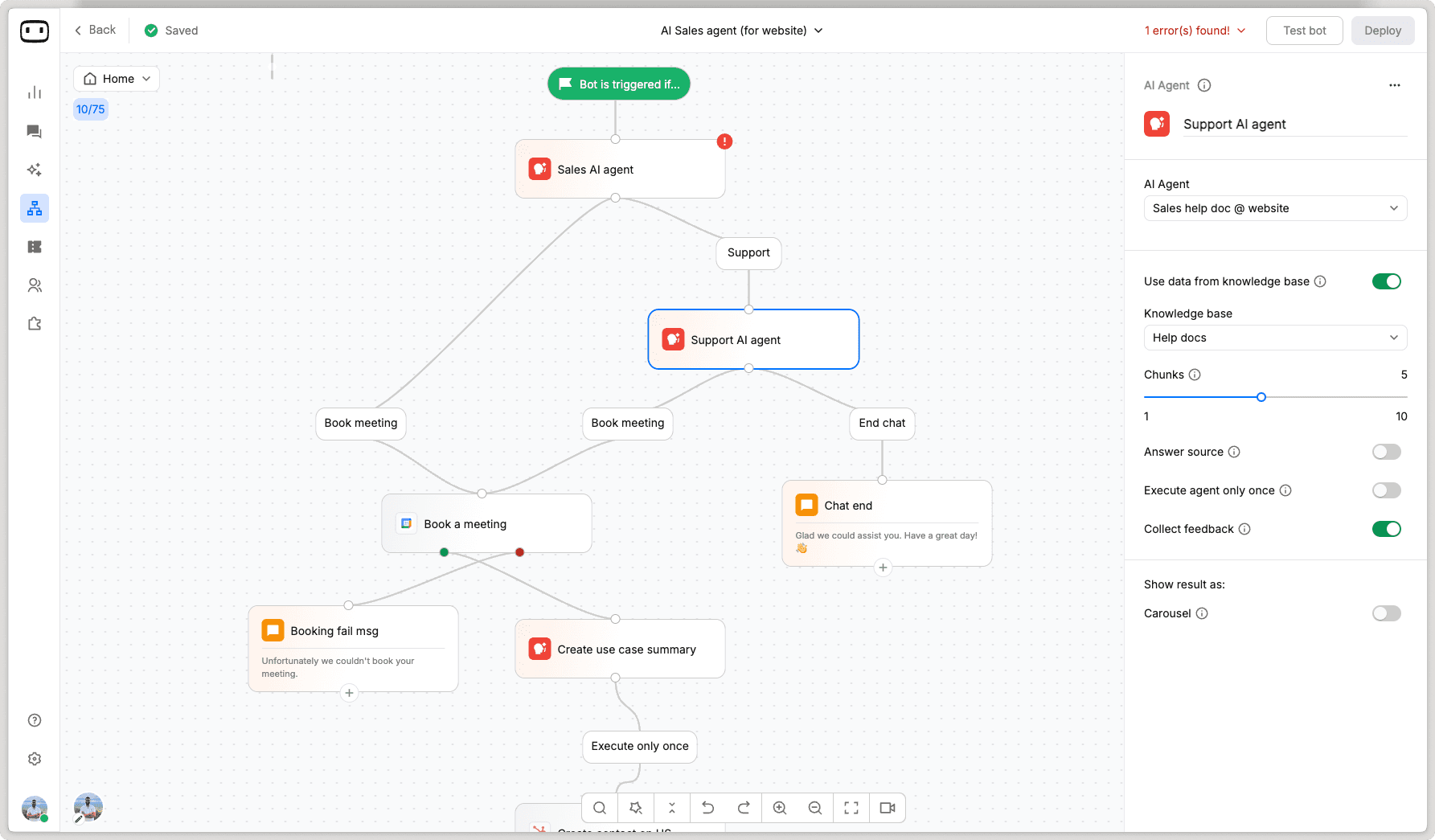
From a functionality standpoint, WotNot covers what most teams expect from Intercom: omnichannel support (including WhatsApp and Messenger), AI agents trained on your data, voice capabilities, and analytics. But where it starts to pull ahead is in control.
Workflows are easier to create, fallback handling is more configurable, and the handoff between bot and human feels less rigid.
Intercom does all of this too — but often within more structured boundaries.
And then there’s the user sentiment side of things.
Intercom is widely appreciated for its polished UI and broad capabilities, but pricing and support responsiveness are recurring concerns (especially as usage grows).
WotNot, in contrast, is more preferable by teams that want faster setup, more hands-on support, and fewer costs as they scale.
Pricing Comparison
This is usually the turning point for most teams.
Intercom’s pricing has steadily moved toward a usage-based model, including per-resolution by FinAI that can cost around $0.99.
That might seem manageable early on, but as conversation volume increases, costs can scale in ways that are hard to predict.
WotNot takes a more straightforward approach.
There’s no per-resolution pricing, and you’re not charged based on agent seats. Which means your costs don’t spike crazily just because your support volume does.
For teams trying to balance automation with cost efficiency, WotNot wins by a margin.
Start building, not just reading
Build AI chatbots and agents with WotNot and see how easily they work in real conversations.

Start building, not just reading
Build AI chatbots and agents with WotNot and see how easily they work in real conversations.
Start building, not just reading
Build AI chatbots and agents with WotNot and see how easily they work in real conversations.

2. Zendesk
Zendesk is a full-scale customer service platform built around ticketing, support operations, and enterprise-grade workflows.
Best for: Mid-market to enterprise teams that need structured support operations, ticketing systems, and advanced workflow management.
User Rating: 4.4/5 on G2
How is Zendesk Better Than Intercom?
At a glance, Zendesk and Intercom seem like direct competitors.
In reality, they’re built with very different philosophies.
Intercom is fundamentally a messaging-first platform. It’s designed around real-time conversations — live chat, in-app messaging, and proactive engagement. That works well for sales-led support and fast-moving teams.
Zendesk, on the other hand, is ticketing-first.
And that single difference changes everything.
Most comparisons focus on features — chat, automation, AI, and reporting. Both platforms check those boxes. But when you look at how support teams actually operate at scale, structure starts to matter more than speed.
That’s where Zendesk stands out.
It’s built for teams that deal with high volumes of requests across channels — email, chat, phone, social — and need a system to organize, prioritize, and resolve them efficiently.
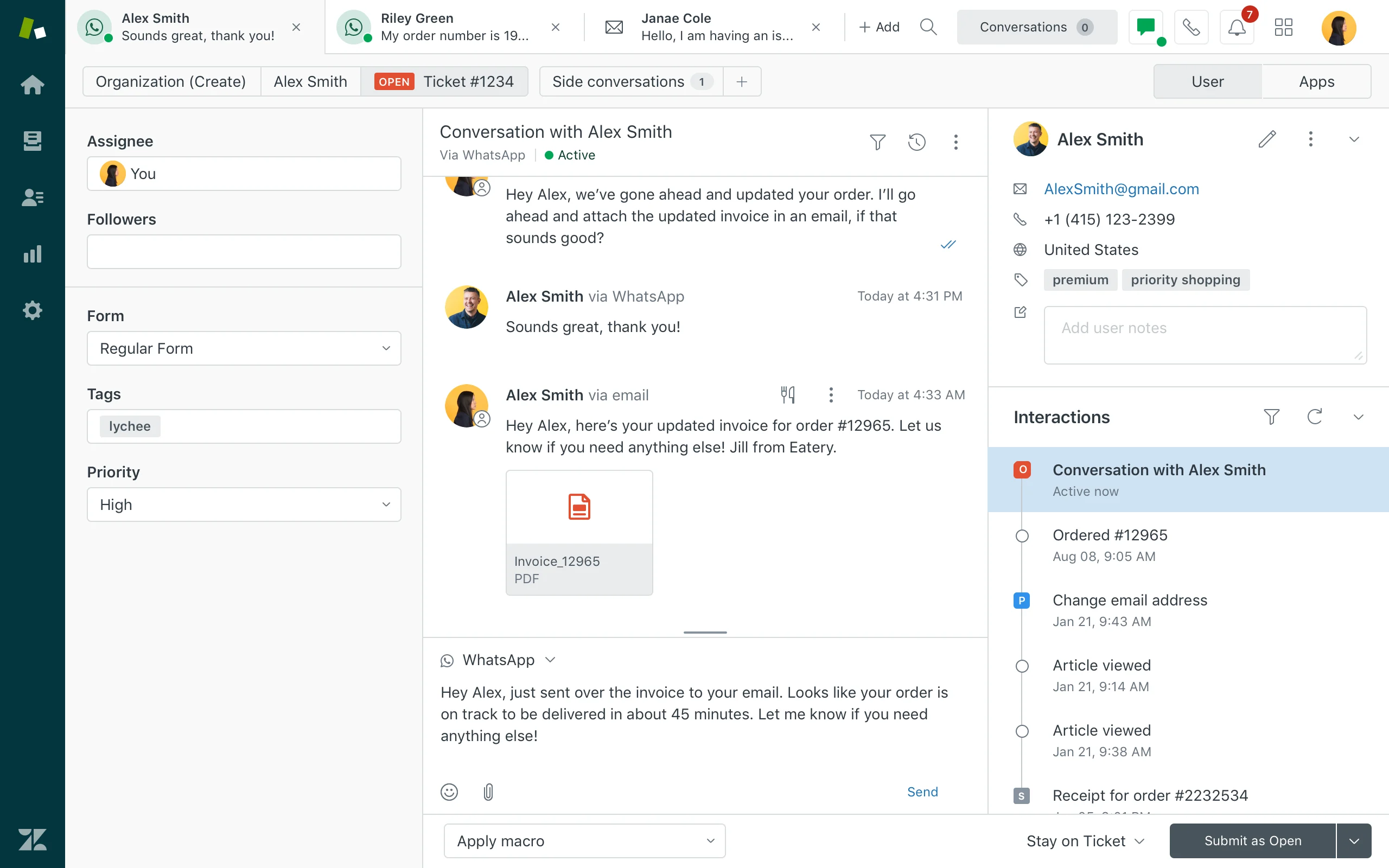
Plus, Zendesk’s workflows, SLAs, routing rules, and escalation paths are far more mature and customizable compared to Intercom.
But but but… It’s not all flowers and rainbows.
Zendesk isn’t as lightweight or quick to set up as Intercom. The interface can feel heavier, and getting the most out of it often requires more upfront configuration.
Note: You might also come across Zopim while researching Intercom alternatives.
That’s because Zopim was one of the earlier standalone live chat tools. But it was acquired by Zendesk and is now part of its ecosystem (often referred to as Zendesk Chat).
So if you’re considering Zopim, you’re essentially evaluating Zendesk’s chat capabilities rather than a separate platform.
Pricing Comparison
Both platforms can get expensive (just in different ways).
Intercom’s costs tend to scale with usage — especially with per-resolution pricing and add-ons for advanced features.
Zendesk follows a more traditional per-agent pricing model, where you pay based on the number of support agents and the suite of features you need.
At first glance, this can feel more affordable. But as your team grows, costs can add up quickly. Especially if you need higher-tier plans for advanced capabilities like automation, analytics, or AI.
So while Zendesk offers more structured support operations, it doesn’t necessarily come out as the cheaper option.
The real trade-off here isn’t just pricing, it’s how you want to run your support team.
3. Help Scout
Help Scout is a customer support platform built around collaborative inbox software, email-first support, and a clean, lightweight experience. And it has just enough automation to keep things efficient.
Best for: Small to mid-sized teams that want structured support without the complexity of enterprise tools.
User Rating: 4.4/5 on G2
How is Help Scout Better Than Intercom?
Most teams don’t actually need a complex support stack. But they end up with one anyway. That’s usually what happens with Intercom.
It starts as a simple live chat tool and gradually turns into a layered system with bots, campaigns, inboxes, and automation.
For some teams, that’s powerful. For others, it’s more than they need.
Help Scout takes a different route. It strips support back to what most teams actually rely on: conversations, email, and a shared inbox that feels intuitive from day one.
And that simplicity is its biggest advantage.
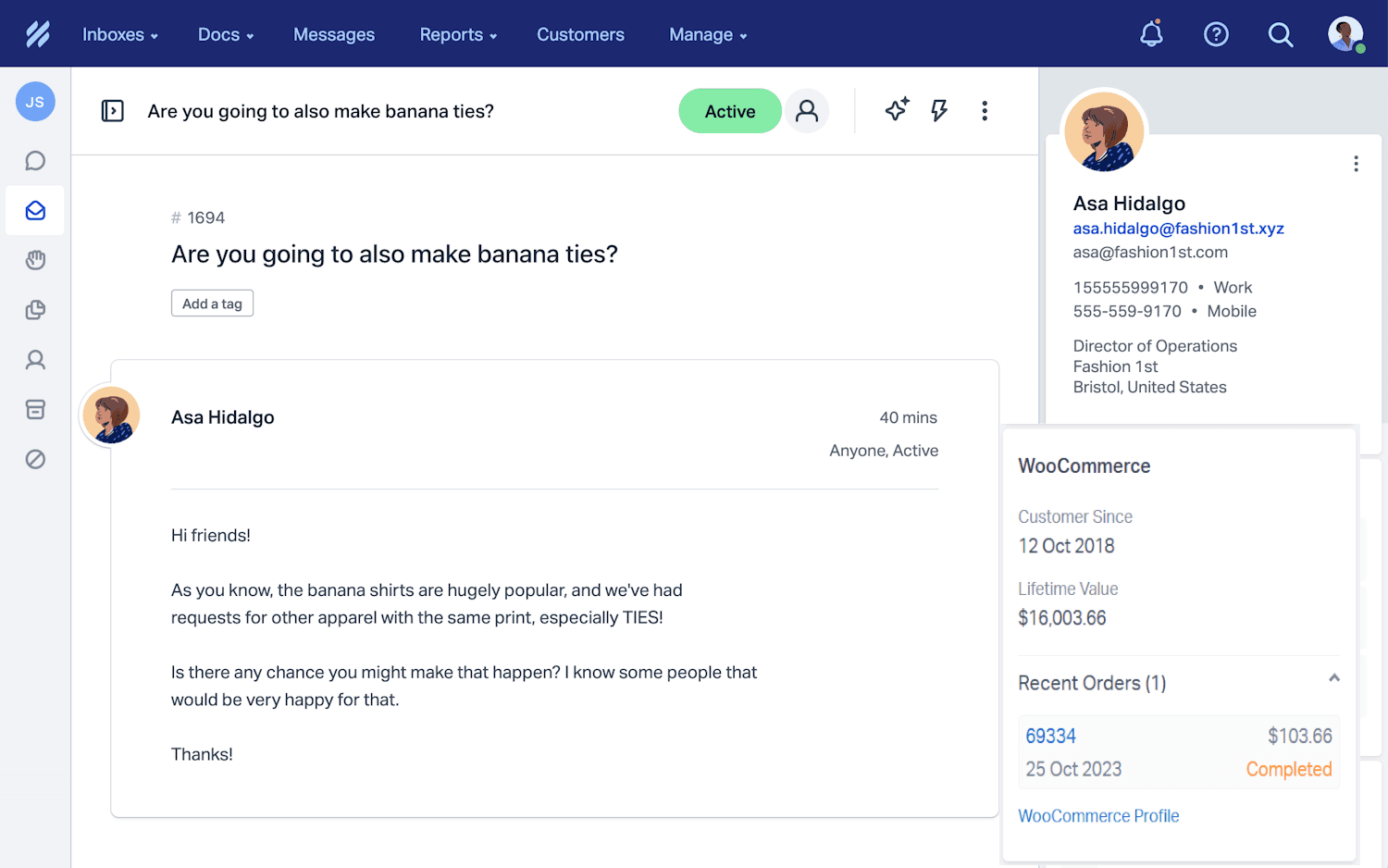
Intercom is built around real-time messaging. That works great for instant responses and proactive engagement. But not every support interaction needs to be a live chat.
In fact, a large chunk of support still happens over email, especially for detailed queries or ongoing conversations. Help Scout leans into that part more.
The shared inbox is designed to feel like email, but it has cool built-in collaboration features like internal notes and workflows that don’t feel overwhelming.
It’s structured, but not rigid like a full ticketing system. That balance is where it stands out.
Of course, there are some trade-offs.
Note: Help Scout isn’t trying to compete with Intercom on advanced chatbot automation or AI-driven workflows.
Its live chat (“Beacon”) is solid, but not as feature-rich or central to the product as Intercom’s messaging suite.
Pricing Comparison
Pricing is where Help Scout becomes especially attractive.
Intercom’s pricing tends to scale with usage. Help Scout’s pricing is primarily based on users (with fairly transparent tiers), and most core features are included without forcing you into multiple upgrades.
For teams that want a reliable support system without constantly worrying about cost spikes, Help Scout offers a much simpler path.
4. Tidio
Tidio is a live chat and AI chatbot platform designed for small businesses that want to automate conversations and support without dealing with complex setups.
Best for: Startups and SMBs looking for an easy-to-use live chat and chatbot solution with quick setup and affordable pricing.
User Rating: 4.7/5 on G2
How is Tidio Better Than Intercom?
Not every team needs a heavyweight tool like Intercom. But many end up using it anyway and end up paying for features they won’t even touch.
That’s where Tidio comes in.
It focuses on doing a few things really well: live chat, basic automation, and quick deployment.
No steep learning curve, no layered product ecosystem. Just something you can set up and start using almost immediately.
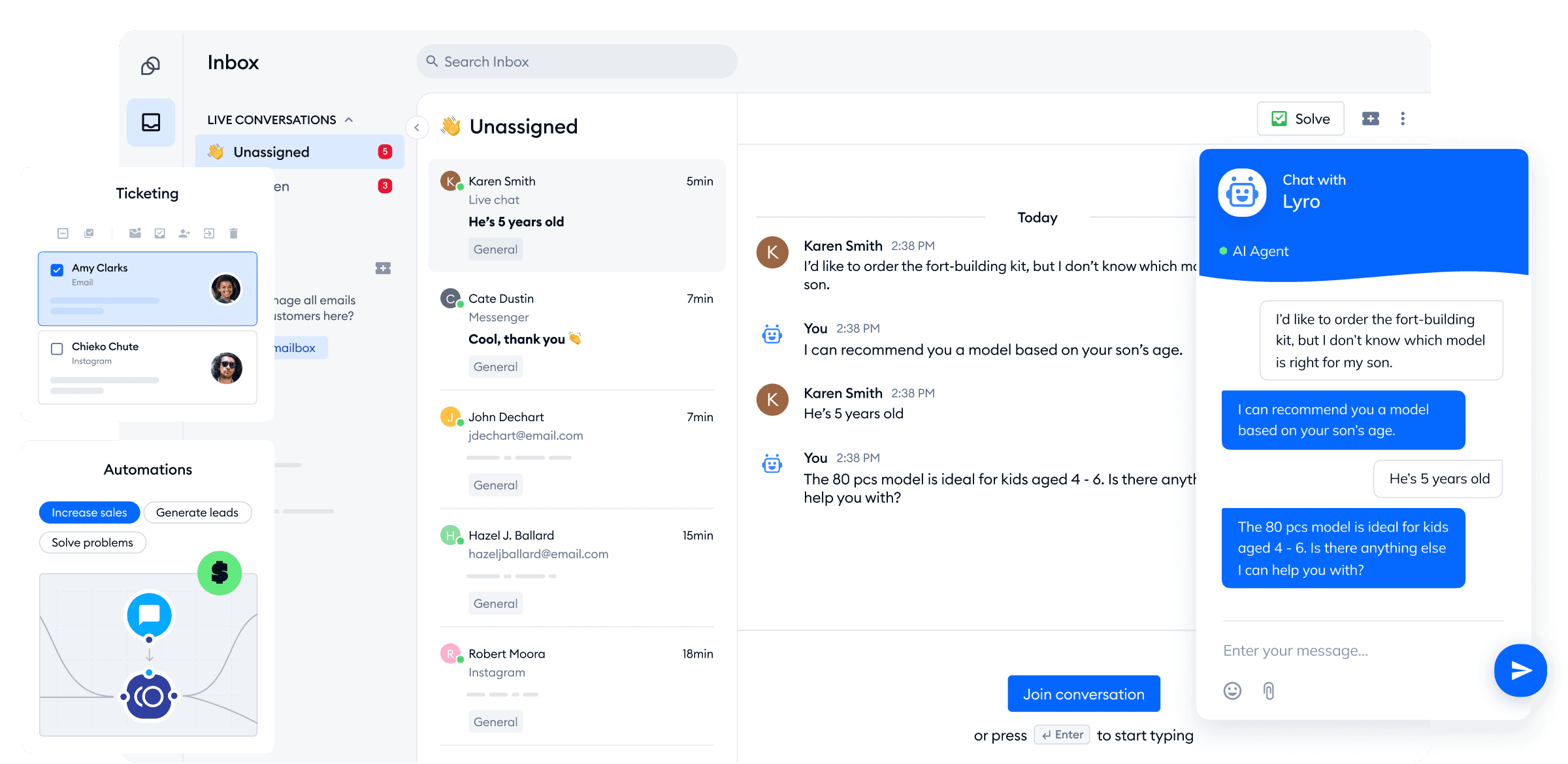
The interface in Tidio is quite straightforward, the chatbot builder is easy to grasp, and most teams can get a working setup live within hours.
It’s genuinely built for speed (like WotNot).
From a functionality standpoint, Tidio covers the basics: live chat, chatbot automation, email integration, and even some AI-driven responses through its Lyro AI. For many SMBs, that’s more than enough.
But this is also where the gap with Intercom becomes clear.
Tidio won’t be able to match Intercom’s depth (like complex automation workflows).
So, if you need a highly customizable, all-in-one customer engagement platform, Intercom still has the edge.
But if your goal is to get up and running quickly and handle conversations efficiently, Tidio often feels like the more practical choice.
Pricing Comparison
This is where Tidio becomes especially compelling. It starts with a minimal plan of $29, and its paid tiers are relatively affordable compared to Intercom.
There’s no per-resolution pricing, which means your costs don’t spike just because your conversations increase.
For startups and small teams, that difference can be huge.
5. YourGPT
YourGPT is an AI-first platform for building and deploying customer support agents across multiple channels without code. It's built around automation, self-learning AI, omnichannel deployment, and integration with business tools like Shopify and Stripe.
Best for: Growing teams that want one AI agent managing support across WhatsApp, Instagram, Slack, Discord, Telegram, email, and web without developers.
User Rating: 4.7/5 (G2)
How is YourGPT Different From Intercom?
At a glance, YourGPT and Intercom seem like direct competitors.
In reality, they're built with very different philosophies.
Intercom is fundamentally a messaging-first platform. It's designed around real-time conversations, live chat, email, and messaging apps. The AI (Fin) layers on top of that foundation to automate responses and escalate when needed.
YourGPT, on the other hand, is automation-first.
And that single difference changes how they work at scale.
Intercom excels at building personalized, real-time customer experiences. Live chat, proactive messaging, human handoff - it's built for sales-led support and fast-moving teams.
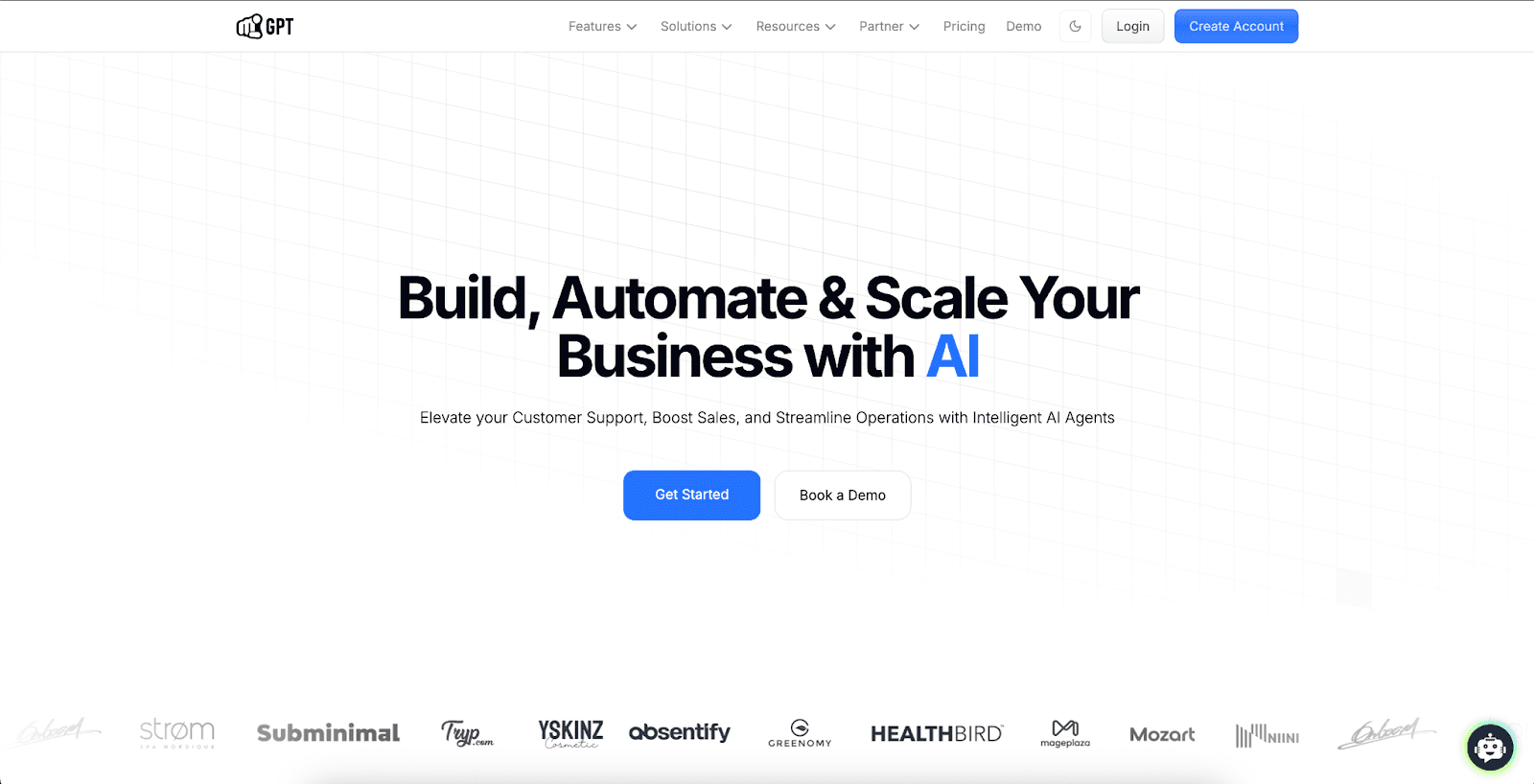
YourGPT is built for teams that deal with high volumes of repetitive questions across multiple channels simultaneously. You need one AI agent handling WhatsApp, Instagram, Slack, and email all at once without rebuilding per platform. YourGPT handles that from day one with self-learning automation.
That's where YourGPT stands out.
Most comparisons focus on features: chat, automation, AI, and voice. Both platforms check those boxes. But when you look at how teams actually operate, especially teams managing customers across many channels, the architectural difference matters.
Intercom charges per-resolution ($0.99/resolution), which means costs scale with volume. YourGPT uses monthly subscription pricing, making it more predictable for high-volume support.
YourGPT is also simpler to set up. No-code builder, instant omnichannel deployment, minimal configuration. Intercom is more feature-rich but requires more upfront setup and customization.
Note: If you need sophisticated live chat features, proactive messaging, or voice AI (Fin Voice), Intercom is the stronger choice. YourGPT focuses on automation efficiency and multi-channel consistency instead.
Pricing Comparison
Both platforms can get expensive (in different ways).
Intercom charges per resolution ($0.99) plus platform fees ($39/seat/month), which compounds quickly at scale.
YourGPT uses fixed monthly subscription pricing ($39–$499/month) with no per-resolution fees. More predictable, but advanced features cost more.
So while Intercom offers more sophisticated conversational AI, YourGPT offers more transparent, predictable pricing for high-volume automation.
Pros:
Self-learning AI improves automatically without manual retraining
True omnichannel automation across 100+ channels from one agent
No-code builder makes setup accessible to non-technical teams
Transparent monthly pricing with no per-resolution fees
Cons:
The knowledge base requires manual updates when information changes
Advanced features like custom branding are only on higher-tier plans
Resolution rate depends on the knowledge base quality and the completeness of initial training
Pricing: Plans start at $39/month (Essential) and scale to $499/month (Advanced). Enterprise custom pricing available.
6. Crisp
Crisp is a customer messaging platform that combines live chat, email, and basic automation into a single, lightweight tool.
Best for: SMBs and growing teams that want an Intercom-like experience without the overhead or cost.
User Rating: 4.5/5 on G2
How is Crisp Better Than Intercom?
A lot of tools try to replace Intercom by doing more. Crisp takes a different approach. It focuses on doing just enough, but doing it well.
And for many teams, that’s exactly what makes it a better fit.
On the surface, Crisp and Intercom look quite similar. Both offer live chat, shared inboxes, automation, and multi-channel messaging. But once you start using them, the difference shows up in how heavy the experience feels.
In Crisp, you get a unified inbox that brings together chat, email, and other channels in one place. The interface is pretty clean, the setup is fast, and most teams can start using it effectively without much onboarding.
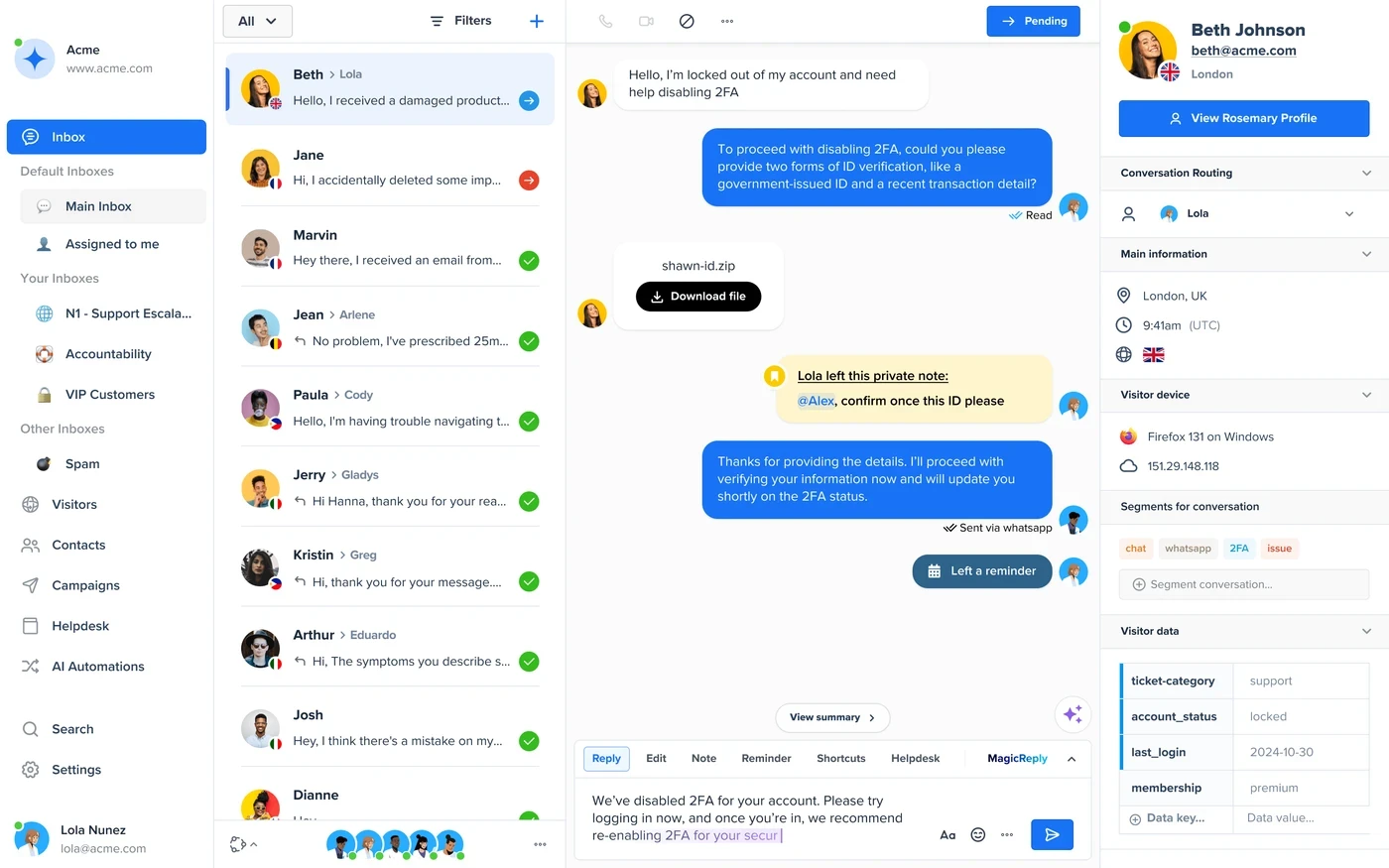
The best part? Crisp has features like co-browsing and session replay.
They are surprisingly useful for support and onboarding. But unlike Intercom, these features feel more accessible and less gated behind higher-tier plans.
But there are a few trade-offs.
First of all, Crisp doesn’t go as deep as Intercom when it comes to advanced segmentation, product tours, or complex automation workflows.
Pricing Comparison
This is where Crisp becomes hard to ignore. In fact, Crisp’s users like its transparent pricing the most.
It has a free plan, and its paid tiers are relatively affordable. Its “Mini” plan starts with $45 per month per workspace, which includes 4 seats.
There’s no per-resolution pricing, and costs don’t spike unnaturally (unlike Intercom).
7. Featurebase
Featurebase is a modern AI customer support platform for product-led SaaS. It combines AI-powered support, help center, and feedback management into a single platform for startups that want all their customer-facing tools in one place.
Best for: Product-led SaaS teams that want AI-powered customer support, feedback collection, and product updates in one platform.
User Rating: 4.7/5 on G2
How is Featurebase Better Than Intercom?
Featurebase stands out for teams that want customer support and product feedback connected from the start.
You can manage live chat and email conversations from one AI-powered inbox. Fibi AI Agent resolves customer issues on autopilot and runs custom actions like trial extensions. AI Copilot helps your agents answer customers faster using your internal knowledge, while the help center provides instant, multilingual self-serve answers.
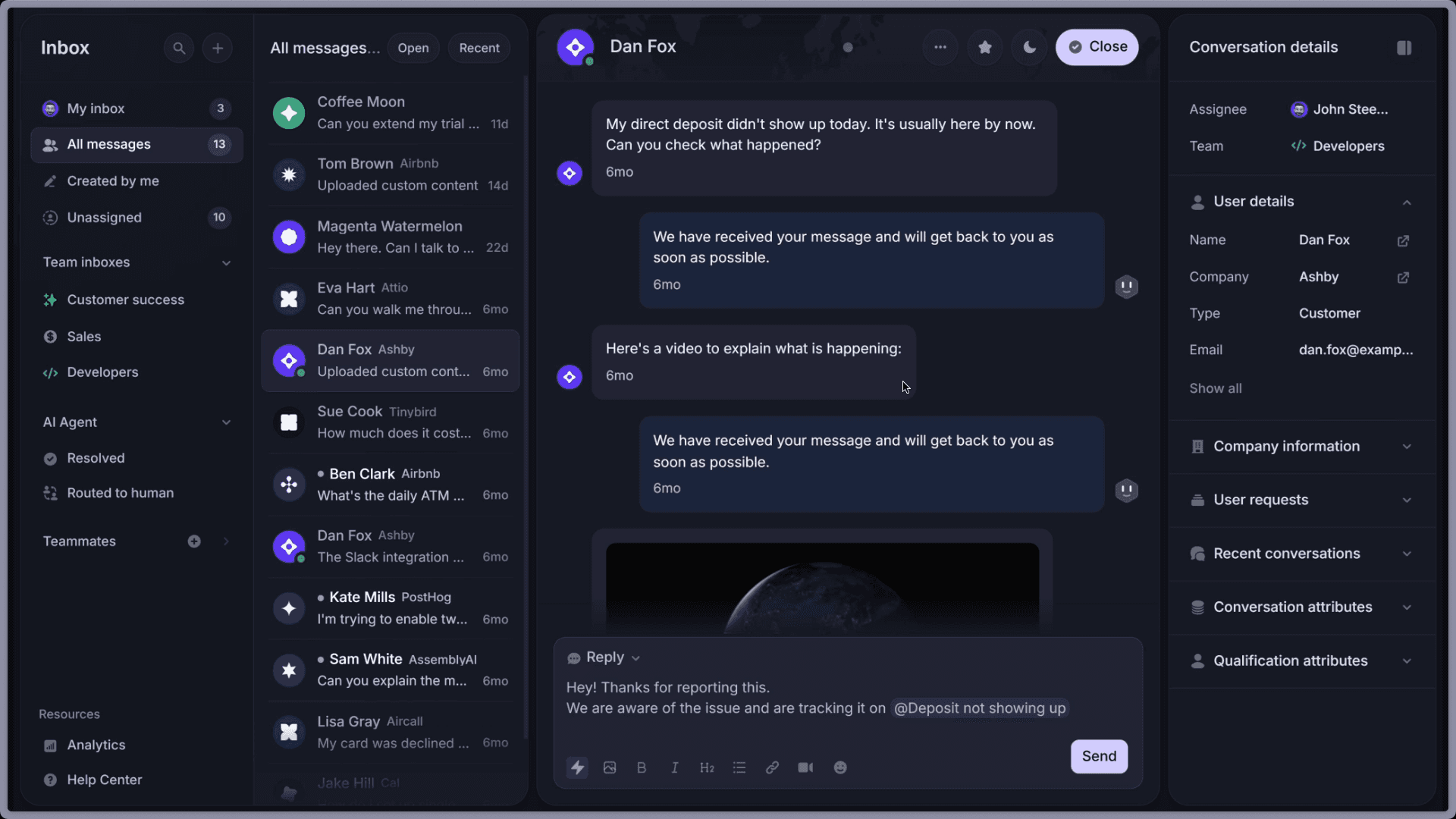
The product tools are what make this especially useful for SaaS teams. Alongside support, you get feedback collection, public roadmaps, and product updates. Customers can submit feature requests, vote on ideas, and receive updates when their requests ship.
Instead of having separate tools for support, feedback, and release notes, Featurebase brings them together to help you build products your users love.
There are plan limits to consider. Workflows, SLAs, and multilingual support require Professional or above, so teams that need those features should compare that tier rather than the starting price.
Pricing Comparison
Featurebase offers a free plan with 1 seat and unlimited conversations. Paid plans start at $29/seat/month, billed yearly, with $0.49 per AI resolution. The free plan doesn’t include AI.
Intercom’s Essential plan also starts at $29/seat/month with annual billing, with Fin priced from $0.99 per outcome. The starting seat price is the same, but Featurebase’s AI usage rate is lower. Each vendor defines its billing unit differently, so total costs depend on usage.
Featurebase also includes AI Copilot on its Growth plan. Intercom charges separately for unlimited Copilot usage. For teams using both AI automation and an agent assistant, those differences are worth including in the comparison.
8. Chatbase
Chatbase is an AI chatbot platform that lets you build custom GPT-powered agents trained on your own data. It is designed primarily for answering queries, automating support, and handling FAQs.
Best for: Teams looking to deploy AI-first support agents quickly, especially for handling repetitive queries and knowledge-based interactions.
User Rating: 4.6/5 on G2 (approx.)
How is Chatbase Better Than Intercom?
Chatbase and Intercom are solving very different problems, but there's an overlap worth discussing (especially around AI).
Intercom's Fin AI is good. But it's a bolt-on feature in a broader platform, and you're paying for all that platform whether you need it or not.
Chatbase is AI-first, AI-only. If all you want is a smart chatbot that can answer questions about your product using your actual documentation, Chatbase does this faster, cheaper, and with less friction than Intercom.
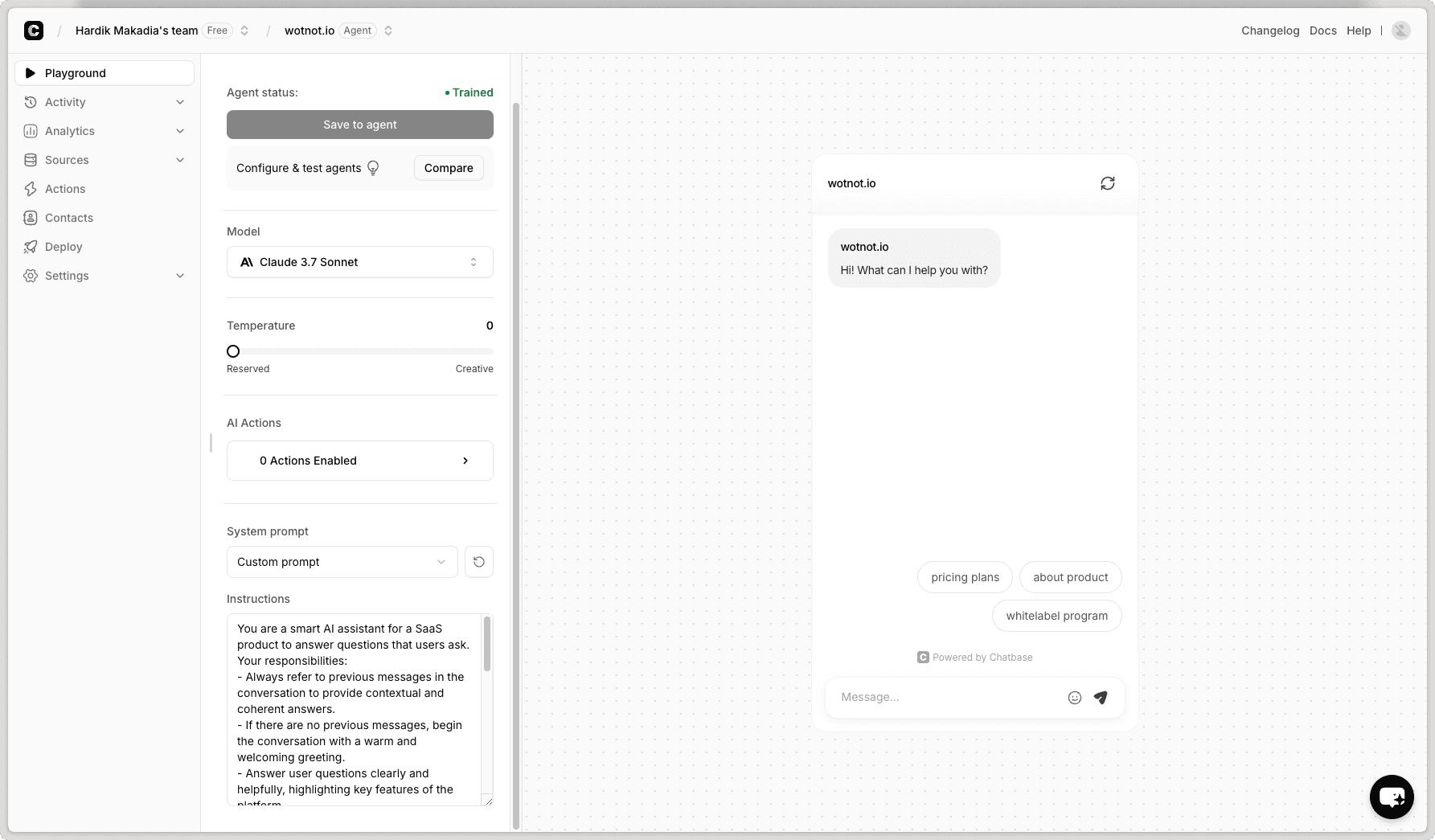
The setup is genuinely impressive. All you need to do is paste your website URL or upload your docs, and the model ingests them. And within minutes, you have a chatbot that answers questions in natural language.
I tested it on a software documentation site, and the accuracy was solid. It pulled from the right sections and gave coherent answers rather than hallucinating.
What Chatbase doesn't have is everything else Intercom does. There's no shared inbox for human agents, no campaigns, no product tours, no CRM. Chatbase is a tool, not a platform.
If you need a bot to handle tier-1 support at scale while your human team focuses on complex issues, Chatbase is excellent.
If you need a full-suite customer communication tool, you'll need to pair it with something else.
Users on G2 and Product Hunt love the ease of setup, but mention that the chatbot can sometimes give confident-sounding but slightly inaccurate answers.
This is a known challenge with LLM-based bots. The newer versions have gotten better, but this is worth monitoring if accuracy is critical for your use case.
Pricing Comparison
Chatbase is priced based on usage metrics like message volume or tokens, depending on the plan.
That means your costs are more directly tied to how much your AI agent is used.
For teams aiming to deflect support volume using AI, this model can be far more efficient.
But if you still need a full support system alongside it, Chatbase works best as a complement rather than a complete replacement.
9. Freshdesk
Freshdesk is a customer support platform by Freshworks that focuses on ticketing, automation, and multi-channel support. It is built to help teams manage and resolve customer queries at scale.
Best for: Growing teams that need structured support workflows and ticketing, without the heaviness of enterprise tools like Zendesk.
User Rating: 4.4/5 on G2
How is Freshdesk Better Than Intercom?
Intercom and Freshdesk solve the same problem – but in very different ways.
Intercom is built around conversations.
Freshdesk is built around resolution.
With Intercom, everything starts as a conversation. Which works well for fast, real-time interactions.
But as the number of queries increases, managing those conversations can start to feel unstructured, especially if you’re dealing with follow-ups, escalations, or cross-team collaboration.
Freshdesk brings structure into that process.
Every query becomes a ticket. It can be assigned, prioritized, tracked, and resolved with clear ownership.
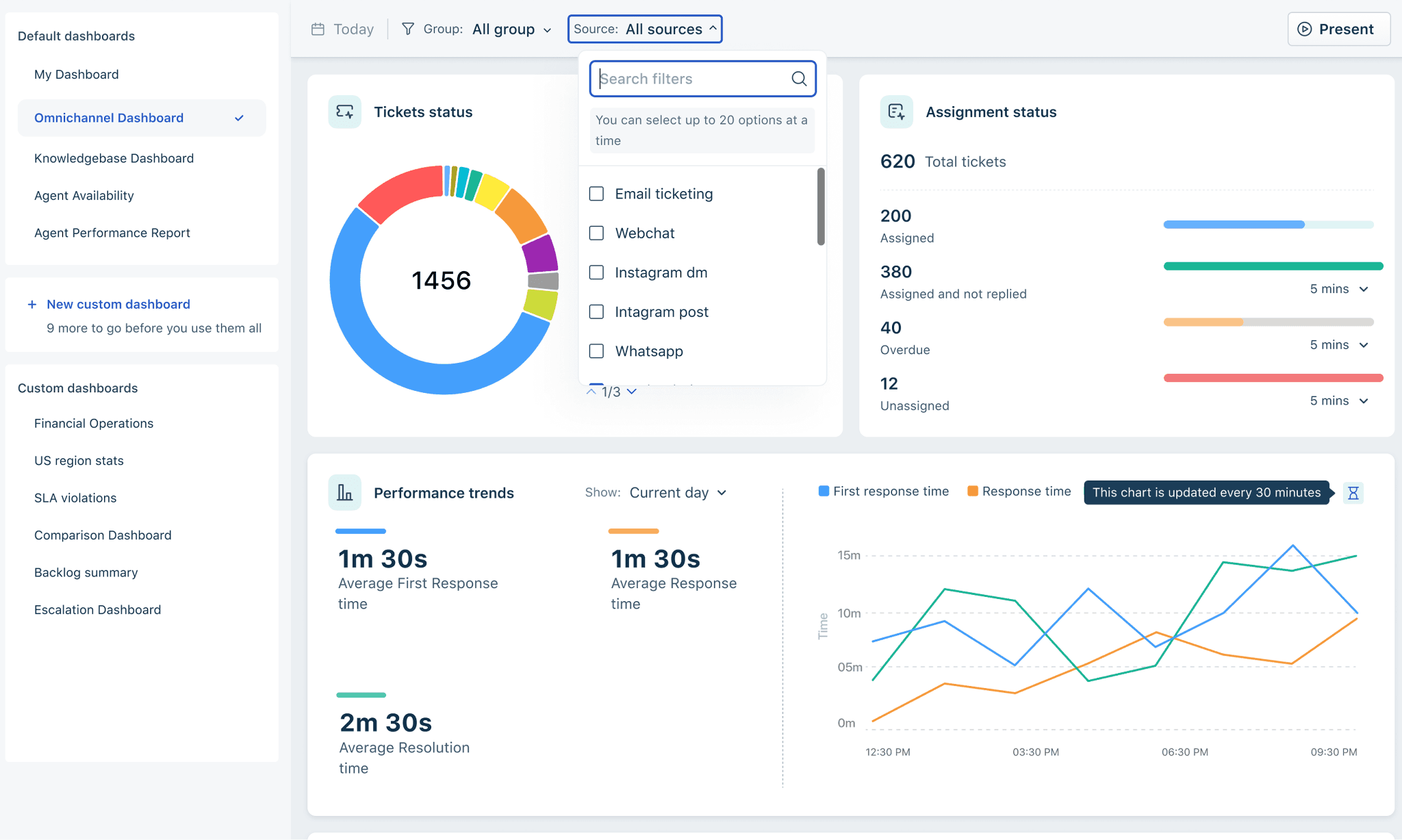
You get SLAs, automation rules, collision detection, and workflows that are designed to keep support operations organized.
That’s where it starts to outperform Intercom.
For teams handling a large volume of support requests across email, chat, phone, and other channels, Freshdesk makes it easier to maintain consistency and accountability. Nothing slips through the cracks because everything is tracked.
At the same time, Freshdesk is more approachable than tools like Zendesk.
The interface is cleaner, the setup is relatively straightforward, and most teams can get up and running without heavy implementation.
It strikes a balance between capability and usability. Which is why it appeals to growing teams that are outgrowing simpler tools but aren’t ready for enterprise-level complexity.
Of course, there are trade-offs.
Freshdesk doesn’t match Intercom when it comes to proactive messaging, product tours, or deeply integrated customer engagement features.
Pricing Comparison
Freshdesk has a traditional pricing model, with per-agent pricing across tiered plans.
This makes costs more predictable, especially for teams with high support volume. Which means you don’t have to pay more just because you’re handling more conversations.
Freshdesk also offers a free plan and relatively affordable entry-level tiers, making it accessible for smaller teams while still providing room to grow.
10. Tawk.to
Tawk.to is a completely free live chat and customer messaging platform that offers chat, ticketing, and basic automation (with no limits on agents or conversations).
Best for: Startups and small businesses that want a zero-cost live chat solution with decent functionality.
User Rating: ~4.5/5 on G2
How is Tawk.to Better Than Intercom?
Let’s be honest. Most comparisons between Tawk.to and Intercom aren’t really fair.
Because they’re not playing the same game.
Intercom is a premium, all-in-one customer engagement platform. Tawk.to is… free.
And that single difference changes how you should evaluate it.
Most tools on this list try to compete with Intercom on features, UX, or automation.
Tawk.to competes on accessibility.
It gives you live chat, ticketing, a knowledge base, and even basic automation — all without charging anything. No per-seat pricing, no usage-based costs, no “upgrade to unlock this” pressure.
That’s what makes it stand out.
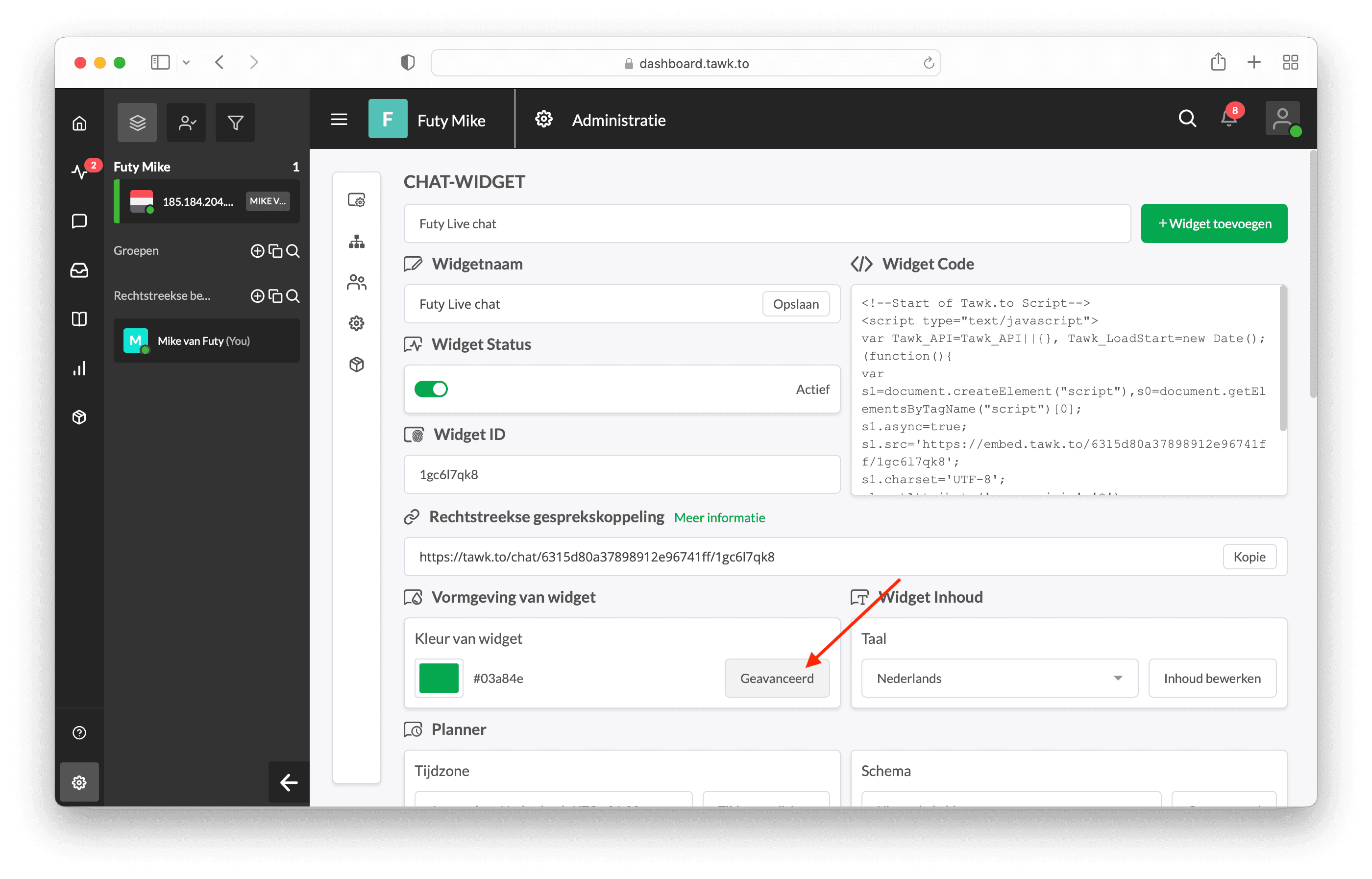
For early-stage teams, the biggest challenge isn’t optimizing support workflows — it’s just having a system in place.
And Tawk.to removes that barrier completely. You can install it, start chatting with users, and manage conversations without worrying about budget.
That’s something Intercom simply doesn’t offer.
But this is also where the trade-offs become obvious.
Tawk.to is not built for depth.
Compared to Intercom, it lacks advanced automation, refined UI, and the kind of ecosystem (campaigns, product tours, deep segmentation) that larger teams rely on.
The product is optimized to deliver maximum value at zero cost, which means compromises show up in areas like advanced customization, mobile experience, and support responsiveness.
So the real comparison isn’t: “Is Tawk.to better than Intercom?”
It’s: “Do you actually need everything Intercom offers right now?”
If the answer is no, Tawk.to often feels like the more practical starting point.
Pricing Comparison
This is where the conversation becomes very simple. Tawk.to is free forever.
No limits on agents, no limits on chats, no hidden usage pricing.
There are paid add-ons (like removing branding or adding AI features), but the core product remains fully usable without spending anything.
For small teams or startups, that’s the best.
But as your needs grow, you’ll likely start feeling the limitations.
And that’s usually the point where teams transition to tools like Intercom or other alternatives on this list.
It’s Like Intercom… But Better?!
Okay, so here's my honest take after going through all of these.
Intercom isn't overpriced because it's greedy. It's priced that way because it genuinely does a lot. Behavioral messaging, in-app product tours, a proper CRM, AI support, and campaigns.
If you're using all of that, the price might actually make sense.
But most companies aren't. Most companies are paying Intercom prices for a live chat widget and some basic automation. And for that use case? There are better options.
Here's how I'd break it down:
AI-first automation with strong Omnichannel suite → WotNot
Enterprise that needs serious ticketing infrastructure → Zendesk
Clean, simple inbox for a small team → Help Scout
E-commerce store on Shopify → Tidio
Bootstrapped startup watching every dollar → Crisp
Just want a smart AI bot trained on your docs → Chatbase
Need a free plan that actually works → Freshdesk
None of these are Intercom. Some are worse in specific areas. But all of them deliver real value, and most at a fraction of the cost.
The right choice depends on your team size, your support workflow, and honestly, your budget.
Take a free trial where available (most of these offer them) and see which one clicks.
FAQs
FAQs
FAQs
Is there a free alternative to Intercom?
Can I switch from Intercom without losing my data?
Which Intercom alternative has the best AI chatbot?
ABOUT AUTHOR
Hardik Makadia
Co-founder & CEO, WotNot
Hardik leads the company with a focus on sales, innovation, and customer-centric solutions. Passionate about problem-solving, he drives business growth by delivering impactful and scalable solutions for clients.

Start building your chatbots today!
Curious to know how WotNot can help you? Let’s talk.
Start building your chatbots today!
Curious to know how WotNot can help you? Let’s talk.