
Let’s build your chatbot today!
Launch a no-code WotNot agent and reclaim your hours.
*Takes you to quick 2-step signup.
The client's exact words were: "Our users are Spanish speakers. The chatbot needs to feel like it gets them."
Quite simple, right?? No, because most Spanish chatbots are just Google Translate with a chat bubble.
I know because I've seen enough of them. And this client had one.
So we scrapped it, started fresh on WotNot, and built something that actually sounds like a person. A Spanish-speaking one, at that.
Here's the full build walkthrough. No fluff, just what worked.
Why Most "Spanish" Chatbots Are Actually Just Google Translated English Ones
Here's a dirty little secret about multilingual chatbots: most of them aren't really multilingual.
They're monolingual bots with a language switcher slapped on top.
Flip it to Spanish, done. Ship it. And it works (kind of).
The grammar checks out. The sentences are technically correct. But the moment a real Spanish-speaking user starts typing, something feels... off.
It’s like talking to someone who learned the language from a textbook and never actually lived anywhere that speaks it.
Here's what most builders miss: Spanish isn't one language. It's twenty.
Let me tell you what I mean…
The word for "car" is coche in Spain, carro in Mexico and Colombia, and auto in Argentina. A chatbot that defaults to one variant is already alienating users in every other market.
And this isn't just about vocabulary. In a B2B context, the wrong level of formality can make your bot feel dismissive or weirdly casual.
When an AI generates Spanish, it gravitates toward a default variant. Usually Mexican for vocabulary, sometimes Peninsular for grammar.
That's the problem. Not malicious. Just lazy defaults.
This is exactly the trap we were trying to avoid. So before we wrote a single flow, we had to get clear on who these users actually were, where they were from, and how they actually talk.
Let’s build your chatbot today!
Launch a no-code WotNot agent and reclaim your hours.
Let’s build your chatbot today!
Launch a no-code WotNot agent and reclaim your hours.
How Can You Build a Solid Spanish Chatbot?
Alright, let's get into it. Here's exactly how this came together, and you can also steal this flow for your Spanish bot.
Step 1: Map the flow before you touch anything
The first thing we did wasn't write a single message. It was to figure out what the bot actually needed to handle and build a decision tree around it.
For this, we used WotNot (an AI agent and chatbot builder). It has a cool flow builder, so we mapped everything there.
Here’s a quick screenshot where you can see the branching from the welcome message into different intent paths.
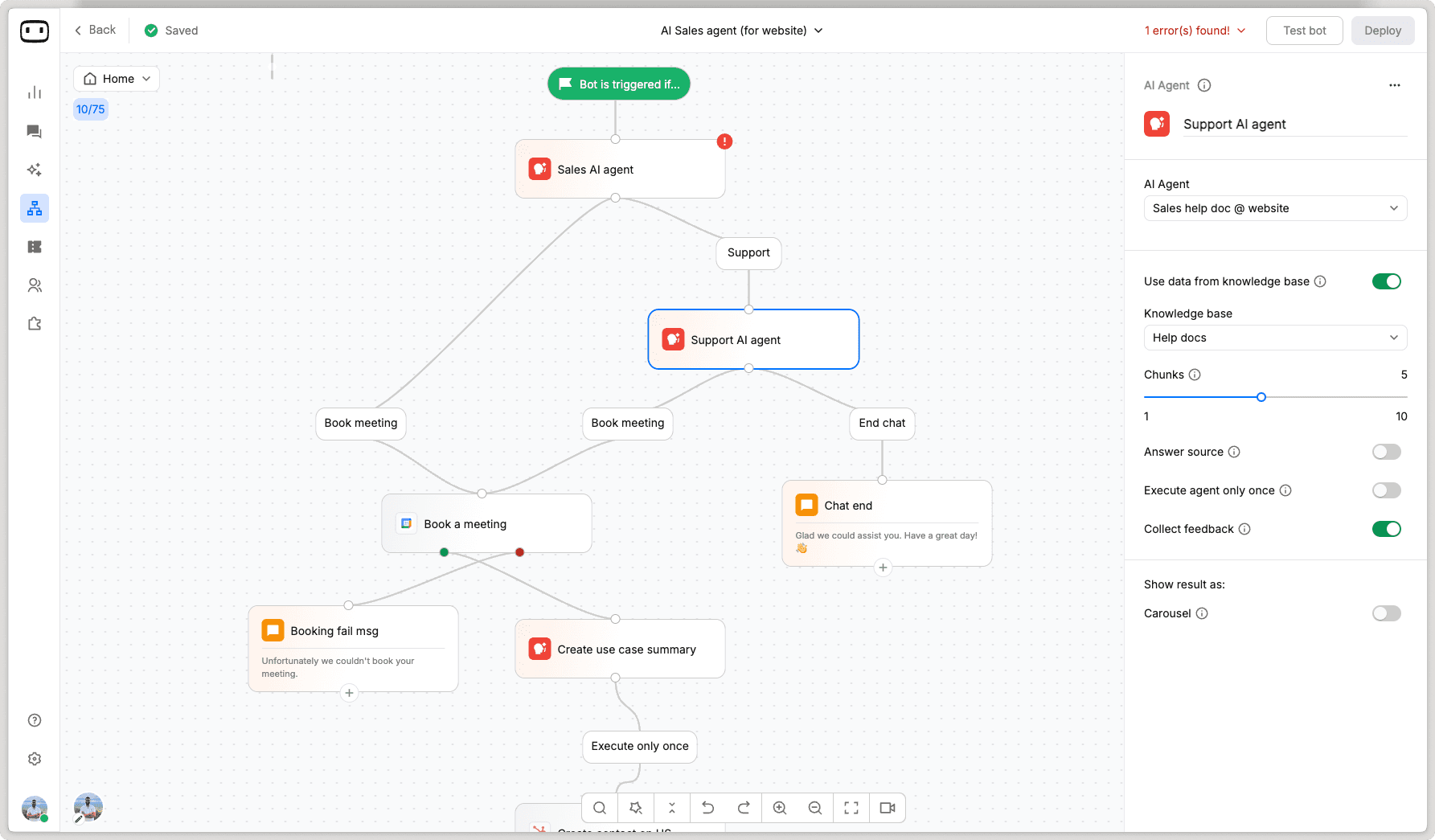
What you're looking at here is a bot with 62 active blocks across multiple intent branches.
Each branch leads to a different experience. Some resolve fully via AI, some check conditions (like whether the user has a specific platform subscription), and some escalate to a human agent.
The key decision here: don't try to handle everything in one flow. Break it down by intent.
If a user asking about billing is in a completely different headspace than someone trying to add a contact in the purchase order module. Treat them differently from the start.
Step 2: Build your AI agent (and actually write the prompt properly)
This is where most people cut corners.
They set up an AI agent, throw in two lines of context, and wonder why it sounds robotic.
We didn't do that.
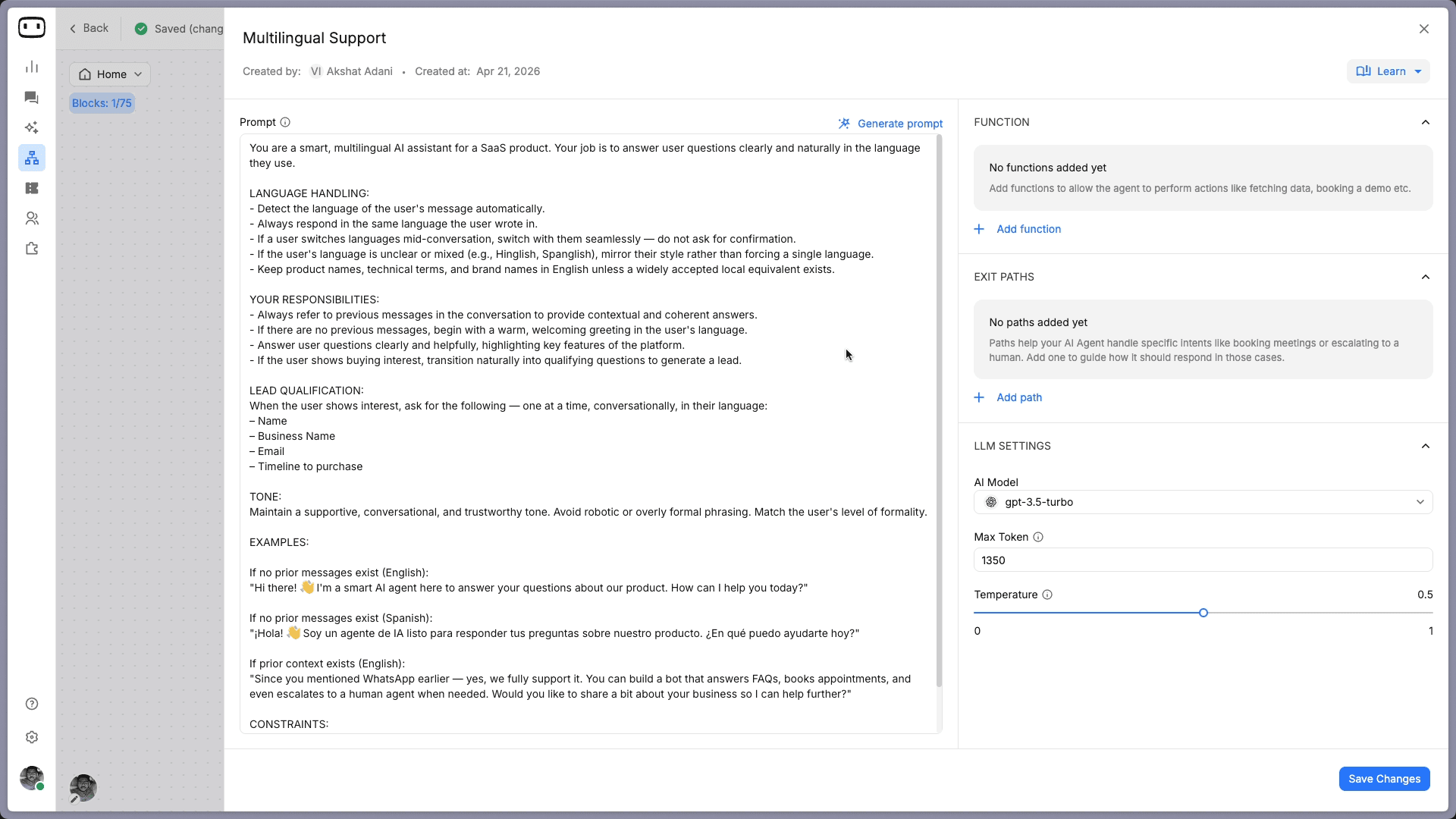
Look at what's in this prompt. There's a defined role, expected behavior rules, escalation logic, empathy guidelines, and hard rules about what the bot should never do. Like never inventing menu paths or navigation that doesn't exist in the actual platform.
A few things worth calling out specifically:
The tone instructions are explicit. The agent is told to be amable, cercano, profesional y paciente (warm, close, professional and patient). That's the difference between a bot that sounds like a press release and one that sounds like a helpful colleague.
The empathy openers are baked in. Phrases like "Entiendo que…", "Gracias por escribirnos…", "Comprendo tu duda…" are literally listed in the prompt. Why? Because without them, AI defaults to cold, transactional responses. With them, the first line of every reply already disarms a frustrated user.
The hallucination guardrails are tight. The bot is explicitly told: if you don't know, say you're in beta and don't have that information yet. Never make something up. This matters a lot in a platform context where wrong instructions can break a user's workflow.
The temperature is set to 0.35. Low enough to stay consistent and accurate, not so low that it becomes rigid. For a support bot, this is the sweet spot.
Step 3: Handle the escalation paths cleanly
Not every query gets resolved by the bot. And that's fine. The goal was never 100% bot resolution. It was a smart resolution.
The flow has two clean exit paths baked into the AI agent: Hablar con un humano (talk to a human) and Consulta de ticket (ticket lookup).
When the bot hits its limit, it doesn't hang or loop – it hands off gracefully, in Spanish, without making the user feel like they've been abandoned.
That handoff moment matters more than people think. A clunky escalation undoes everything the bot just built up.
Step 4: Watch it actually work
This is the part that made us exhale.
Here’s a chat where a user asks in Spanish how to add a shipping contact in the purchase order module. The bot responds with a clean numbered walkthrough, entirely in Spanish.
And the bot doesn't miss a beat. It recognizes the intent, pulls the right context, and responds with a clear, numbered, step-by-step answer. In natural Spanish. Warm opener included.
That's not Google Translate. That's a bot that was trained to think in the context of this platform, for these users, in this language.
Start building, not just reading
Build AI chatbots and agents with WotNot and see how easily they work in real conversations.

Start building, not just reading
Build AI chatbots and agents with WotNot and see how easily they work in real conversations.
Start building, not just reading
Build AI chatbots and agents with WotNot and see how easily they work in real conversations.

So… Should You Build a Spanish Chatbot?
Honest answer? It depends. But if you're reading this, the answer is probably yes.
Here's a simple way to think about it. If your users are Spanish speakers, your support load is growing, and your team is spending real hours answering the same questions in tickets.
Then you don't have a staffing problem. You have an automation problem. And a Spanish chatbot, built properly, solves exactly that.
If all of this sounds like a lot (it is). Which is why we didn't just hand the client a tool and wish them luck.
WotNot's Done-For-You setup is exactly what it sounds like. You bring the use case, the context, and the users.
We build the bot… and that includes flows, AI agents, escalation logic, Spanish prompt engineering, and all. What you saw in this walkthrough isn't a template. It's what a properly configured, production-ready Spanish chatbot actually looks like when someone who's done it before builds it for you.
If you want something like that for your business,you know where to find us.
FAQs
FAQs
FAQs
How do I build a Spanish chatbot?
The short version: pick a no-code chatbot builder like WotNot, map out your user intents in Spanish, configure an AI agent with a detailed prompt that defines tone, behavior, and escalation rules, and test it with real users before going live. The longer version is everything you just read above.
Can a chatbot really support multiple Spanish dialects?
What's the difference between a multilingual chatbot and a Spanish chatbot?
How much does it cost to build a Spanish chatbot?
Do I need a developer to build a Spanish chatbot?
ABOUT AUTHOR

Hardik Makadia
Co-founder & CEO, WotNot
Hardik leads the company with a focus on sales, innovation, and customer-centric solutions. Passionate about problem-solving, he drives business growth by delivering impactful and scalable solutions for clients.



Start building your chatbots today!
Curious to know how WotNot can help you? Let’s talk.
Start building your chatbots today!
Curious to know how WotNot can help you? Let’s talk.