15 min read
AI Voice Agents and What Nobody Tells You Before You Buy One

Hardik Makadia

Let’s build your chatbot today!
Launch a no-code WotNot agent and reclaim your hours.
*Takes you to quick 2-step signup.
Gartner long back had predicted that conversational AI would cut global contact center labor costs by $80 billion in 2026. The same research predicts that over 40% of agentic AI projects will fail because businesses weren’t prepared for the complexity involved.
That gap tells you something important. AI voice agents work. But working and working for your business are two different things.
By the time you finish reading, you'll have a clear, jargon-free understanding of how voice agents actually work and where they break down. You'll know what they really cost, not the headline rate, but the full picture. And you'll have a practical framework for deciding whether your business is ready to deploy one, which type to start with, what compliance obligations apply, and whether to build or buy.
No vendor spin. No top-10 lists. Just the information serious buyers need.
What Is an AI Voice Agent?
Most definitions tell you an AI voice agent is "an intelligent system that uses natural language processing to handle conversations."
That's mostly accurate and almost completely useless.
Here's a more useful definition: an AI voice agent is software that answers your phone, understands what the caller is saying, takes a specific action in response, and speaks back, all in real time, without a human involved.
How does it function on a call?
Picture this: a patient calls a dental clinic at 7 pm to reschedule an appointment. Before the clinic had a voice agent, that call went to voicemail. The patient left a message, maybe waited a day for a callback, maybe called a competitor instead.
With a voice agent handling the call, here's what happens in about three seconds:
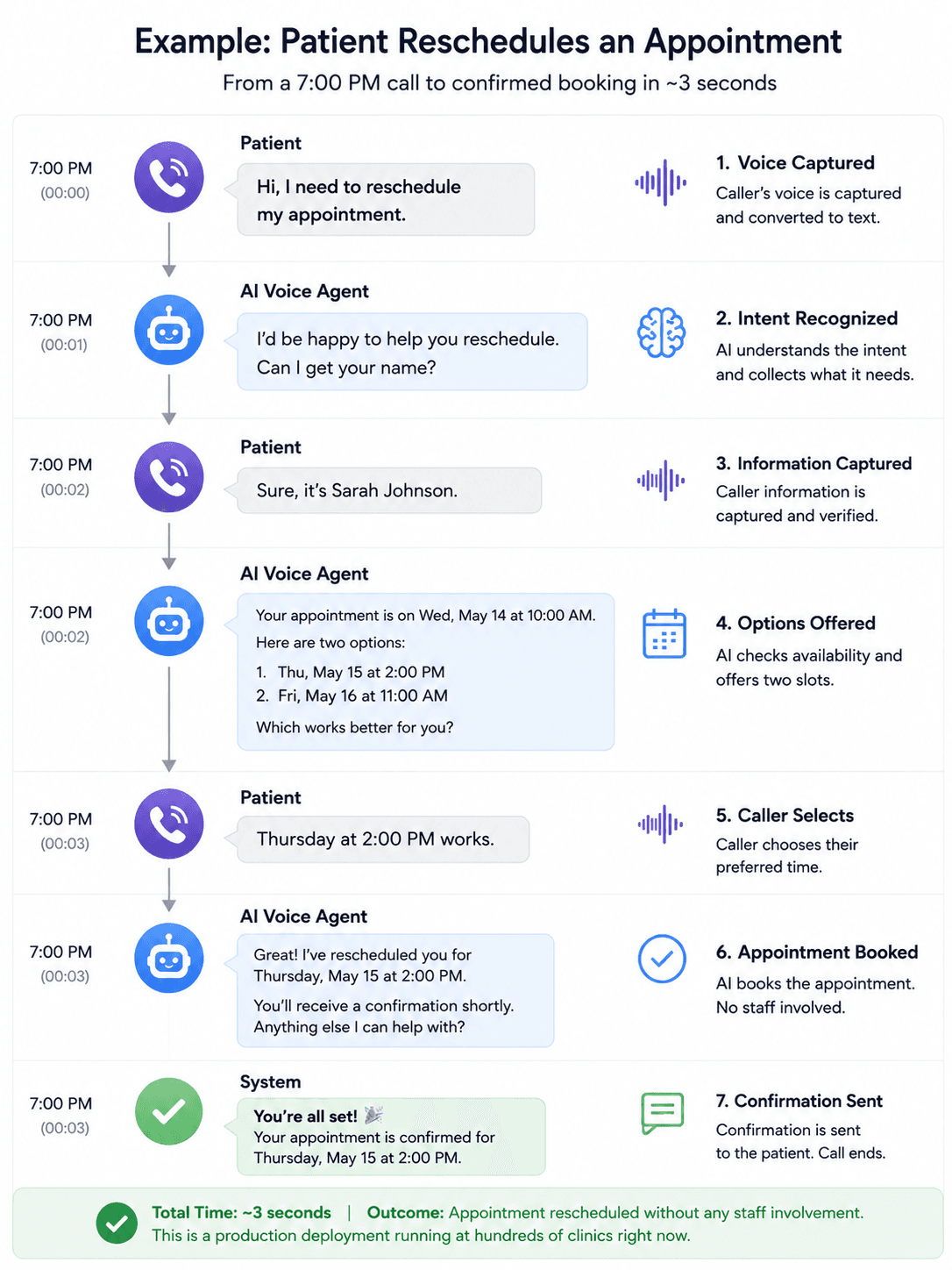
That's not a concept. That's a production deployment running at hundreds of clinics right now.
Let’s build your chatbot today!
Launch a no-code WotNot agent and reclaim your hours.
Let’s build your chatbot today!
Launch a no-code WotNot agent and reclaim your hours.
Types of Voice Agents based on Function
Now, based on what is their function, there are two types of voice agents.
Voice Agents for Inbound Calls:
Inbound agents answer calls coming to you. The caller initiates, consent is simpler, and you already know why people call because you've been answering those calls manually.
Start with inbound if your staff is spending significant time on repetitive calls, or you're missing calls during busy periods or after hours.
Voice Agents for Outbound Calls:
Outbound agents initiate calls like reminders, lead follow-up, payment collection, surveys, etc. The ROI is real, but the preparation requirements are significantly higher.
Add outbound when you have clean consent documentation, a defined use case, and someone monitoring compliance from day one.
Where the Ceiling for AI Voice Agents
AI voice agents are genuinely capable but not infinitely so. In well-configured production deployments, they reliably handle 55–70% of inbound call volume. That includes appointment bookings, FAQ answers, lead qualification, and after-hours coverage.
The remaining part, which includes higher-stakes tasks, needs human intervention. These tasks entail billing disputes, frustrated callers, edge cases, and anything genuinely ambiguous.
That's the current state of the technology, and any vendor who tells you otherwise is overstating things.
Knowing this allows you to design an AI voice agent that works, rather than one that frustrates your customers.
How is AI Voice Agent different from IVR and Chatbot?
IVR (Interactive Voice Response) is a classic menu-driven system that asks callers to "press 1 for sales, press 2 for support". It only allows callers to select from a limited number of options provided by the system.
A chatbot is a text-based system that lives on your website or in a messaging app. It processes written input on a screen. A voice agent processes spoken language in real time, over the phone, with the added complexity of audio quality, tone, accents, background noise, and the human expectation of an immediate response.
They share some underlying technology, but a chatbot and AI agent are fundamentally different.
Comparison: IVR vs. Chatbot vs. AI Voice Agent
IVR | Chatbot | AI Voice Agent | |
Input type | Button presses / single keywords | Typed text | Natural spoken language |
Conversation flexibility | Rigid menu paths | Semi-flexible, text-only | Dynamic, multi-turn dialogue |
Task complexity | Simple routing | FAQs, basic transactions | Booking, qualification, triage, integrations |
Personalization | None | Basic | CRM-connected, context-aware |
Escalation | Menu loop or queue | Human chat handoff | Warm transfer with context |
What Is a Voice Agent Composed Of?
Every AI voice agent runs on four distinct layers of technology. Most business buyers don't know this, and many vendors prefer it that way, because the more complexity they can obscure, the easier it is to sell it.
Understanding these four layers takes about five minutes and will save you significant money and frustration.
The layers of an AI Voice Agent
Speech-to-Text (STT) is the ears. It converts the caller's voice into text that the system can process. The quality of this layer determines whether the AI actually understands what was said, especially with accents, fast speech, or background noise.
The Large Language Model (LLM) is the brain. It reads the text, figures out what the caller wants, and decides what to do next, whether that's checking a calendar, answering a question, or escalating to a human. The LLM is also where the agent's "personality" and conversation logic live.
Example: GPT-4, Claude, Gemini, etc.
Text-to-Speech (TTS) is the voice. It converts the agent's text response back into spoken audio. Modern TTS systems can sound remarkably natural, but quality varies significantly between providers, and a robotic voice is one of the fastest ways to lose caller trust.
Telephony is the phone line itself. It's the infrastructure that connects your phone number to the AI system. This is often where hidden costs accumulate. Every minute of connected call time has a carrier cost, and it's typically billed separately from the AI platform fee.
Orchestration sits atop all the above layers. Its role is to handle the logic that coordinates the handoffs, manages turn-taking, interruptions, and decides when to escalate.
Types of AI Voice Agents Based on Build
Not all voice agents are built the same way. The type you choose determines how fast you go live, how much technical work is involved, and how much control you have.
There are three main types.
1. Custom-Built (Self-Assembled Stack)
You pick and integrate each component yourself, including STT, LLM, TTS, and telephony to build the logic that ties them together. If you're evaluating the TTS layer specifically, these voice generator options can help you compare the different tools available.
Full control over every layer
Requires a dedicated engineering team
8–16 weeks to go live, $30K–$100K+ upfront
You own all maintenance and updates
Examples of tools used: Deepgram or AssemblyAI (STT) + OpenAI or Anthropic (LLM) + ElevenLabs (TTS) + Twilio (telephony), orchestrated via a custom framework.
Best for: Large enterprises with complex, proprietary workflows and a full engineering team to build and maintain the system.
2. No-Code Low-Code Platform (Configure, Don't Build)
The vendor provides the full stack in one place. You set up your agent through a visual interface, no coding required.
Live in days to a few weeks
Non-technical teams can manage it
Less granular control over individual components
Vendor handles infrastructure, updates, and maintenance
Examples: Vapi, Retell AI, Voiceflow, WotNot
Best for: SMBs and mid-market businesses that need to move fast without developer dependency.
Here is a overview of build and deploy an AI voice agent.
3. Fully Managed Service
A third-party team designs, builds, and runs the agent for you. You define what you need, and they handle everything else. These platforms also provide white-label AI voice agents for consistent branding for enterprise users.
No internal technical effort required
Highest cost — typically $100K+/year enterprise contracts
Deployment takes 6–12 weeks due to scoping
Least day-to-day visibility or control
Examples: PolyAI, Replicant, Nuance (Microsoft)
Best for: Large enterprises and regulated industries like healthcare, finance, insurance, that want a proven, fully managed solution with dedicated support.
Which One Fits Your Business?
Custom-Built | No-Code Platform | Managed Service | |
Technical need | High | Low | None |
Time to launch | 8–16 weeks | 1–4 weeks | 6–12 weeks |
Cost | $30K–$100K+ upfront | Low subscription | $100K+/year |
Control | Full | Platform-defined | Vendor-led |
Best for | Engineering teams | SMBs, non-technical teams | Enterprise, regulated industries |
For most businesses evaluating voice agents for the first time, the no-code platform is the right starting point. Fastest to deploy, lowest barrier to iterate, and no engineering team required.
Start building, not just reading
Build AI chatbots and agents with WotNot and see how easily they work in real conversations.

Start building, not just reading
Build AI chatbots and agents with WotNot and see how easily they work in real conversations.
Start building, not just reading
Build AI chatbots and agents with WotNot and see how easily they work in real conversations.

Why do Multi-Stack AI Voice Models Fail?
Many businesses assemble this tech stack from different vendors.
On paper, this gives you the best tool for each job!
In practice, each individual layer has its own failure modes. The multi-vendor model adds a compounding effect on the risk involved for each tool in the stack.
The accountability gap
When the system breaks, there is an equal probability of any of the tools in the stack being at fault. Each support team runs checks and declares that their layer is not the one malfunctioning. You’re the one still left with the problem.
This is the default experience for most businesses running multi-vendor voice stacks in production.
The latency problem
Latency is the gap between when a caller finishes speaking and when the agent responds. In text, a two-second delay is barely noticeable. In a phone conversation, it feels like the line went dead.
Latency accumulates across every layer, STT processing time, LLM inference, TTS rendering, and network round-trip all add up.
Costs calculation complexity
Each vendor charges separately. The base price looks manageable until you add token usage, call volume, API calls, and overage fees across four different billing models. Costs that looked predictable in the demo room routinely run two to three times the projection once the system is in production at scale.
Technical Dependency
A multi-platform stack is not something a single person can manage and operate. Every integration needs to be built, monitored, and updated by someone technical.
When one of the tools gets an update, someone has to check if it broke the connection downstream. And for all of this, you need a whole team of developers who would look after the whole system.
Data compliance complication
Customer conversations and data span multiple platforms, which can create compliance incompatibilities. Each has its own data-handling policies, and in regulated industries, this creates a real problem.
You need data processing agreements with every vendor, and you need to verify that each one meets the compliance standard your business is held to.
What AI Voice Agents Actually Cost (The Full Picture)
The number vendors advertise is almost never what you'll actually pay. Most platforms advertise a per-minute rate fall somewhere around $0.05, $0.07, or $0.10, which covers only their orchestration layer. The real cost is the sum of four separate layers, each billed independently.
The operational costs that never appear on any pricing page:
Prompt engineering time
QA overhead
Integration development
The cost of bad calls
Gartner research identifies cost underestimation as a leading reason that AI projects get cancelled before they deliver value. The businesses that succeed are the ones that budget for the full picture from day one.
Pricing models that fit your situation
Pay-as-you-go (per-minute): Best for businesses with unpredictable or low call volumes. You pay only for what you use, and costs are predictable per call, but they can spike for larger volumes.
For example: A small dental clinic or an art studio.Subscription tiers: Best for predictable, mid-volume usage. You commit to a monthly volume and get a lower per-minute rate. The risk is over-committing and paying for minutes you don't use.
For example: An ecommerce brand handling hundreds of calls.Enterprise custom pricing: Best for high-volume deployments. You negotiate rates based on committed volume. These deals usually include dedicated infrastructure, HIPAA/GDPR compliance support, and account management — but also require more time to set up.
For example: An insurance company handling calls in bulk, managing claims, policy inquiries, and customer support across multiple regions.
Industries Where AI Voice Agents Are Delivering Real Results
Here's what a working deployment actually looks like across five industries and whether inbound, outbound, or both are driving the results.
Healthcare and Dental
The most successful early vertical for AI agents is the healthcare industry. Call types are predictable, volume is high, and the cost of a missed call is measurable. Voice agents handle appointment booking, rescheduling, cancellations, and after-hours coverage, all for recovering calls that previously went to voicemail.
Real Estate
Brokerages receive high volumes of inbound calls from prospects at very different stages of intent. A voice agent handles the initial qualification — budget, timeline, property type, and routes only serious leads to a human agent, cutting time wasted on unqualified calls.
Home Services
HVAC companies, plumbers, and electricians lose revenue to missed after-hours calls. A caller who can't reach anyone at 8pm calls the next result on Google. A voice agent answers, captures the job details, and books the next available slot — even when no technician is available.
Restaurants and Hospitality
Restaurants miss 30–40% of calls during peak service hours. A voice agent handles reservations, location and hours queries, and private event inquiries without pulling staff away from the floor.
B2B SaaS and Professional Services
63% of companies never respond to inbound leads at all. A voice agent that answers a demo request call, qualifies the prospect in three questions, and books a slot on the rep's calendar before a human has even seen the notification has an immediate impact on the pipeline.
Is Your Business Ready for an AI Voice Agent?
Taking a demo is not the same as being ready to deploy.
Hopping on the AI agent bandwagon has become very easy due to the accessibility of the tech out there. However, if you’re actually overreaching and don’t necessarily need the AI voice automation, it’ll end up wasting your resources and bleeding money.
Some of the businesses have learned this the hard way. A survey by HubSpot says that 80% of the businesses being surveyed said they used voice agents, but only 21% of them were satisfied with them.
We don’t want that happening to you.
The Prerequisites for an AI Voice Agent
Professionals who've run dozens of voice agent deployments consistently point to these factors as a litmus test to tell if you are ready for an AI voice agent.
1. Defined, repeatable call types: If your business receives predictable call patterns like bookings, FAQs, or scheduling requests, a voice agent can handle them effectively.
2. A working CRM or booking system: Data readiness is the most commonly underestimated requirement. Voice agents need clean, connected, interoperable systems to read from and update in real time.
3. A clear escalation path: Every voice agent needs a plan for when it can't handle a call. You need a seamless process for transferring complex or unresolved calls to a human.
4. Someone who owns it: A voice agent isn't a set-it-and-forget-it tool. Someone needs to review call transcripts, catch failures, and iterate on the conversation flow. Without a named internal owner, even a well-configured agent degrades over time.
5. You have a considerable call volume: A business receiving fewer than 20–30 calls per day is unlikely to see meaningful ROI from deploying an AI voice agent. The setup, integration, and maintenance require a fixed cost, which won't make sense with such low call numbers. The sweet spot for first deployments is businesses handling 50 or more calls per day in repeatable categories.
A16z's research identified a pattern in successful deployments: companies start with one narrow, high-volume, low-complexity use case and nail it before expanding. The logic is simple: a focused agent is easier to configure, easier to test, faster to iterate on, and faster to prove ROI. Once it's working, you expand.
Here is a short, easy questionnaire to help you assess whether you are ready for the successful deployment of an AI voice agent.
|
The Compliance Checklist Before You Go Live
Most buyers skip compliance until they get a complaint. Here's what applies to your deployment and what you need to verify before the agent goes live.
Before your voice agent handles a single live call, confirm all eight of these:
AI disclosure language is scripted into the agent's opening line
Consent documentation exists for every contact in your outbound list
Your vendor has confirmed their data storage region in writing
If you're in healthcare, a Business Associate Agreement (BAA) is signed
Call recording notification is configured per local law (one-party vs. two-party consent states)
Opt-out handling is built into every outbound campaign flow
PII redaction is enabled in transcripts and logs
Your vendor's compliance certifications (SOC 2 Type II, GDPR DPA, HIPAA BAA) have been reviewed and documented
PII leaks in AI voice agent logs are not edge cases. They happen regularly in production, often through third-party analytics integrations that weren't scoped to handle sensitive data. Automated transcript scanning for sensitive information before it reaches your dashboards is not optional but a production necessity.
Build vs. Buy: The Honest Breakdown
This is the question most articles try to answer with a diplomatic "it depends." Here's a less diplomatic answer: for most businesses reading this, buying a platform is the right choice.
Build vs. Buy comparison
Custom Build | No-Code Platform | |
Time to launch | 8–16 weeks | 2–4 weeks |
Upfront cost | $30K–$100K+ | $0–$2K setup |
Ongoing cost | $2K–$10K/month | $100–$2K/month |
Customization depth | Unlimited | Platform-defined |
Maintenance | Your team | Platform handles |
Data ownership | Full | Vendor-held (with DPA) |
Best for | Enterprise, complex workflows | SMB, mid-market, speed |
Conclusion
AI voice agents are past the hype stage. The businesses deploying them successfully have a few things in common: they started with a narrow, well-defined use case. A simpler agent in a well-prepared business will outperform a sophisticated agent in an unprepared one, almost every time.
Businesses that had successful deployments that were data-ready with defined workflows, working CRM, and clear escalation paths in place before they moved ahead with the AI voice agents.
The voice AI market is moving fast, with the gap between what an AI can handle and what requires a human narrowing every quarter.
If you're evaluating AI voice agents for your business, WotNot's voice agent builder gives you no-code conversation design. It’s a pre-built unified platform that handles all the voice agent layers without requiring you to manage five separate vendor relationships. You can get your first agent live without a developer and without a six-figure build cost.
FAQs
FAQs
FAQs
What is an AI voice agent and how is it different from a regular chatbot?
Can an AI voice agent handle calls in multiple languages?
Do I need a developer to build and maintain an AI voice agent, or can a non-technical team run it?
What happens when the AI voice agent can't answer a question how does it hand off to a human?
How long does it take to set up and deploy an AI voice agent?
ABOUT AUTHOR
Hardik Makadia
Co-founder & CEO, WotNot
Hardik leads the company with a focus on sales, innovation, and customer-centric solutions. Passionate about problem-solving, he drives business growth by delivering impactful and scalable solutions for clients.

Start building your chatbots today!
Curious to know how WotNot can help you? Let’s talk.
Start building your chatbots today!
Curious to know how WotNot can help you? Let’s talk.