
Let’s build your chatbot today!
Launch a no-code WotNot agent and reclaim your hours.
*Takes you to quick 2-step signup.
It used to be so simple to pick a chatbot development framework.
You'd Google it, find the same four names. Read a blog written in 2021, and go with your gut.
That worked fine... until LLMs showed up and flipped the entire dynamics.
Now the NLP-heavy approach feels a bit… old-ish.
So here's what I did. I went through like 10 frameworks that are worth trying.
And out of those, I’ve cherry-picked 4 based on their practical usage.
I’ve tested them thoroughly, talked with devs who’ve actually used them, and shared unbiased thoughts on them in this blog.
Let's get into it.
What Are Chatbot Development Frameworks & What’s Changed in 2026?
The Chatbot development framework is like an infrastructure underneath your chatbot. It handles these things,
Your core NLP
Intent recognition
Dialogue management
Channel deployment
Integrations with your existing tools.
Without a framework, you'll have to build all of that from scratch. And no one wants to do that.
But what exactly changed in 2026?
Simple answer: LLMs are now smarter, and businesses are actually using them to automate everything possible.
So… till now, frameworks were rule-based or NLP-first. It worked, but it was rigid. And it was also tough to handle edge cases.
Now, modern frameworks are more into reasoning and context awareness.
Plus, it has laid the foundation for some standard expectations that make developing a chatbot easier. (I’ve listed them below)
Retrieval Augmented Generation (RAG) is now the baseline. Chatbots retrieve from your own knowledge base before generating a response.
Guardrails and hallucination control are non-negotiable, especially for anything customer-facing.
Graph-based agent orchestration is replacing linear flows. Bots can now loop, retry, and run tasks in parallel instead of following rigid A→B trees.
Bots are becoming proactive. For example, it can auto-detect a shipment delay and share an update before the customer even asks
Businesses want more control and observability. This includes stuff like logging, auditability, and role-based access.
That's the context you need before picking one.
You can also check out these chatbot ideas to see how businesses are improving their chatbots.
Let’s build your chatbot today!
Launch a no-code WotNot agent and reclaim your hours.
Let’s build your chatbot today!
Launch a no-code WotNot agent and reclaim your hours.
4 Chatbot Development Frameworks Worth Your Time
Alright, this is where you decide which framework is best for your use case as well as team.
For that, I have kept typical frameworks (like Rasa or Botpress) and cloud platforms, as well as low-code builders.
This will help you decide.
1. Rasa
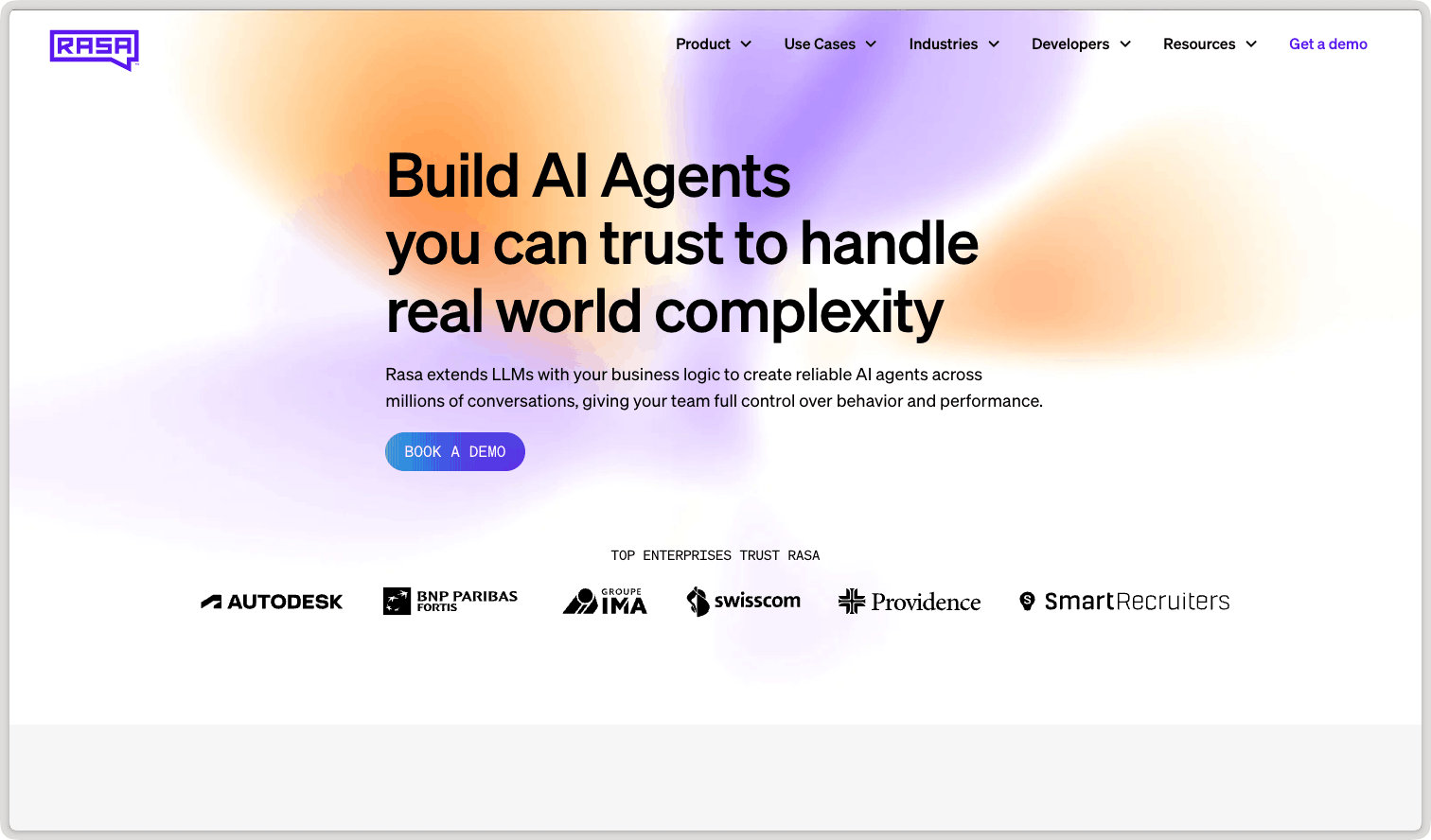
Best for: Teams that need full data ownership, complex conversation logic, and don't mind getting their hands dirty.
If there's one framework that's earned its reputation the hard way, it's Rasa.
This is the one developers reach for when they absolutely cannot let their data sit on someone else's cloud.
And the industries that rely most on Rasa are healthcare, finance, and anything where compliance is non-negotiable.
Building with Rasa feels like having complete control over every dial and switch in the room. Why? Because you're not working around someone else's opinionated system.
You can freely define the NLP pipeline, you manage the dialogue logic, and you own infrastructure. That kind of freedom is rare.
The big shift in recent Rasa is CALM (Conversational AI with Language Models). The old Rasa had you writing out story paths and training intents by hand, which honestly got exhausting fast.
CALM changes that. The LLM handles understanding what the user means, while your defined flows enforce the business logic. So you get the flexibility of generative AI without handing control entirely to the model. That balance is genuinely useful in production.
That said, this isn't something you spin up over a weekend. Rasa demands a team that knows what it's doing.
You will need ML engineers, infra management, and ongoing model maintenance.
Technically, Rasa is free to use for small teams and devs who want to test before scaling.
But there is also a Growth Plan that starts at $35,000/year, which already tells you who this is really built for. If your team is small or your timelines are tight, Rasa will likely feel like more framework than you need.
But if you're building something where data sovereignty and customization depth are actual requirements? Rasa is hard to beat.
Strengths | Limitations |
Complete data ownership. Runs fully on your infra | High setup and maintenance overhead |
CALM engine balances LLM flexibility with strict business logic | Steep learning curve for new teams |
Highly customizable NLP pipeline | Requires ML/infra expertise to manage |
Strong fit for regulated industries (healthcare, finance) | Enterprise pricing starts at $35K/year |
Active open-source community | No managed hosting on the free tier |
2. Dialogflow
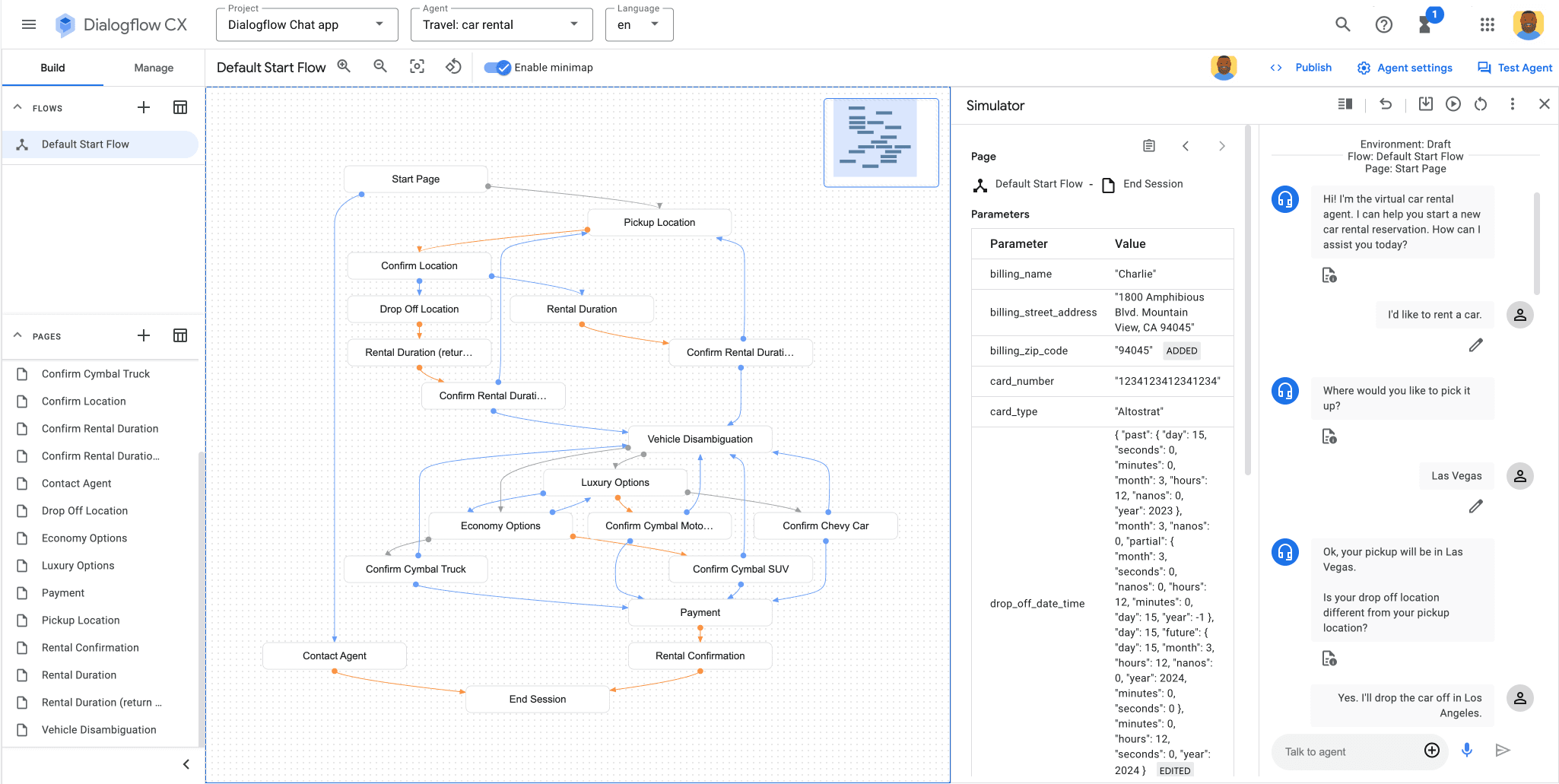
Best for: Teams already in the Google ecosystem who want solid NLP without building from scratch.
Dialogflow is kind of like the sensible choice. It's not the flashiest framework on this list, but Google has put serious muscle into its NLP layer.
Intent recognition is accurate
Multilingual support is genuinely broad (95+ languages in ES, 25+ in CX)
And if your stack is already Google Cloud, the integrations practically wire themselves.
There are two versions worth knowing about.
Dialogflow ES is the simpler one. It is good for straightforward bots and is fast to set up.
Plus, it is free for most use cases.
Dialogflow CX is the heavier-duty version built for enterprise-grade conversations with complex branching, proper flow management, and versioning.
CX is where you'll spend most of your time if you're building something serious.
The newer addition is Playbooks. It is Dialogflow CX's answer to the LLM shift.
Playbooks let you define how the bot should behave in specific situations using Gemini under the hood.
And they can dynamically generate responses, call APIs, and adjust based on conversation context. It's a solid hybrid approach in my opinion.
But but but… It’s not all flowers and rainbows.
Dialogflow can frustrate you when you push beyond the basics.
That’s because managing complex flows isn't particularly visual or intuitive, especially in CX.
For example, if you want to store user data, you will have to write custom integrations.
Pricing is per-message and can spike unpredictably during busy periods. And if you're not in the Google ecosystem, that tight integration advantage disappears pretty quickly.
It's a framework that rewards teams who play within its guardrails. When you try to bend it too far, you start wishing you'd picked something else. Plus, it is best if you want to build a multilingual chatbot.
Strengths | Limitations |
Best-in-class NLP powered by Google's AI | Steep learning curve for Dialogflow CX |
Playbooks + Gemini 2 for hybrid generative flows | Complex user data requires custom integrations |
Broad multilingual support (95+ languages in ES) | Per-message pricing can get unpredictable |
Deep Google Cloud and Workspace integration | Less flexibility outside the Google ecosystem |
Free tier is genuinely usable for small projects | Advanced features still require developer heavy-lifting |
Start building, not just reading
Build AI chatbots and agents with WotNot and see how easily they work in real conversations.

Start building, not just reading
Build AI chatbots and agents with WotNot and see how easily they work in real conversations.
Start building, not just reading
Build AI chatbots and agents with WotNot and see how easily they work in real conversations.

3. Azure AI Bot Service
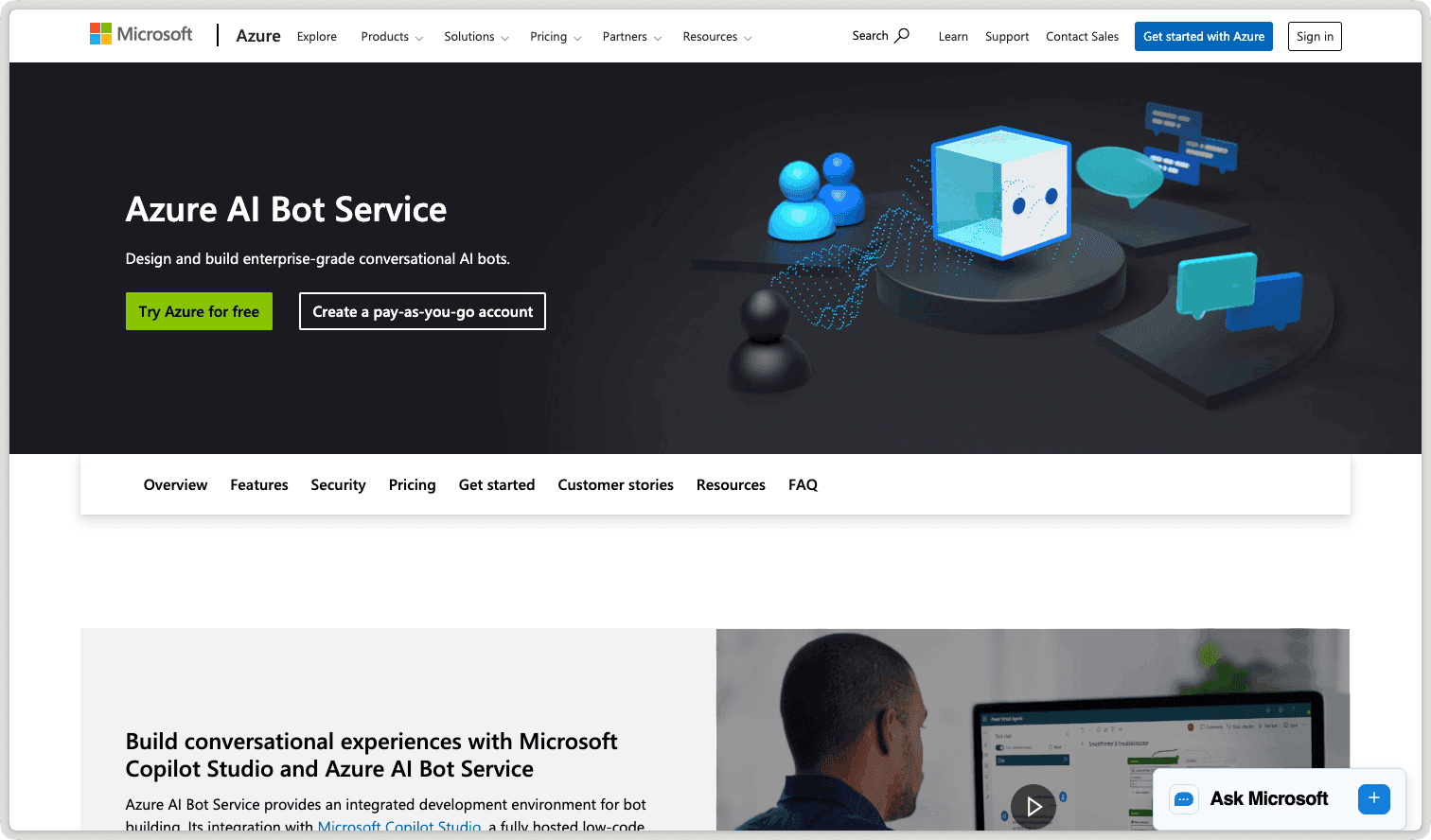
Best for: Enterprises that are already deep in the Microsoft stack and use Teams, Azure, Office 365, the whole thing.
Here's my honest thoughts on Azure AI Bot Service.
The main reason anyone would pick this framework is because they’re already living in the Microsoft ecosystem. Plus, the integration advantages are just too good to ignore.
You can literally build a bot that natively lives inside Teams, connects to Azure Cognitive Services, and pulls from SharePoint knowledge bases.
That whole experience is genuinely smooth in a way that other frameworks can't replicate.
Microsoft also gives you a few ways to build. The Bot Framework SDK is the full code-level approach. But it is development-heavy.
The best part is that the Bot Framework Composer adds a visual layer on top. And Copilot Studio is the low-code option for teams that want to move fast without writing everything from scratch.
The tradeoff is that you're dealing with Azure's complexity. Every piece is available and solid, but wiring them together takes real developer time.
Note: The learning curve is steep, and pricing across multiple Azure services can get difficult to predict.
If you're an enterprise with a team that already knows Azure, this is probably your path of least resistance. If you're not? The setup cost is significant.
Strengths | Limitations |
Unmatched integration with Microsoft Teams and Azure ecosystem | Complex + multi-service setup. |
Enterprise-grade security, compliance, and data residency controls | Requires dedicated Azure expertise |
Multi-channel deployment through a single bot implementation | Pricing across multiple Azure services is hard to predict |
Flexible build options (SDK, Composer, Copilot Studio) | LUIS language analysis has been flagged for occasional inaccuracies |
Strong fit for regulated industries with existing Microsoft infra | Heavy for teams outside the Microsoft ecosystem |
4. Botpress

Best for: Developer teams who want LLM-native architecture with visual tooling.
Botpress is the most interesting framework on this list right now.
It started as an open-source chatbot builder and has since repositioned itself as an LLM-native agent platform. And that pivot has genuinely worked.
What makes Botpress stand out is the Autonomous Node.
Basically, you can hand certain decisions entirely to the LLM. This lets it decide when to pull from the knowledge base, when to make an API call, and when to escalate.
Pair that with the visual flow builder for the structured parts of your conversation, and you get a genuinely hybrid system.
The platform is also LLM-agnostic. Which matters more than people initially realize.
You can swap between OpenAI, Claude, Gemini, or open-source models depending on cost, performance, or compliance needs. That kind of portability is a real advantage if you want to build an LLM-powered chatbot.
Where Botpress gets complicated is cost.
The platform itself has tiered pricing starting free, but LLM usage is billed separately at provider rates, and channel connections (WhatsApp, SMS, voice) add another bill on top.
For small teams that run high-volume bots, the total can creep up fast.
The documentation is solid for basic flows but gets thin as you move into advanced territory, and the learning curve is real.
That said, Botpress raised a $25M Series B in 2025 with HubSpot and Deloitte participating. So… the investment in the platform is clearly not slowing down.
Strengths | Limitations |
LLM-native architecture with hybrid flow + autonomous node design | Learning curve, especially for advanced use cases |
LLM-agnostic — swap models without rebuilding | Total costs can be unpredictable (platform + LLM + channel fees) |
Visual studio + code-level control in the same platform | Documentation gaps for complex implementations |
Open-source core — self-hostable for data-sensitive teams | Knowledge base syncing often requires manual updates |
100+ integrations, strong community, active development | Not the right fit for teams wanting plug-and-play simplicity |
Want a Less Development-Heavy Framework?
So… here’s a reality check.
Chatbot development frameworks are powerful. But you need to invest your resources in artificial intelligence course to build a decent chatbot.
That includes dev hours, infra setup, LLM tuning, and ongoing maintenance.
That's fine if deep customization and data sovereignty are hard requirements.
But a lot of teams don't actually need that level of complexity.
They need something that deploys fast and gives them control over how the LLM behaves.
That's where a modern low-code chatbot builder makes more sense.
And WotNot sits in that space (it's a hybrid platform). You get:
A visual flow builder where you can actually control how the LLM behaves, set guardrails, define what it can and can't say.
It also has an AI Studio where you can train the bot on your own knowledge base and from examples.
So it's not just a drag-and-drop toy. You're getting real NLP control without having to manage the underlying infrastructure yourself.
Weighing a code framework against a no-code path? Get a real cost comparison for the chatbot here before you decide.
You can take a quick product demo to see how it can fit your use case.
FAQs
FAQs
FAQs
What is the difference between a chatbot framework and a chatbot builder?
A chatbot framework is a development infrastructure. You write code, manage your own NLP pipeline, handle deployments, and own the whole stack.
A chatbot builder is a platform that abstracts all of that. You're working visually, configuring instead of coding. Frameworks give you more control. Builders get you to production faster. Which one you need depends entirely on your team's technical depth and how custom your requirements are.
Are chatbot frameworks still relevant with LLMs?
Which framework is best for enterprise use?
Can I build a chatbot without coding?
What is the most flexible open-source chatbot framework?
ABOUT AUTHOR

Hardik Makadia
Co-founder & CEO, WotNot
Hardik leads the company with a focus on sales, innovation, and customer-centric solutions. Passionate about problem-solving, he drives business growth by delivering impactful and scalable solutions for clients.



Start building your chatbots today!
Curious to know how WotNot can help you? Let’s talk.
Start building your chatbots today!
Curious to know how WotNot can help you? Let’s talk.