
Let’s build your chatbot today!
Launch a no-code WotNot agent and reclaim your hours.
*Takes you to quick 2-step signup.
“Pourquoi ne comprends-tu pas le français?”
Didn’t get it? Same here…
But a French chatbot will have no problem understanding it.
And that's exactly the point.
While you and I are busy Googling what that means, your French-speaking customers are already typing – expecting a response that actually makes sense.
If your chatbot can't deliver that, they're gone.
In fact, there are currently 300+ million people who speak French worldwide.
And French-speaking people are not limited to France. There are significant numbers in Canada, Belgium, Switzerland, and a massive chunk of West Africa.
So if your chatbot can't speak their language, someone else's will.
That's what this guide is about. What a French chatbot really is, why your business needs one, how to build it, and what most people get badly wrong along the way.
Allons-y. (That one means "let's go.")
French Chatbot – Table of Contents
What Is a French Chatbot?
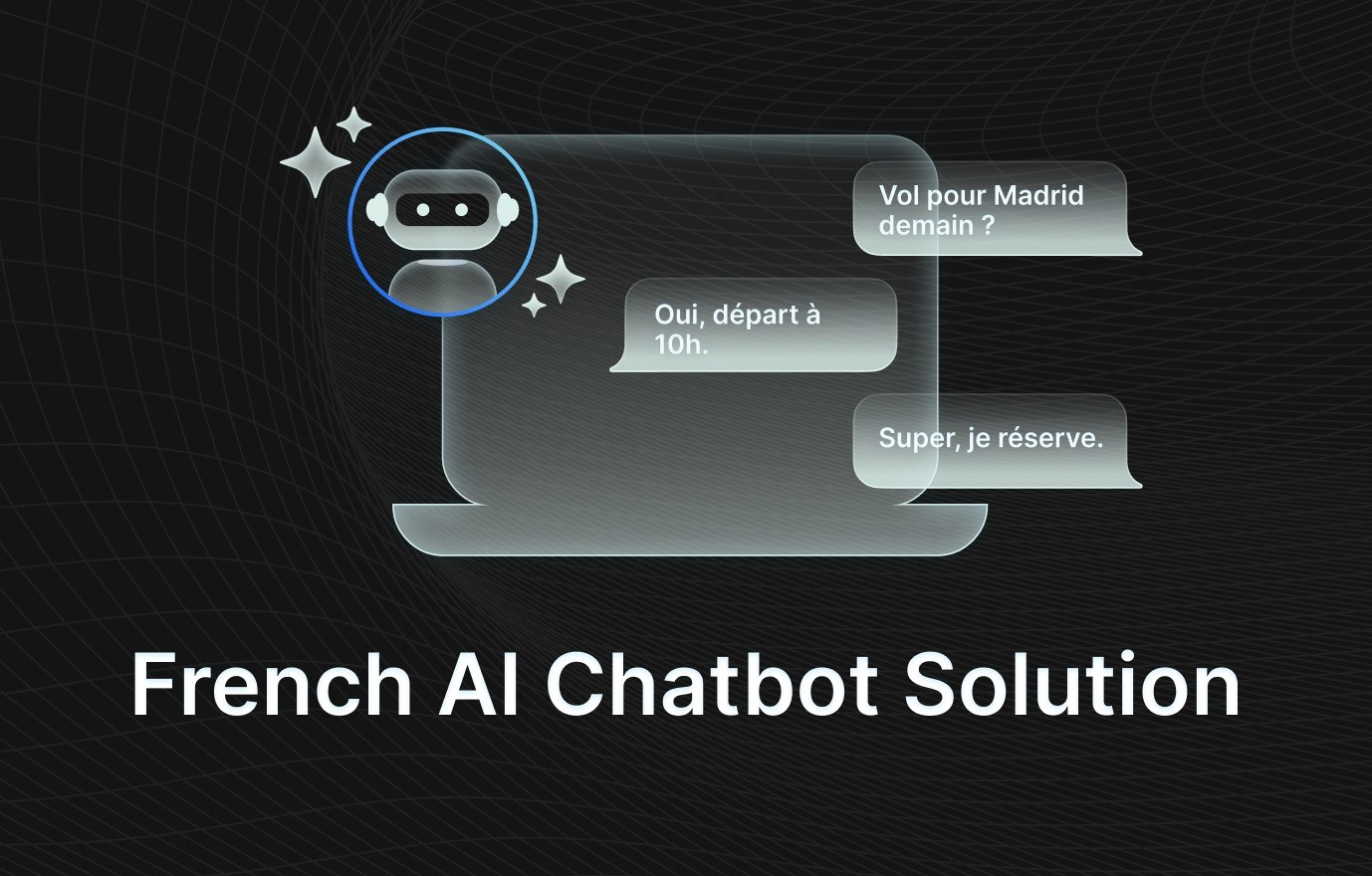
A French chatbot is an AI-powered conversational tool that can understand and respond in French – naturally, accurately, and without making your customers cringe.
It can handle support queries, guide users through processes, answer FAQs, and automate entire conversation flows. All in French.
But here's where most people get it wrong.
There's a big difference between a chatbot that's translated into French and one that actually thinks in French.
A translated chatbot was built in English (or another language) and just has its responses swapped out.
The underlying model still processes language in the English way.
Which means the moment a French user throws in an idiom, a regional expression, or even just a naturally structured French sentence, it breaks. Badly.
A native French NLP chatbot, on the other hand, is trained on actual French conversational data from the ground up.
It understands how French speakers naturally phrase things, how sentence structure differs, how formality works, and how context shifts meaning.
Basically, it doesn't translate — it just… gets it.
Let’s build your chatbot today!
Launch a no-code WotNot agent and reclaim your hours.
Let’s build your chatbot today!
Launch a no-code WotNot agent and reclaim your hours.
Why Businesses Need a French Chatbot in 2026
Look, if you're targeting French-speaking markets and your chatbot isn't in French, you're already behind.
Here's the ground reality when it comes to French-speaking folks.
1. The market is massive and growing
French is the 5th most spoken language in the world. And unlike some languages, its speaker base is actively expanding.
It is mostly driven by Sub-Saharan Africa, where countries like Côte d'Ivoire, Senegal, and Cameroon have young, digitally active populations that are increasingly shopping, banking, and getting support online.
This isn't a future opportunity. It's happening now.
2. People buy more when you speak their language
This one's been proven over and over.
Customers are significantly more likely to complete a purchase, stay on a page longer, and trust a brand more when they're engaged in their native language.
For customer support specifically, language mismatch is one of the top reasons for escalations, bad reviews, and churn.
Your chatbot is often the first real interaction someone has with your brand. If that interaction feels foreign, you've already lost ground.
3. France has legal expectations around language
This one catches a lot of businesses off guard. The Toubon Law in France requires that commercial communications be in French. Your chatbot is a commercial communication. So, beyond just user experience, there's a compliance angle here that businesses entering the French market need to take seriously.
And then there's GDPR — which adds another layer of requirements around how you handle user data, all of which needs to be clearly communicated. In French.
4. Localized experience = trust
When a French speaker lands on your site, and your chatbot immediately responds in clear, natural French — it signals that you built this for them.
That small thing reduces friction in a way that's hard to measure but very easy to feel.
It's the difference between a customer thinking "this brand gets me" vs "this feels like it was built for someone else."
Use Cases of a French Chatbot
Alright, enough of the "why." Let's see how a French chatbot can actually create an impact on businesses in various industries.
E-commerce
This is the most obvious one – and for good reason.
French e-commerce is booming, and customers expect support in their language at every step of the buying journey.
Here’s what it can handle:
Order tracking
Product recommendations
Returns and refund guidance
And even promotional messaging
All this without a human agent involved.
The key difference from a generic chatbot? It doesn't just answer in French. It answers in French the way a French customer actually speaks.
SaaS
If you're a SaaS company selling into France or Francophone markets, your onboarding experience is your first impression.
A clunky, English-first onboarding flow with a half-translated chatbot tells users you didn't really build this for them.
A French chatbot walks new users through setup in their language, handles Tier 1 support without escalation, and collects structured feedback — all in French.
Small things, big impact on activation rates.
Travel & Hospitality
France is the most visited country in the world.
Hence… Hotels, airlines, and tour operators dealing with French-speaking travellers need 24/7 support.
And since you get a lot of booking inquiries, itinerary changes, and complaints — you need a fluent chatbot that does not mess up while talking in French.
Education
EdTech platforms targeting Francophone Africa or France need chatbots that can answer student queries.
EdTech platforms can also use online exam proctoring solutions to help institutions conduct secure remote assessments, verify student identities, and maintain academic integrity during online examinations.
The questions can vary from course navigation to handling enrollment queries and more.
So the chatbot needs to have a good knowledge base and a clear understanding of French “natively”.
Government Services
French public sector institutions are increasingly deploying chatbots for citizen services.
That includes tax guidance, permit applications, and healthcare information.
These chatbots need to be precise, formal, and GDPR-compliant.
Hence, there's very little room for "close enough" here. A wrong answer or an awkward phrasing in a government context erodes trust fast.
WhatsApp & Website Automation
WhatsApp is huge across Francophone Africa. It's often the primary communication channel.
So, if you're automating customer engagement on WhatsApp or your website for these markets, the chatbot isn't just answering questions.
It's often the first real touchpoint between your brand and the customer.
That first message needs to land right. In French.
If you’re interested in knowing how chatbots can help your business, then check out these high-impact chatbot use cases.
Must-Have Features in a French Chatbot
I’ve tested many chatbots in the last 8 years. And trust me, it’s a different ball game when it comes to chatbots that need to perform in a native language.
And of course, the features that you need also turn up a notch. And these are the ones that you must look out for.
Native French NLP
This is the big one. The chatbot's NLP engine needs to be trained on actual French conversational data.
French syntax is different. Verbs conjugate in ways that completely change meaning.
Trust me, French is such a complex language that way.
And a model that genuinely understands French handles these naturally. A translated one breaks on them constantly.
If a vendor can't clearly tell you how their French NLP was trained, that's a red flag.
Regional dialect handling
"Courriel" vs "email." "Magasiner" vs "faire du shopping."
Quebec French and European French aren't the same language.
They just share the same roots. Your chatbot will sound off to native speakers if it gets this wrong.
A good French chatbot either detects regional context and adapts or is trained specifically for your target market from the start.
Accent and typo tolerance
Real users type fast and messily.
They drop accent marks — é becomes e, ç becomes c.
They make typos. If your chatbot can only understand perfectly written French, it's going to fail constantly in front of your customers.
Hence, you need robust accent normalization and fuzzy matching.
Multilingual switching
In many markets (especially Canada and parts of Africa) users will switch mid-conversation between French and English, or French and a local language.
Your chatbot needs to follow the user's lead without losing context or throwing an error.
Because nothing kills a conversation faster than a chatbot that responds, "I didn't understand that", the moment someone switches.
CRM integration
The chatbot doesn't exist in isolation. It needs to pull customer data, log conversations, trigger workflows, and hand off to human agents when needed.
All this is supposed to be done while keeping the French-language experience seamless throughout.
GDPR compliance
If you're targeting France or any EU market, this is non-negotiable.
Your chatbot needs clear data consent flows, the ability to handle deletion requests, and transparent data processing disclosures.
All of which need to be communicated in French.
Useful resource: Chatbot ideas for every business.
How to Build and Train a French Chatbot?
Alright, this is the part you actually came here for. Let's get into it.
There are three main approaches. And the right one depends on your technical depth, budget, and how sophisticated the conversations need to be.
Method 1: No-Code Chatbot Builder
Best for: Small teams, quick deployment, and non-technical founders.
Platforms like WotNot, Tidio, or Landbot let you build chatbots visually without writing a single line of code.
Most support French as a language option out of the box.
Here’s what you need to do:
Step 1: Select a good chatbot builder
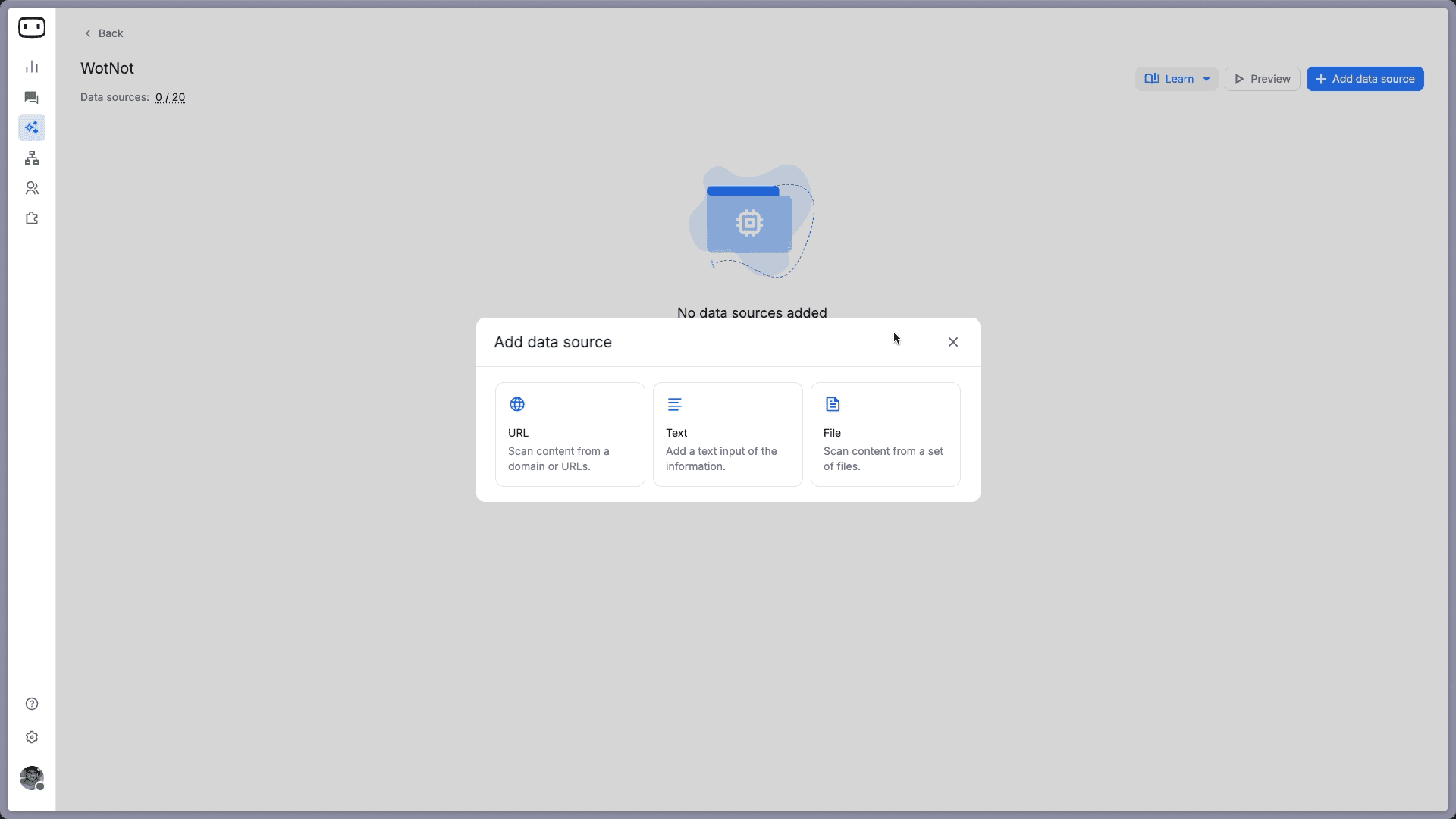
Step 2: Build a knowledge base
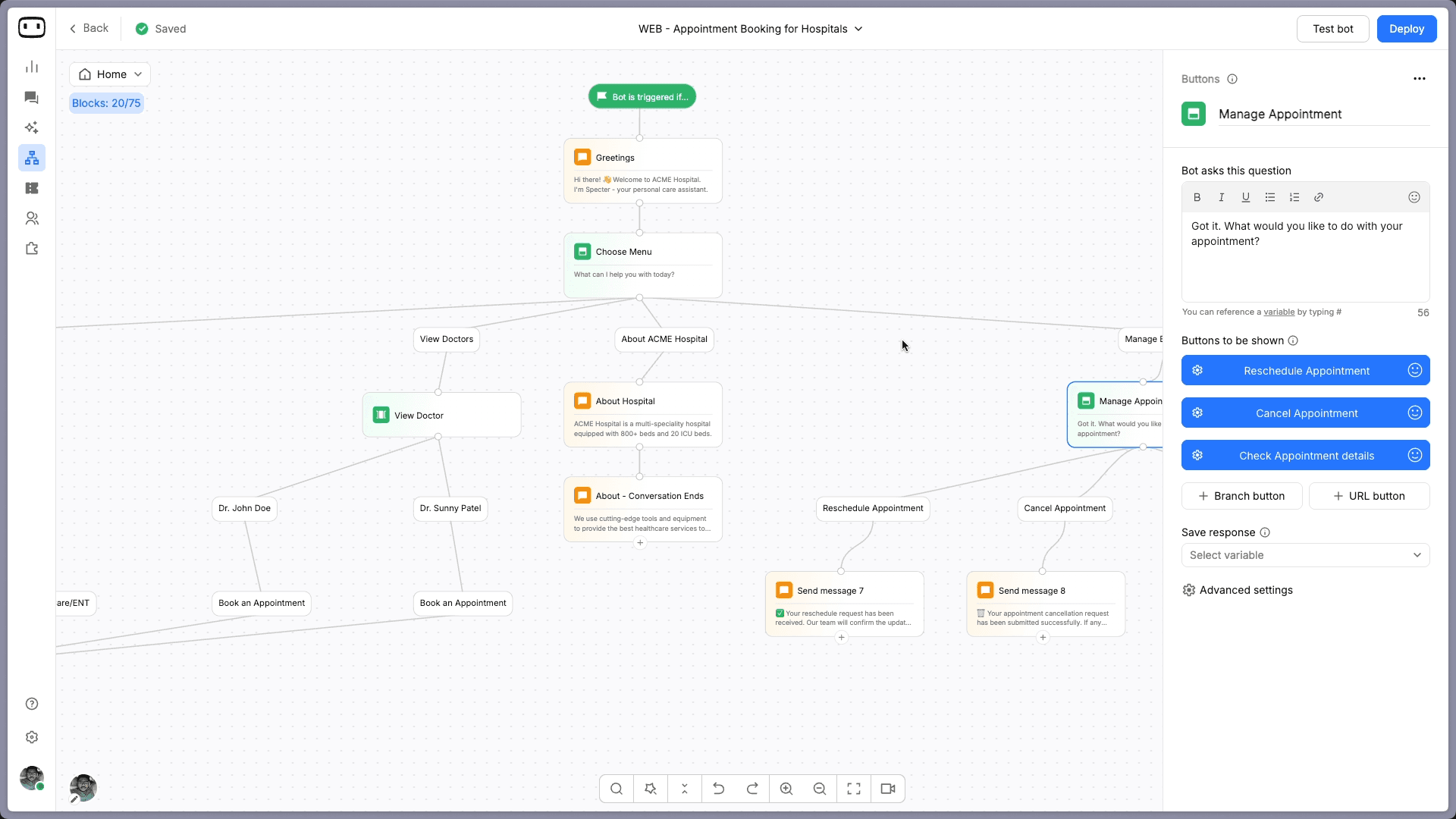
Step 3: Map out your chatbot flow
Step 4: Test your chatbot thoroughly for various queries in French
Step 5: Deploy your chatbot
It’s a really good starting point if you want to test the waters.
Start building, not just reading
Build AI chatbots and agents with WotNot and see how easily they work in real conversations.

Start building, not just reading
Build AI chatbots and agents with WotNot and see how easily they work in real conversations.
Start building, not just reading
Build AI chatbots and agents with WotNot and see how easily they work in real conversations.

Method 2: NLP Platforms
Best for: Teams with some technical capability who need more control.
Google Dialogflow: Supports French natively and has solid multilingual capabilities. Good for structured, intent-based flows. Works well for most standard use cases.
Microsoft Azure Bot Service + LUIS: Enterprise-grade option with strong French support. Works especially well for organizations already in the Microsoft ecosystem.
Rasa: Open-source and highly customizable. You can train it on French-specific data and tune it exactly how you want. Requires more technical effort but gives you full control over the model.
This is the sweet spot for most mid-sized businesses building a serious French chatbot without going fully custom.
Method 3: Custom LLM-Based Chatbot
Best for: Companies that need genuinely natural French conversations and have the engineering resources to support it.
This uses models like GPT-4, Claude, or French-specialized open-source models like CamemBERT (which was specifically trained on French data).
With this, you can genuinely build a chatbot with conversational French capabilities.
The tradeoff is cost and complexity.
You'll need retrieval layers, safety guardrails, proper integration infrastructure, and ongoing maintenance.
Now, the actual building process (for methods 2 and 3, also relevant for method 1)
Step 1: Data collection
Gather real French conversational data. You can pick customer emails, support tickets, or even chat logs.
The more domain-specific and market-specific, the better. Generic French training data produces generic results.
If you're targeting Quebec specifically, train on Quebec French data. If it's West Africa, same principle.
Step 2: French intent mapping
Define the user intents that matter for your use case and map them to French phrasing patterns.
"Track my order" in French isn't just "Suivre ma commande". Users might say "où en est mon colis", "j'ai pas reçu ma commande", "c'est où mon truc".
Map the variations. All of them.
Step 3: Training with real conversational data
Feed the model actual user queries from your target market.
The difference between a chatbot trained on textbook French and one trained on real, messy user messages is night and day.
Textbook French sounds like a textbook. Real users don't talk like textbooks.
Step 4: Testing with native speakers
This step gets skipped way too often. Get actual French speakers (ideally from your target region) to run through the chatbot before you go live.
They will catch things your testing team won't. Especially around formality, tone, and anything that sounds subtly off to a native ear.
Common Challenges When Building a French Chatbot
I won’t bore you with fluff. So here’s a quick overview of major issues businesses face while building a French chatbot.
Literal translation errors
Idiomatic expressions don't translate. "Casser les pieds" literally means "break the feet". But it actually means "to annoy someone."
If your chatbot is translating English responses into French at runtime, it will produce responses that range from mildly awkward to completely baffling.
French speakers notice this immediately. And once trust is gone, it's gone.
Gendered language complexity
French is a gendered language. Nouns are either masculine or feminine, and everything around them (articles, adjectives, past participles) has to agree.
Get it wrong, and you get sentences like "le client est satisfaite" instead of "satisfait."
Grammatically incorrect, and immediately signals to the user that this chatbot wasn't built with French in mind.
For a chatbot handling thousands of conversations, these errors add up fast.
Formal vs informal tone (tu vs vous)
This one trips up a lot of teams, and it's surprisingly easy to get wrong.
French has two forms of "you" — tu (informal) and vous (formal).
Using the wrong one isn't just stylistically off — it can actually come across as rude or unprofessional depending on the context.
Consumer brands typically use tu. B2B, government, and financial services almost always use vous.
Your chatbot needs to pick one and be consistent. Mixing them mid-conversation is somehow worse than just picking the wrong one.
Regional slang and expressions
As I mentioned earlier in this blog, Quebec French and European French are not the same.
Even the Senegalese French has its own local influences. Moroccan French is different again.
If your chatbot was trained only on European French data and you're deploying it in Montreal or Dakar, users are going to notice the mismatch.
It won't break the chatbot, but it'll feel like talking to someone who learned French in Paris and has never left.
For serious multi-market deployments, regional training data isn't optional. It's what separates a chatbot that works from one that works for your audience.
Conclusion
French speakers are not a niche. Their numbers are not something to scoff at.
And hence, if you want your business to target the French audience, then you need to train your chatbot properly.
If you want to avoid the hassle, then you can use AI-powered chatbot builders that have natively trained their system to handle multiple languages.
One such platform is WotNot. You can take a 14-day free trial to see how things work out.
FAQs
FAQs
FAQs
Can ChatGPT understand French?
Yes, pretty well actually. ChatGPT has been trained on large amounts of multilingual data, including French, so it can hold a decent French conversation.
That said, for a production chatbot targeting French-speaking markets, you'll want to think beyond just "can it speak French". You need regional accuracy, tone consistency, and domain-specific training, all of which matter a lot in real deployments.
Is French NLP different from English NLP?
How much does it cost to build a French chatbot?
Can one chatbot support both French and English?
ABOUT AUTHOR

Hardik Makadia
Co-founder & CEO, WotNot
Hardik leads the company with a focus on sales, innovation, and customer-centric solutions. Passionate about problem-solving, he drives business growth by delivering impactful and scalable solutions for clients.



Start building your chatbots today!
Curious to know how WotNot can help you? Let’s talk.
Start building your chatbots today!
Curious to know how WotNot can help you? Let’s talk.