

Let’s build your chatbot today!
Launch a no-code WotNot agent and reclaim your hours.
*Takes you to quick 2-step signup.
Chatbots are a norm on any and every website you visit, acting as devices to ease the visitors' (or customers') journeys. But once the new wave of AI came along, most people started to lean towards having AI agents over chatbots.
Most of them take no time to choose between a chatbot or an AI agent, but a few stop to ask the harder question.
Can this tool actually handle what it's being handed?
77% of consumers say a poor self-service experience is worse than no self-service at all. Most companies deploy a chatbot and consider the job done.
Here's the uncomfortable truth: "chatbot" and "virtual agent" are not the same thing. Vendors use them interchangeably. Analysts do too.
Not this article.
It's written for someone who has already deployed a chatbot, or is close to committing to one. You'll get honest definitions, a real side-by-side breakdown, and signals that tell you whether it's time to upgrade.
Here's what you'll walk away with:
A practical understanding of what separates a chatbot from a virtual agent
A side-by-side view of where each performs well and where each breaks down
Concrete signals that tell you when your chatbot has hit its ceiling
Let's start from the beginning.
What Is A Chatbot and How It Works
A chatbot is software that can carry on a conversation by matching user inputs to predefined responses.
There are two main types you'll encounter.
1. Rule-Based Chatbot: This kind of bot is purely scripted and keyword-triggered. It works well for straightforward queries, but can't really understand context or intent beyond what it's been programmed for.
2. AI-Powered Chatbot: It uses NLP (natural language processing) to interpret more varied inputs. It's more flexible than a rule-based bot, but it's still primarily reactive. It waits for input and responds. It doesn't act independently.
Since the first chatbot, ELIZA, 60 years ago, the core principle for rule-based bots hasn't changed. Input goes in. A matched response comes out.
|
Let’s build your chatbot today!
Launch a no-code WotNot agent and reclaim your hours.
Let’s build your chatbot today!
Launch a no-code WotNot agent and reclaim your hours.
How does a Chatbot operate?
When a chatbot is built, it is programmed with a number of conversational paths at every step. For every option, there is a corresponding action that would be executed in the backend.
For example, here is a chatbot flow, built for a restaurant on SMS.
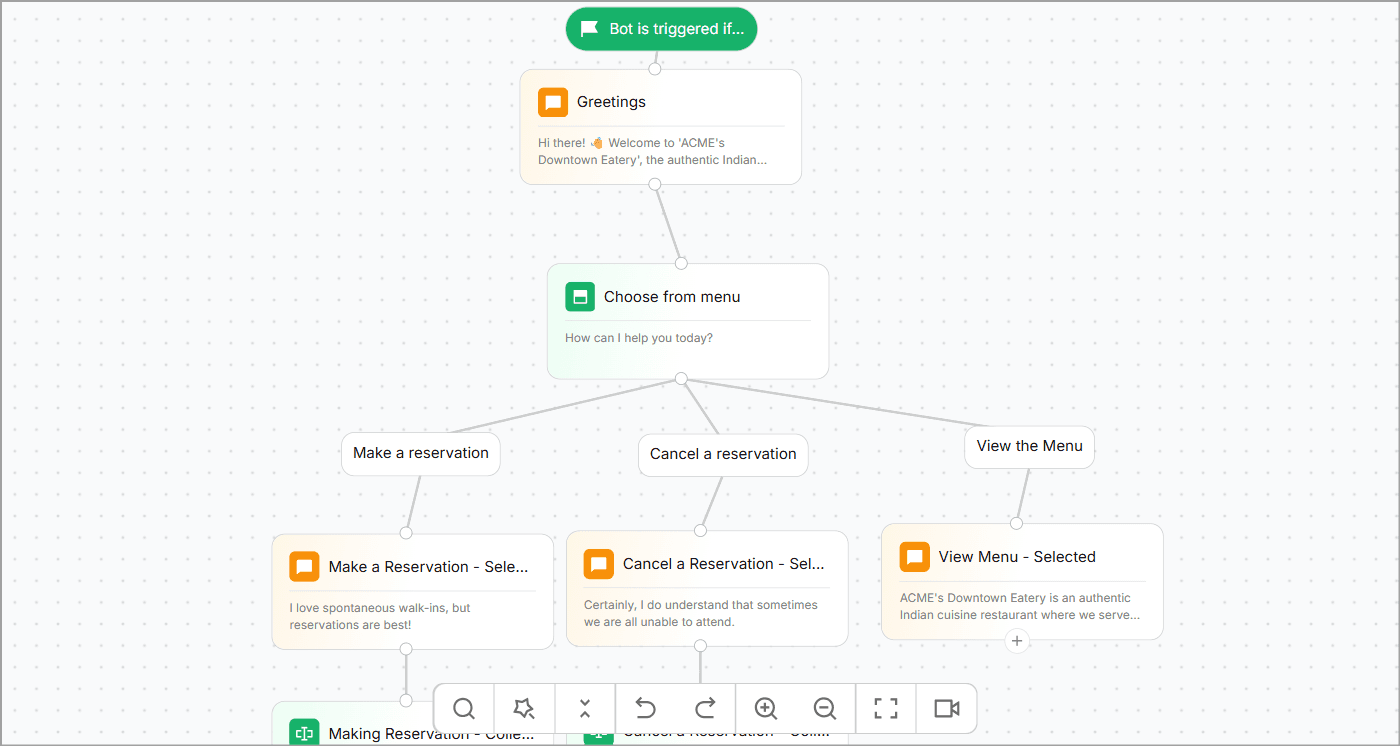
When a user goes off-script, things break down fast. Ask something unexpected, phrase a question differently, or raise a follow-up that the bot wasn't built for. The result is a misroute, a loop, or a dead end.
The limitation is the fundamental design assumption that conversations are predictable. They're not.
Where do chatbots fit?
Chatbots are the right tool when the possible queries are narrow and predictable. Imagine store hours, return policies, password reset instructions, FAQ deflection, etc.
Chatbots can handle up to 80% of routine queries without human involvement when those queries are well-defined. For this kind of work, they're fast, consistent, and cost-effective.
They're also a smart choice when consistent messaging matters more than depth. Chatbots give you control over conversation flows.
The Pros of chatbots
Four genuine advantages worth naming clearly:
24/7 availability without staffing cost
Instant response time for high-volume, simple queries
Unlimited simultaneous conversations with no degradation
Consistency in every response, every time, regardless of volume
What is a Virtual Agent and How It Works
The virtual agent can seem like a "smarter chatbot" on the outside, but it's architecturally different.
A virtual agent is an AI-powered system that understands what a user needs and takes action on it. IBM states it combines NLU (natural language understanding), machine learning, and often RPA (robotic process automation) to read intent, hold context across a conversation, and complete tasks in connected systems like CRM, billing, or ticketing.
Virtual agents that use machine learning get smarter with every interaction. They learn what phrases correspond to which intents. Accuracy improves over time without manual re-scripting.
That last part is the key distinction. A chatbot responds. A virtual agent responds and does something (directed towards an objective).
One quick note on terminology:
|
How a virtual agent operates
You can think of it in three layers.
The perception layer is where NLU reads what the user means, not just what they type. It handles everything, including varied phrasing, incomplete sentences, and multi-part questions.
The context layer retains conversation history so it knows what was said earlier. It learns more and adapts as the conversation evolves.
The action layer connects to backend systems such as CRM, ticketing, billing, knowledge base, etc. It completes transactions without routing to a human.
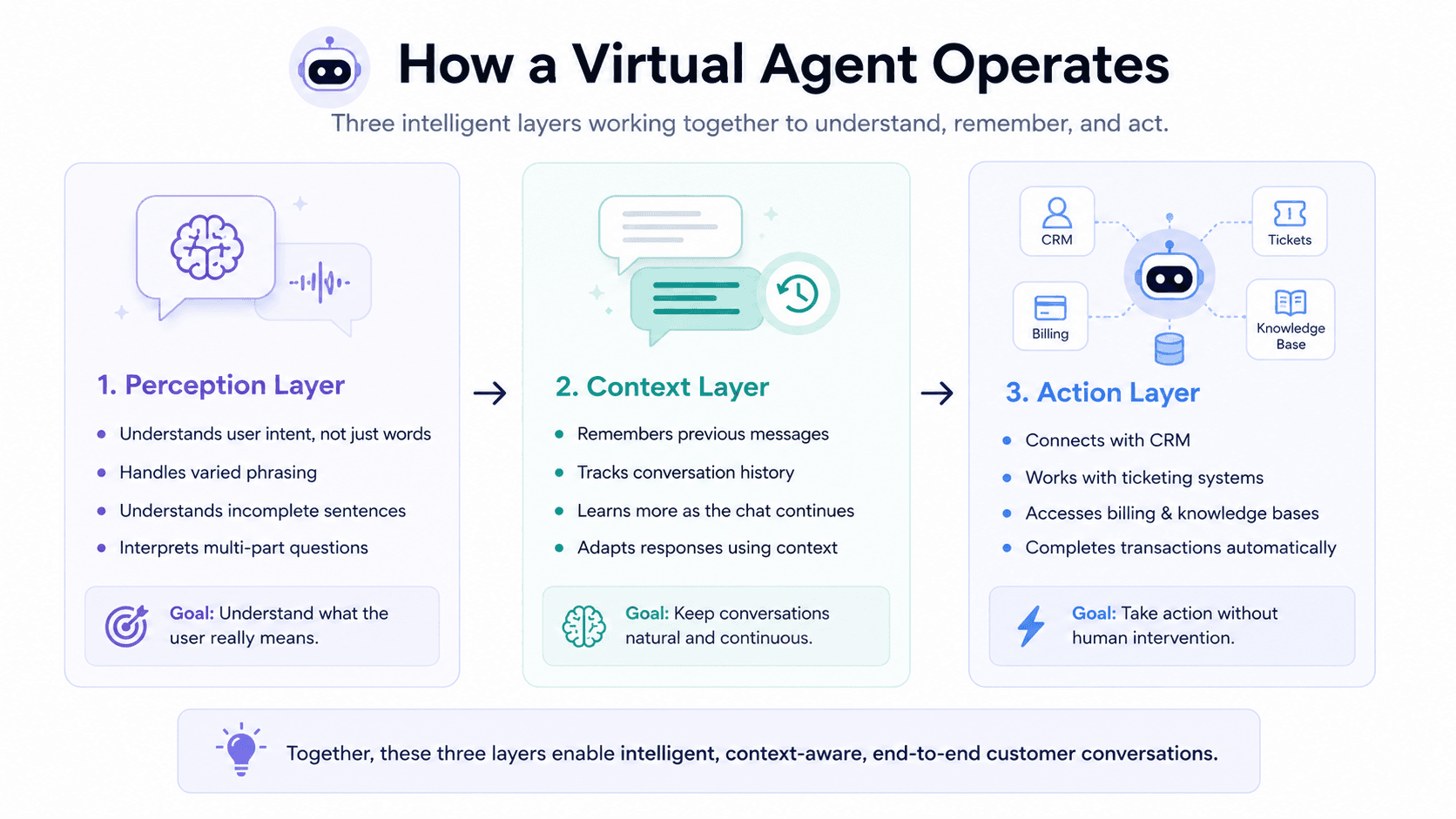
Here's what that looks like in practice:
A customer says: "I need to change my billing date. Also, can I get a refund on last month cuz I had paid double the actual amount?"
A chatbot would handle one request or escalate both.
A virtual agent reads intent regardless of how the request is worded. It holds context across the full conversation. It connects to the relevant systems and processes each request in the same thread.
The pros of virtual agents
Four concrete benefits, each with an operational implication:
Intent accuracy: Handles varied, unexpected phrasing without failing or looping
End-to-end resolution: Closes the interaction in the same session without deflecting
Sentiment detection: Identifies frustration, urgency, or confusion and adjusts accordingly
System integration: Acts as a live connector to business data, making it transactional, not just informational
Where do virtual agents fit?
Virtual agents are the perfect solution to automation when conversations go beyond a single, predictable question.
Think billing disputes that involve a refund request, a subscription change, and an account lookup, all in the same thread.
They are built for queries that require live data, multi-step logic, or actions in connected systems, resolving issues end-to-end without escalating to a human.
They're also the right choice when resolution quality matters more than consistency. Virtual agents adapt to what the customer actually said and not just what they were expected to say.
The market is moving this direction fast. The AI agent market was valued at $7.84 billion in 2025. It's projected to reach $52.62 billion by 2030 at a 46.3% CAGR. Businesses are investing in action-capable AI systems at pace.
Note: Virtual agents require real setup investment. Training data, system integration, ongoing monitoring. They are not plug-and-play. That's worth knowing before you evaluate one. |
Start building, not just reading
Build AI chatbots and agents with WotNot and see how easily they work in real conversations.

Start building, not just reading
Build AI chatbots and agents with WotNot and see how easily they work in real conversations.
Start building, not just reading
Build AI chatbots and agents with WotNot and see how easily they work in real conversations.

Chatbot vs Virtual Agent: The Side-by-Side Breakdown:
Comparing the basics
Dimension | Chatbot | Virtual Agent |
How it understands input | Keyword match and decision tree triggers | NLU reads intent regardless of phrasing |
Task complexity | Single-intent, scripted interactions | Multi-intent, multi-step, transactional |
Context retention | Forgets between turns; no session memory | Retains context across full conversation arc |
System integration | Limited; static responses unless custom APIs added | Native connectors to CRM, billing, ticketing, knowledge base |
Learning over time | Must be manually updated for new scenarios | Learns from interactions, improves without updates |
Sentiment awareness | Same response regardless of customer tone | Detects frustration, urgency, confusion; adjusts behavior |
Escalation behavior | Escalates frequently; context often lost on handoff | Escalates gracefully with full context intact |
How performance is measured | Deflection rate | First-contact resolution (FCR) |
The same conversation, two outcomes
A customer contacts a utility company. They want to change their direct debit date. They also mention they're struggling financially and ask whether support options are available.
A chatbot recognizes "change direct debit" and routes accordingly. The mention of financial difficulty falls outside its scope. It either ignores it or gives a generic "speak to an agent" response. The customer's real need goes unaddressed. | A virtual agent processes both elements. It changes the direct debit as requested. It detects the vulnerability signal in the financial difficulty mention. It surfaces the company's hardship support options. All in one thread. No human required. |
Same input but completely different outcomes.
Where each technology belongs
This isn't a chatbot being bad or a virtual agent being better. It's about matching the tool to the conversation type.
Use a chatbot:
If the answer exists without looking anything up like store hours, return policies, product FAQs.
When the goal is to deflect volume fast, like in triage, lead capture, appointment booking.
Where every interaction follows the same path and the same answer is always correct.
Use a virtual agent:
If resolving the issue requires pulling live data from account status, order history, or billing records.
When the customer has more than one thing to sort out in the same conversation.
While the interaction involves a transaction like a refund, a plan change, a ticket creation.
If getting it wrong has a real cost.
Use both when your support volume is high, but query complexity varies. Let the chatbot handle the simple front end, the virtual agent handle everything the chatbot can't close.
Signs You've Outgrown Your Current Bot
You can say you have hit your chatbot ceiling when your bot's fundamental design constraints start showing up in your business metrics.
You didn't make a bad decision when you deployed it. But the conversations have evolved, and the tool hasn't.
Here are five signals that tell you you've hit it.
Signal 1: Your deflection rate is high but so are your re-contacts
Deflection rate says nothing about whether the issue was actually resolved. It only measures whether the bot ended the session.
If your support team sees high re-contact rates despite strong deflection numbers, it means the bot ended the session without resolving anything.
Signal 2: Your escalation rate isn't falling
A well-deployed chatbot should reduce escalations over time. If your escalation rate has plateaued or risen as traffic grows, something is off. The queries reaching your bot are either too complex or phrased in ways it wasn't trained for.
Signal 3: The bot is looping or failing consistently
Looping is the clearest user-facing sign of the chatbot ceiling. A customer rephrases their question but the bot gives the same scripted response. They rephrase again. Loop.
CX leaders say looping chatbot isn't just unhelpful. It's actively damaging.
Signal 4: Your queries are increasingly multi-intent
Chatbots handle one intent per conversation well. Two connected intents in the same thread expose the architectural limit. A chatbot maps specific words to preset responses. If your customer conversations have grown more complex because your product has, the tool needs to evolve with them.
Signal 5: You're manually re-scripting constantly with no improvement
If your team spends significant hours monthly just to hold the bot at baseline, that's a problem. Chatbots must be manually updated to handle new scenarios. Virtual agents that learn from interactions reduce this maintenance burden over time.
If you have seen three or more of these signals in your operations, the next section is written for you.
Chatbot vs Virtual Agent: How to Choose the Right One for Your Business
This is the decision framework. It's not biased toward the more expensive option.
Some businesses genuinely need only a chatbot right now, and the right answer here says so clearly.
Start with your query profile
The single most useful starting point is this question: what does the majority of your incoming conversation volume actually look like?
Pull a sample of 50 to 100 recent support interactions and classify them:
Single-intent, simple answer: A chatbot handles this well
Single-intent, requires live data lookup: A chatbot might handle it with API integration
Multi-intent or multi-step: Virtual agent territory
Emotionally sensitive or complex: Virtual agent territory
The distribution tells you more than any vendor pitch will. For simple product FAQs, a basic chatbot is sufficient. If most tickets require a human to look up data first, switch to a virtual agent.
The other decision factors
System integration: If resolving customer issues requires pulling live data from CRM, billing, ticketing, or inventory, a chatbot without deep API integration will always escalate. A virtual agent is built for exactly this.
Scale: It matters when both volume and complexity are growing. A chatbot's maintenance overhead grows linearly with query variety. A virtual agent's self-improvement offsets that overhead over time.
Budget: Virtual agents require more investment to set up because they depend on advanced AI systems, integration work, and ongoing oversight. The ROI question is whether improvement in FCR and reduction in escalation costs justify the upfront delta. For many businesses, they do. For some, not yet.
The hybrid approach
You don't always have to choose one or the other.
Many mature deployments use both strategically.
A chatbot handles top-of-funnel volume: the FAQ, the triage, the first-touch deflection.
A virtual agent handles conversations that require context, system access, or multi-step resolution.
The right tool might look like a chatbot, feel like an assistant, or act like an agent. Sometimes it's a hybrid of all three. For high-volume, mixed-complexity environments, it's the right architecture.
Asking any vendor to demo a multi-step transactional request reveals more than a polished walkthrough of the ideal path. Ask specifically what happens when a customer provides incomplete information mid-conversation.
Conclusion
Chatbots and virtual agents are not the same tool at different price points. They're designed for fundamentally different types of conversations. Deploying the wrong one has real operational consequences: re-contacts, escalations, CSAT drops, and maintenance overhead that doesn't stop growing.
The chatbot ceiling is real. High deflection rates combined with flat first-contact resolution and rising escalations are the clearest signals you've hit it. The decision should be driven by what your conversations actually look like. Not by what sounds more sophisticated.
The line between these two technologies is narrowing. Platforms are adding NLU and integration capabilities to what used to be simple rule-based bots. But the underlying question hasn't changed. Can the tool understand what the customer actually meant? Can it take the action they actually need? As customer expectations rise, the gap between tools that answer that well and tools that don't is widening.
If you're evaluating whether your chatbot is still the right tool, WotNot can help. WotNot lets you build both chatbots and AI agent-powered virtual agents without writing a line of code. Start with a chatbot today and upgrade when you're ready. Start free or book a demo to see how it handles the conversations you're dealing with today.
FAQs
FAQs
FAQs
What is the difference between a chatbot and a virtual agent?
Is a virtual agent the same as a virtual assistant?
Can a virtual agent fully replace a chatbot?
What does "first-contact resolution" mean and why does it matter?
How much does a virtual agent cost compared to a chatbot?
ABOUT AUTHOR

Hardik Makadia
Co-founder & CEO, WotNot
Hardik leads the company with a focus on sales, innovation, and customer-centric solutions. Passionate about problem-solving, he drives business growth by delivering impactful and scalable solutions for clients.

Start building your chatbots today!
Curious to know how WotNot can help you? Let’s talk.
Start building your chatbots today!
Curious to know how WotNot can help you? Let’s talk.


