
Let’s build your chatbot today!
Launch a no-code WotNot agent and reclaim your hours.
*Takes you to quick 2-step signup.
Search for "sales chatbot," and you get ten lists that look the same. Each one throws a support tool, an outbound database, and a website bot into one pile. Then calls them all chatbots.
They are not the same thing. An AI SDR that costs $50K a year is not in the same category as a $29/month lead-capture bot. A support agent that charges you $0.99 every time it resolves a ticket is not a sales chatbot. Comparing them flat is how people buy the wrong tool.
This list sorts 9 tools into what they actually are. Pricing pulled from vendor pages (August 2026). Ratings from G2. Complaints from real reviews and Reddit, not marketing copy. Let's get into it.
Where Chatbots Actually Help You Sell
Before you pick a tool, know where a chatbot fits in your sales process. Not every tool covers every use case. Here is where they actually move numbers.
Lead Qualification
This is the single biggest chatbot use case. The bot asks qualifying questions, scores the visitor, and routes them forward. No form fills or 48-hour email follow-up. The visitor gets a real response within seconds, which matters because 59% of buyers expect a response in under 5 seconds.
Works best for: SaaS, B2B services, insurance, real estate, financial services.
Meeting and Appointment Booking
About 28% of chatbot deployments focus on scheduling. A bot that qualifies and books in the same conversation eliminates the entire back-and-forth cycle. This is especially useful for service businesses, real estate, and SaaS demo pipelines.
Cart Recovery
70.19% of online carts get abandoned (Baymard Institute, tracked over 14 years). A chatbot that triggers at exit intent, answers a quick objection, or offers a discount code can recover a portion of that revenue. This is where tools like Tidio and ManyChat play strongest.
Product Recommendations and Upselling
AI-driven product suggestions in chat increase average order value. This works when the bot can pull live catalog data and respond to what the visitor is actually looking at, not just push static recommendations.
Works best for: E-commerce, D2C, fashion, electronics.
Social Commerce (DM-to-Sale)
Comment-to-DM automation turns public engagement into private sales conversations. Someone comments a keyword on your Instagram post, and the bot slides into their DMs with a coupon or product link. ManyChat built its entire business around this.
B2B Account-Based Engagement
About 97% of B2B website visitors leave without identifying themselves. Tools like Qualified use Salesforce data to detect target accounts in real time and engage them through chat, voice, or video on the spot.
WhatsApp Commerce
WhatsApp open rates hover around 98%. Conversion rates in commerce flows reportedly run 3 to 5x higher than email. For markets like India, LATAM, and Southeast Asia, WhatsApp is not a nice-to-have channel. It is the primary one.
Real Estate and Insurance Lead Capture
Contact forms in real estate convert at roughly 0.6%. That is the lowest of any major industry. Conversational lead capture, where a bot asks questions one at a time instead of throwing a 10-field form, pushes completion rates to 30-50%. About 75% of U.S. real estate brokerages have already adopted AI in some form.
TL;DR Comparison Table
Pricing verified against vendor pages, August 7, 2026. Ratings pulled from G2 on the same date.
Tool | Best For | What Sets It Apart | Starting Price |
SMB/mid-market no-code sales + support | Multi-LLM flexibility + flat pricing | $29/mo (Lite) | |
Landbot | Marketers wanting the cleanest visual builder | "Figma for chatbots" UX | ~$46/mo (Starter) |
Tidio | Shopify/e-commerce SMBs | Lyro AI on Anthropic Claude, Shopify-native | Free / $29/mo |
ManyChat | Creators running Instagram DM funnels | Comment-to-DM automation | Free (25 contacts) / $14/mo |
Apollo.io | Outbound SDR teams (US-focused) | 275M+ contact database + sequencer | Free / $49/user/mo |
Qualified (Piper) | Enterprise B2B inbound on Salesforce | Best-in-class inbound AI SDR | ~$40K+/yr (no public price) |
Agentforce | Salesforce enterprises with admin teams | Agentic multi-step CRM actions | Usage-based (from $0.10/action) |
Intercom Fin | Support teams with sales qualification | Outcome-based pricing across channels | $0.99/resolution (~$49.50 floor) |
HubSpot Breeze | Teams already on HubSpot CRM | Native CRM-context answers | $0.50/resolved conversation |
Not All "Sales Chatbots" Are the Same Thing
Here is the thing most listicles skip. These 10 tools fall into three different categories. If you don't know which category you need, you will buy the wrong one.
Category 1: No-code sales chatbots. These are website and messaging bots that qualify leads, book meetings, recommend products, and hand off to live agents. You build them in a visual builder. Pricing is usually flat or per-plan.
Category 2: AI SDRs. These are autonomous agents that prospect, qualify, and do outreach at scale. They don't sit on your website waiting for visitors. They go find the buyers. Pricing is per-seat, per-credit, or per-conversation.
Category 3: Support-first AI agents with sales features. These started as ticket-deflection bots. They now have lead qualification bolted on. Pricing is outcome-based (you pay per resolved conversation or per qualified lead).
Note: The billing model matters more than features. A $29/month flat plan and a $0.99/resolution plan look similar at low volume. At 5,000 conversations a month, one costs $99 and the other costs $4,950. Keep that in mind as you read.
A Deep Dive into the Best Chatbots for Sales
1. WotNot
User ratings: 4.6/5 on G2
Best for: SMB and mid-market teams that want no-code lead qualification, appointment booking, and omnichannel deployment on a flat, predictable plan.
Core Functionalities (Sales-Focused)
Lead qualification with CRM push (Salesforce, HubSpot, Zoho, Freshdesk, Airtable, Google Sheets)
Appointment booking via Google Calendar, Outlook, and Calendly integration
In-conversation product recommendations and purchase completion
Outbound bot campaigns via WhatsApp and SMS
Multi-LLM AI Studio (GPT, Claude, Gemini, Mistral) on Starter+
Human handover with full context, unlimited agent seats
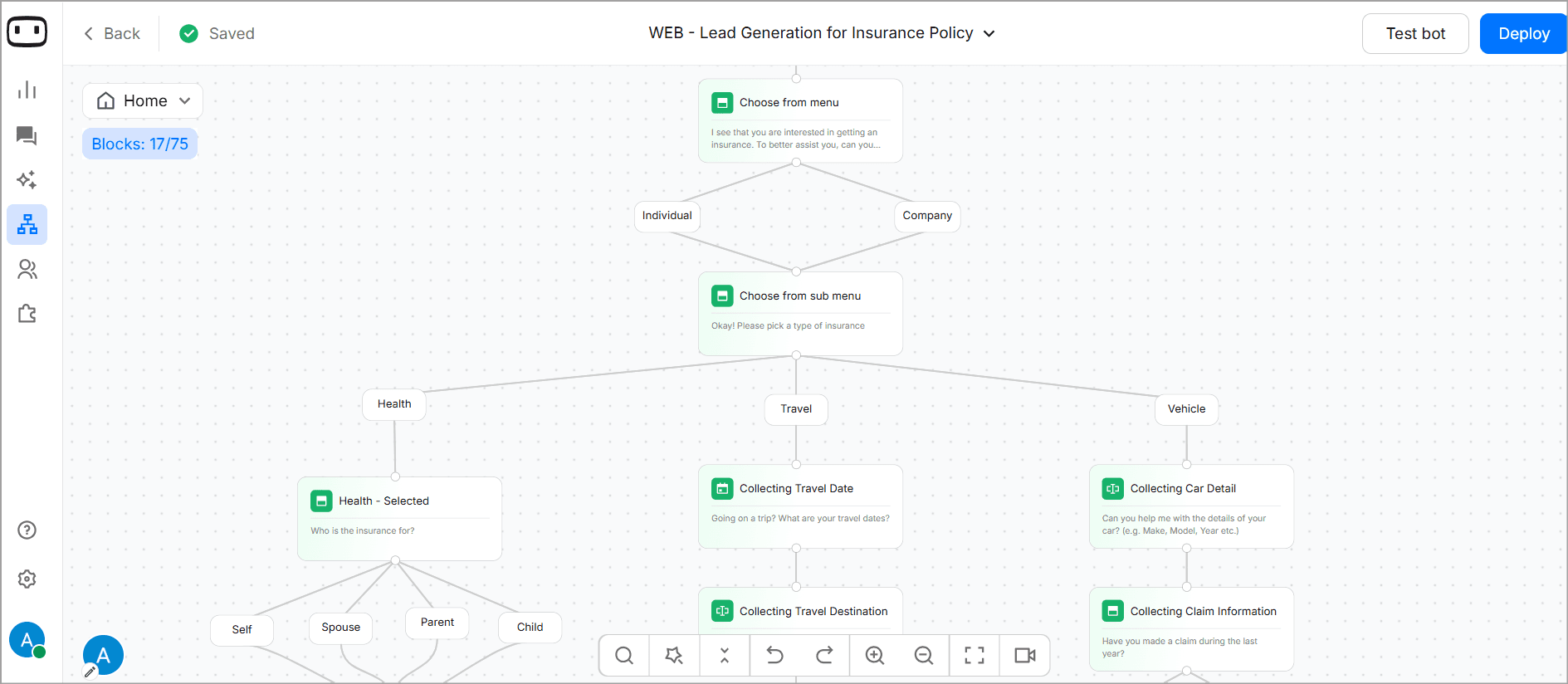
WotNot is known as a no-code AI agent platform. What that means in practice: you build a conversation flow in a visual editor, connect it to your CRM, and deploy it across your website, WhatsApp, Messenger, and SMS from a single build. No separate setups for each channel needed.
The sales angle is straightforward as well. Here’s how it’ll work: A visitor lands on your site, the bot qualifies them by asking preset questions, collects their contact info, and books a meeting on your calendar. If the visitor needs a human, the bot hands over with full conversation context. WotNot provides unlimited agent seats, which is a detail that matters when your team is growing, and you know that most competitors charge per seat.
Another highlight worth noting is the LLM flexibility. From the Starter plan ($99/mo), you can switch between OpenAI, Anthropic, Gemini, and Mistral without retraining the bot. Most tools at this price point lock you to one model. WotNot lets you pick the model that works best for your use case.
The honest differentiator? Pricing. In a market where Intercom charges $0.99 per resolution, HubSpot charges $0.50 per resolved conversation, and Zendesk stacks three billing layers, WotNot charges a flat monthly fee. You know what you'll pay before the month starts. That's not a small thing when budgets are tight.
Pricing:
Plan | Monthly | Key Inclusions |
Lite | $29/mo | 1,000 chats, 1,000 AI credits, no-code builder, Zapier |
Starter | $99/mo | 5,000 chats, 5,000 AI credits, AI Studio (all LLMs), native integrations, ticketing |
Premium | $299/mo | 10,000 chats, 10,000 AI credits, Live Chat, HTTP requests, branding removal |
Enterprise | Custom | Unlimited chats and credits, SSO, on-prem, professional services, priority support |
20% annual discount available ($23/$79/$239 on Lite/Starter/Premium).
Cons: Bot builder’s advanced flows may require some coding skills. Live Chat is gated to the $299 Premium plan. Also, the 14-day trial is tight for full evaluation.
Start building, not just reading
Build AI chatbots and agents with WotNot and see how easily they work in real conversations.

Start building, not just reading
Build AI chatbots and agents with WotNot and see how easily they work in real conversations.
Start building, not just reading
Build AI chatbots and agents with WotNot and see how easily they work in real conversations.

2. Landbot
User rating: 4.7/5 on G2
Best for: marketers and small teams that prioritize the cleanest visual flow-building experience for website lead capture.
Core Functionalities (Sales-Focused)
Visual drag-and-drop flow builder with conditional logic and variables
AI Lead Gen Assistant (OpenAI + Gemini, generates qualification flows from plain English)
Meeting booking via native Calendly block (Professional/Business plans)
Lead scoring through flow variables and tagging
Human Takeover inbox with mobile app and Slack notifications
Native integrations: HubSpot, Salesforce, Stripe, Mailchimp, Zapier
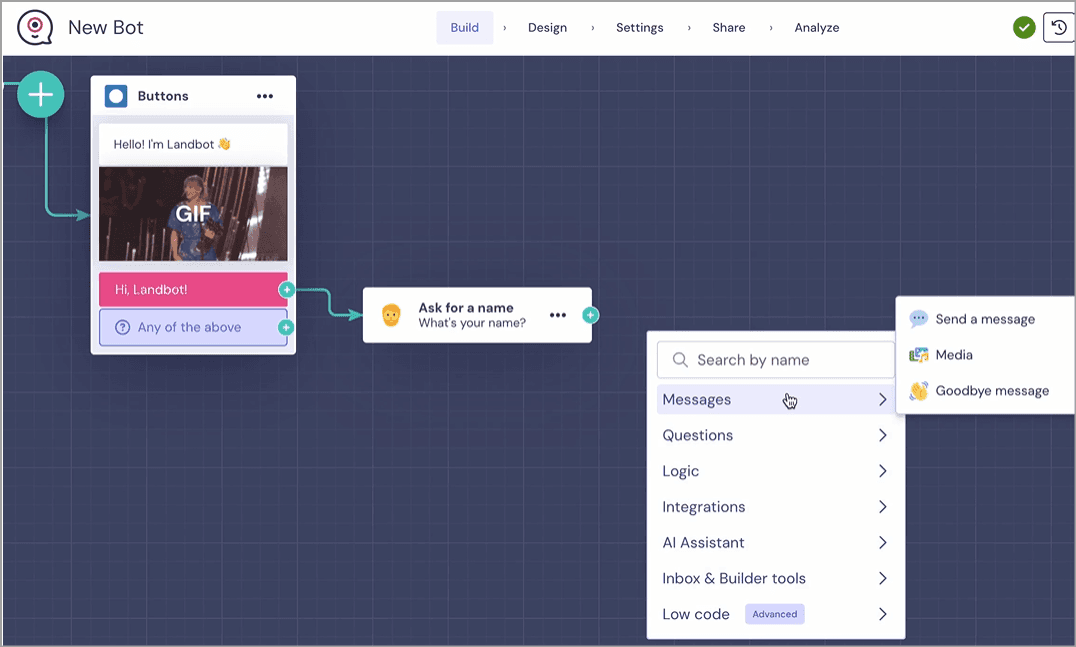
Reviewers call Landbot "Figma for chatbots," and it's an earned comparison. The drag-and-drop builder is genuinely the best-looking canvas in this category. You're working with visual blocks, conditional logic branches, and variables, not typing JSON or tackling a flowchart of dropdowns. For lead gen on a website, you can get a working bot live in an afternoon.
It runs on OpenAI and Google Gemini, and it supports multiple LLM providers and custom API connections.
There is an AI Copilot that generates flow logic from plain English prompts. It won't replace a strategist, but it cuts setup time for simple qualification flows.
What caught me off guard was the WhatsApp pricing. On the web plans, WhatsApp is not available at all. It sits on a completely separate pricing plan starting at €80/month. If your sales team depends on WhatsApp, you're paying for two products.
The other recurring complaint is collaboration. If two team members edit the same flow at the same time, changes get overwritten. There is no real-time concurrent editing. For agencies managing multiple client bots, this proves to be a deal-breaker.
For a solo marketer or a small team building web-based lead funnels, Landbot's builder UX is hard to beat. But for teams that need WhatsApp, real-time collaboration, or voice, the gaps add up.
If you want to explore this platform in detail, read our complete Landbot review and breakdown.
Pricing
Sandbox: Free — ~100 chats, 1,000 AI credits, limited builder
Starter: ~$46/month — 500 chats, 100 AI chats, 2 seats
Pro: ~$105/month — 2,500 chats, 300 AI chats, 3 seats, Calendly
Business: ~$450/month — 5 seats, custom branding, priority support
WhatsApp: From ~$233/month — Separate track, Meta Business Partner
AI chat overages billed at €0.10 per chat. Regular chat overage: €0.05/chat.
Cons: WhatsApp pricing is 3 to 14x higher than competitors. No concurrent editing (changes overwrite). No native Instagram. AI chat overages add up at scale.
3. Tidio
4.6/5 on G2
Best for: small-to-mid Shopify and WooCommerce stores that want fast-setup live chat plus an AI deflection layer.
Core Functionalities (Sales-Focused)
Lyro AI agent on Anthropic Claude with Shopify order/cart data access
Native Shopify and WooCommerce integrations with product cards
Automated cart recovery triggers and discount code delivery
Live chat with up to 10 operator seats on lower plans
Flows builder for rule-based automation sequences
Channels: web, email, Messenger, Instagram, WhatsApp
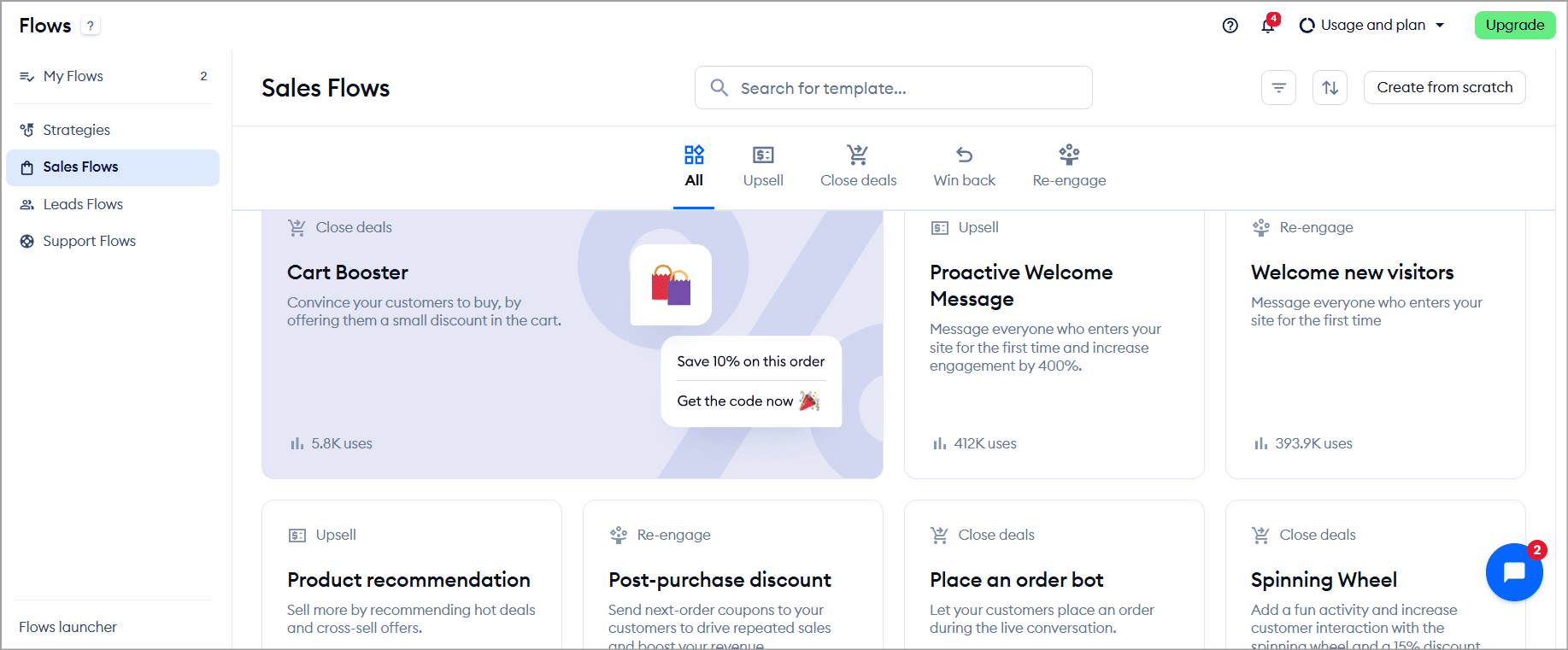
Tidio is the tool most Shopify store owners will encounter first. Setup takes under 20 minutes, the Shopify app is native, and the free plan is generous enough to test with real traffic. The live chat widget is clean, and the dashboard is easy to navigate.
The AI layer is Lyro, and it runs on Anthropic's Claude. Lyro can pull Shopify order data, surface product cards, and handle cart-related conversations. It supports 48 languages and works across web, email, Messenger, Instagram, and WhatsApp.
Now for the part Tidio's landing page won't show you.
Tidio runs on three separate meters. You have billable conversations (your base plan), Lyro AI conversations (a separate add-on starting at ~$39/month for 50 conversations), and Flows (the automation builder, metered by visitors reached). Each one has its own limit, its own overage, and its own counter.
Reviewers describe bills that doubled without notice after Tidio restructured pricing in December 2024. Multiple users used the phrase "bait and switch."
There is also a steep plan cliff you will not see coming. The Growth plan tops out at $349/month for 10 operator seats. The 11th seat forces a jump to Plus at $749/month. That's a 12x gap with nothing in between.
For a small Shopify store doing a few hundred conversations a month, Tidio works well. The free plan plus a small Lyro pack is genuinely useful. But model the full bill before you commit. The headline price and the real price are often very different numbers.
You got a little intro to Tidio, but we have also compiled a list of Tidio alternatives for you to select the best fit for your business.
Pricing
Free: $0 — 50 billable conversations, up to 10 seats, 50 Lyro conversations (lifetime)
Starter: ~$29/month — More conversations, basic automation
Growth: $59–$349/month — Scaled by volume, up to 10 operators
Plus: $749/month — 11+ operators, advanced analytics
Premium: From $2,999/month — Dedicated success manager, custom limits
Lyro AI add-on: From ~$39/month — 50 AI conversations, scales to 1,000+
Note: The free plan's 50 Lyro conversations are a lifetime allocation, not monthly.
Cons: Three separate meters make the real bill hard to predict. $349 to $749 plan cliff with nothing between. Auto-upgrade complaints also pose a problem for users.
4. ManyChat
4.5/5 on G2
Best for: creators, coaches, and e-commerce brands running Instagram and Messenger DM sales funnels.
Core Functionalities (Sales-Focused)
Comment-to-DM automation on Instagram, Facebook, and TikTok
Keyword-triggered DM flows with button/branch logic
Shopify native integration with cart recovery triggers
Multi-channel inbox: Instagram, Messenger, WhatsApp, TikTok, SMS, email
Live Chat with mobile app for human takeover
Broadcast messaging for promotions and re-engagement
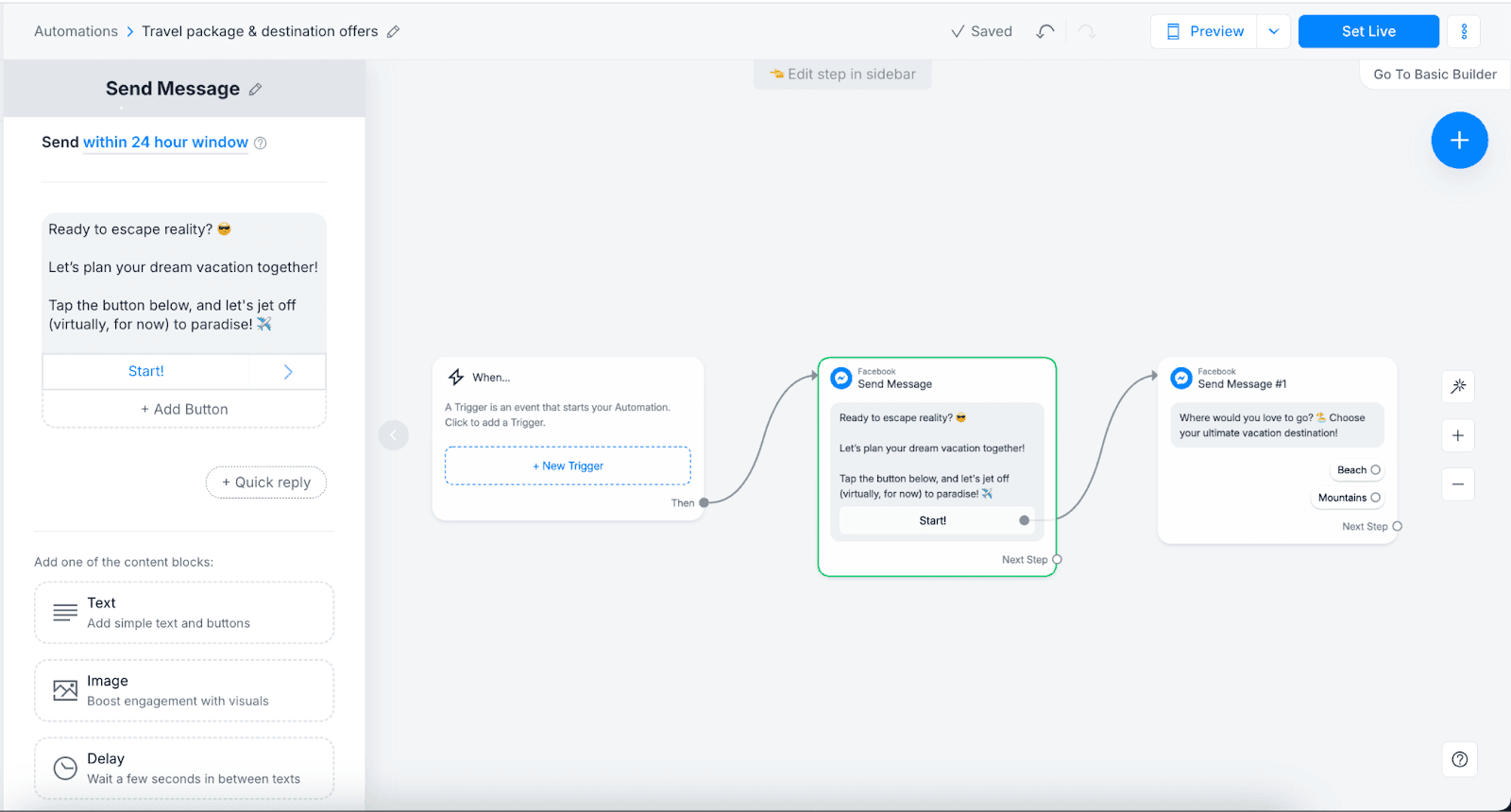
ManyChat is the tool that turned Instagram comment sections into lead-gen funnels. Someone comments a keyword on your Instagram post, and ManyChat fires off a DM with a coupon, a product link, or a qualification flow. It's For that specific use case, nothing else comes close.
The flow builder supports Instagram, Messenger, WhatsApp, TikTok (on Pro), Telegram, SMS, and email. It is a wide channel spread. You set up trigger keywords, build button-based flows, and route conversations to a live inbox.
The Shopify integration supports cart recovery and product catalog triggers natively.
But there is something I want to flag. The "AI" in ManyChat is not conversational AI. The AI Step add-on ($29/month) does keyword-based Q&A. It does not carry context between messages. It cannot learn from your content or hold a multi-turn conversation. If someone asks a follow-up question, it starts from scratch. You can call it automation, not intelligence.
Then there is the pricing shift. On March 2, 2026, ManyChat cut its free plan from 1,000 to 25 active contacts. That's a 97.5% reduction.
The free tier is enough to see the builder, not to run a business. Multiple reviewers noted that ManyChat charges based on active contacts, even if you never message them.
For Instagram and Messenger-first sales funnels, ManyChat is still the default choice. It owns the comment-to-DM flow. But for anything that requires actual AI conversation, contextual qualification, or in-chat meeting booking (you'll need to send a Calendly link instead), it falls short.
Check out the best ManyChat alternatives, which might be a better fit for your business.
Pricing
Free: $0 — 25 active contacts, 2 channels, 4 automations
Essential: $14/month — 250 contacts, basic flows
Pro: $29/month — 2,500 contacts, AI included, all channels
Business: $69/month — 7,500 contacts, advanced analytics
Advanced: $139/month — 25,000 contacts, priority support
AI add-on: ~$29/month — Keyword-based Q&A (separate from Pro AI)
Contact-based billing with per-contact overages. WhatsApp and SMS carry additional Meta/carrier fees on top.
Cons: AI add-on is keyword matching, not conversational AI. Free plan cut to 25 contacts (March 2026). Contact-based billing means the bill grows with your audience, even for untouched contacts.
5. Apollo.io
4.7/5 on G2
Best for: outbound SDR teams and founders running US-focused prospecting who want a database, sequencer, and dialer in one tool.
Core Functionalities (Sales-Focused)
275M+ contact database with email and phone enrichment
AI Lead Finder (natural-language ICP search)
Multi-step email sequences with AI-drafted outreach
Native dialer with call recording and AI summaries (Professional+)
Parallel dialer add-on for simultaneous calls
Native Salesforce and HubSpot CRM sync
Bombora intent data integration
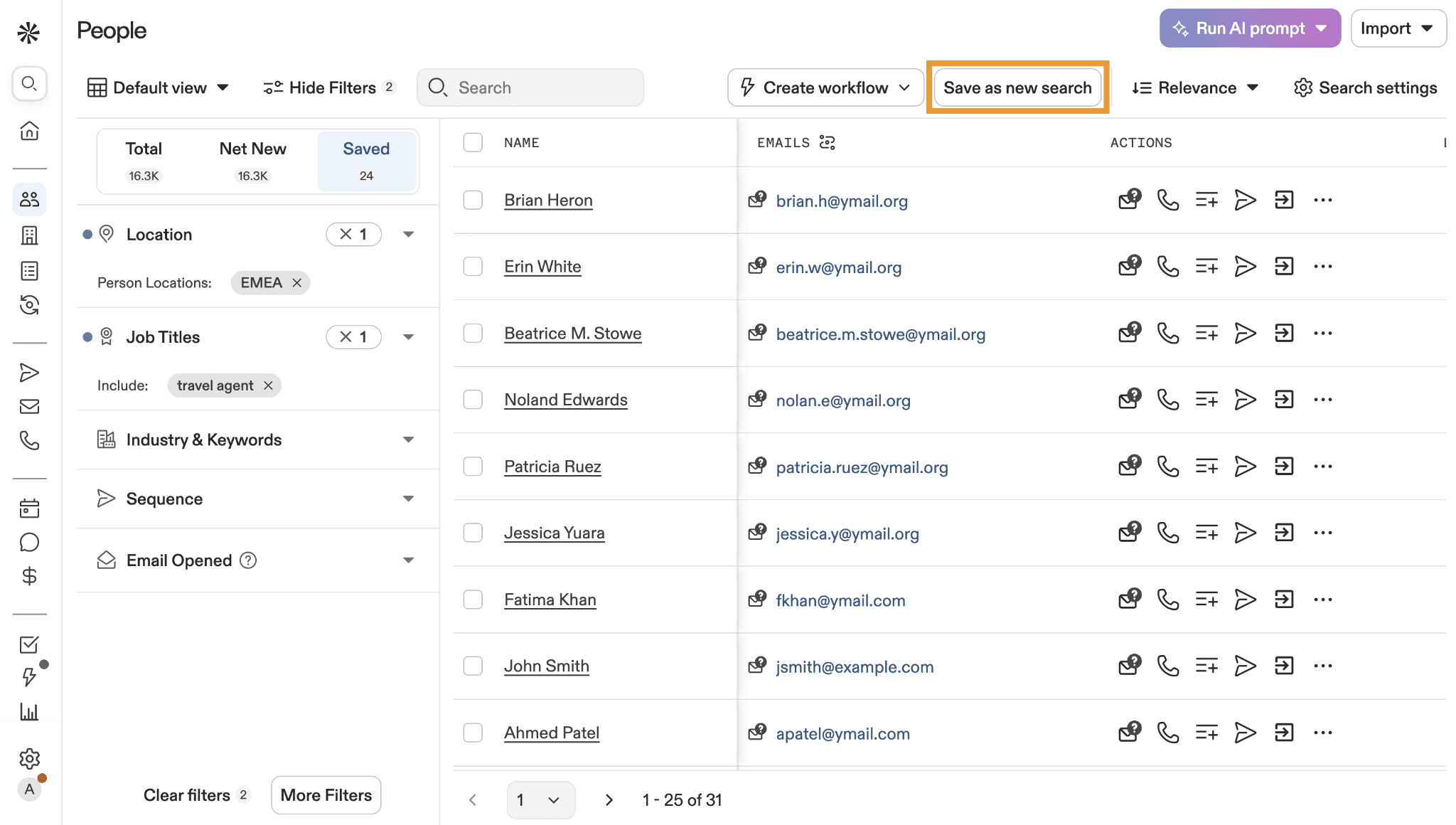
Apollo is not a chatbot. Let's get that out of the way. There is no website widget, no visitor engagement, no live chat. Apollo is an outbound sales engine. It has a 275M+ contact database, email sequences, a dialer, enrichment tools, and intent data through a Bombora integration.
It shows up in "best sales chatbots" lists because of its AI-assisted features. The AI Lead Finder lets you describe your ideal customer in natural language, and Apollo returns matching contacts.
The AI email writer drafts outreach sequences. A parallel dialer add-on lets SDRs run simultaneous calls. These are useful, but they are prospecting tools, not conversational agents.
What Apollo does, it does at a price point that's hard to beat. The free plan gives you a usable starting point. The Basic plan at $49/user/month includes email sequences and 900 credits. The Professional plan at $79/user/month adds the dialer and AI features.
The catch is data accuracy. It is the single most-discussed complaint on G2 (hundreds of mentions). Phone number data is especially weak and expensive, costing roughly 8 credits per reveal compared to 1 credit for an email.
I noticed this while going through the reviews: Apollo users who stay within US-focused B2B outbound love it. The moment you expand internationally or expect phone data to be reliable, the complaints multiply fast.
Pricing
Free: $0 — 1 user, limited credits, basic search
Basic: $49/user/month (billed annually) — 900 credits/year, email sequences, filters
Professional: $79/user/month (billed annually) — Dialer, AI features, advanced reports
Organization: $119/user/month (billed annually) — 3-seat minimum, data enrichment, intent
Enterprise: Custom — Custom limits, SSO, dedicated support
Credit overages at ~$0.20 each (250-credit minimum). Credits do not roll over.
Cons: Data accuracy drops sharply outside the US. Credit system with no rollover is the real cost driver, not the seat price.
6. Qualified (Piper)
4.9/5 on G2
Best for: enterprise B2B SaaS companies on Salesforce with strong inbound website traffic and a $100K+ pipeline budget.
Core Functionalities (Sales-Focused)
Real-time Salesforce-data-driven visitor qualification (chat, voice, and video)
Automated meeting booking on the right rep's calendar
Visitor intent scoring against live CRM records
Email follow-up and nurture for non-converting visitors
Dedicated Success Architects for onboarding and optimization
Website-only engagement (no outbound, no social, no WhatsApp)
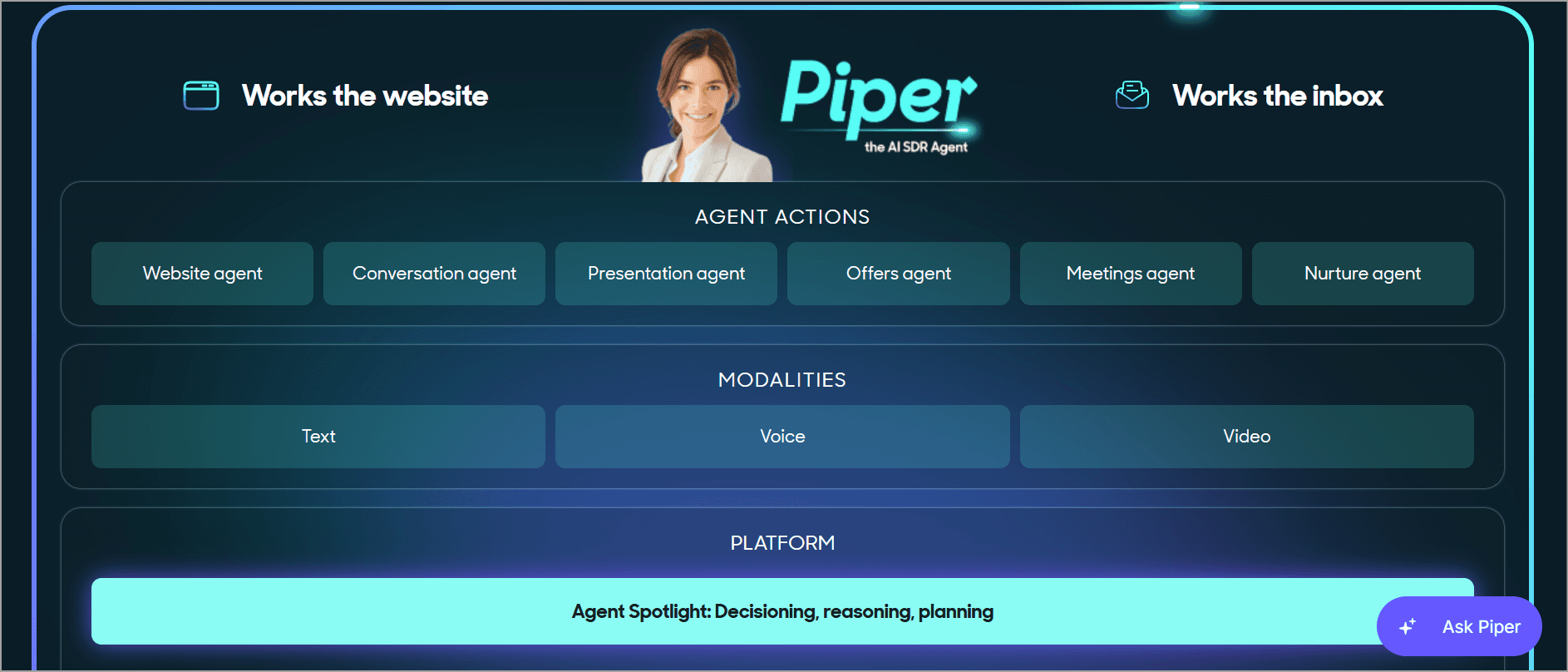
Qualified's Piper is the highest-rated tool on this list. And the reason is specific: Piper engages website visitors via chat, voice, and video. It qualifies them in real time against live Salesforce data, and books meetings on the right seller's calendar. Piper does this 24/7 without a human in the loop.
Salesforce completed its acquisition of Qualified on April 1, 2026. So Piper is now part of the Salesforce ecosystem officially. Every visitor interaction logs directly to Salesforce. Lead records are auto-created and updated. The Salesforce integration is not a connector. It is the foundation.
That's also the limitation. Piper requires Salesforce. If you're on HubSpot, Pipedrive, or anything else, this tool doesn't work for you. Multiple reviewers and community posts describe this as full vendor lock-in.
Looking at the cost picture, it tells a clear story. Qualified publishes no pricing. Third-party reconstruction from Vendr and MarketBetter data puts the Premier tier at roughly $40K to $68K per year for Qualified alone. Add the required Salesforce stack ($30K to $60K per year), and total cost of ownership lands between $95K and $165K annually. Implementation takes 30 to 60 days and requires dedicated RevOps resources.
Piper is also inbound-only. There are no outbound sequences, no dialer, no LinkedIn automation. If a target account doesn't visit your website, Piper doesn't see them. For companies with strong inbound traffic, that's fine. For everyone else, you are paying six figures for half the equation.
Pricing
No public pricing. Three tiers: Premier, Enterprise, Ultimate, all "Schedule a Demo."
Cons: Full Salesforce lock-in. No outbound or multi-channel coverage. $95K+ total cost of ownership makes it inaccessible for SMB and mid-market teams.
How It Compares to WotNot: Qualified is the specialist for enterprise Salesforce inbound. WotNot serves the same qualify-and-book use case at roughly 1/50th the cost, without CRM lock-in, but with less depth in Salesforce-native routing and ABM scoring. Enterprise inbound on Salesforce? Qualified. Everyone else? WotNot is in the conversation.
7. Salesforce Agentforce
4.3/5 on G2
Best for: existing Salesforce enterprises with a dedicated admin or developer team and clean CRM data.
Core Functionalities (Sales-Focused)
Autonomous Lead Nurturing agent (qualification, outreach, follow-up, booking)
Multi-step agentic actions within Sales Cloud and Service Cloud
Grounded in live CRM data (Einstein/Atlas Reasoning Engine)
Custom Topics and Actions for defining agent behavior
Human handoff to AEs with full context
Native Salesforce ecosystem (AppExchange, Slack, Tableau)
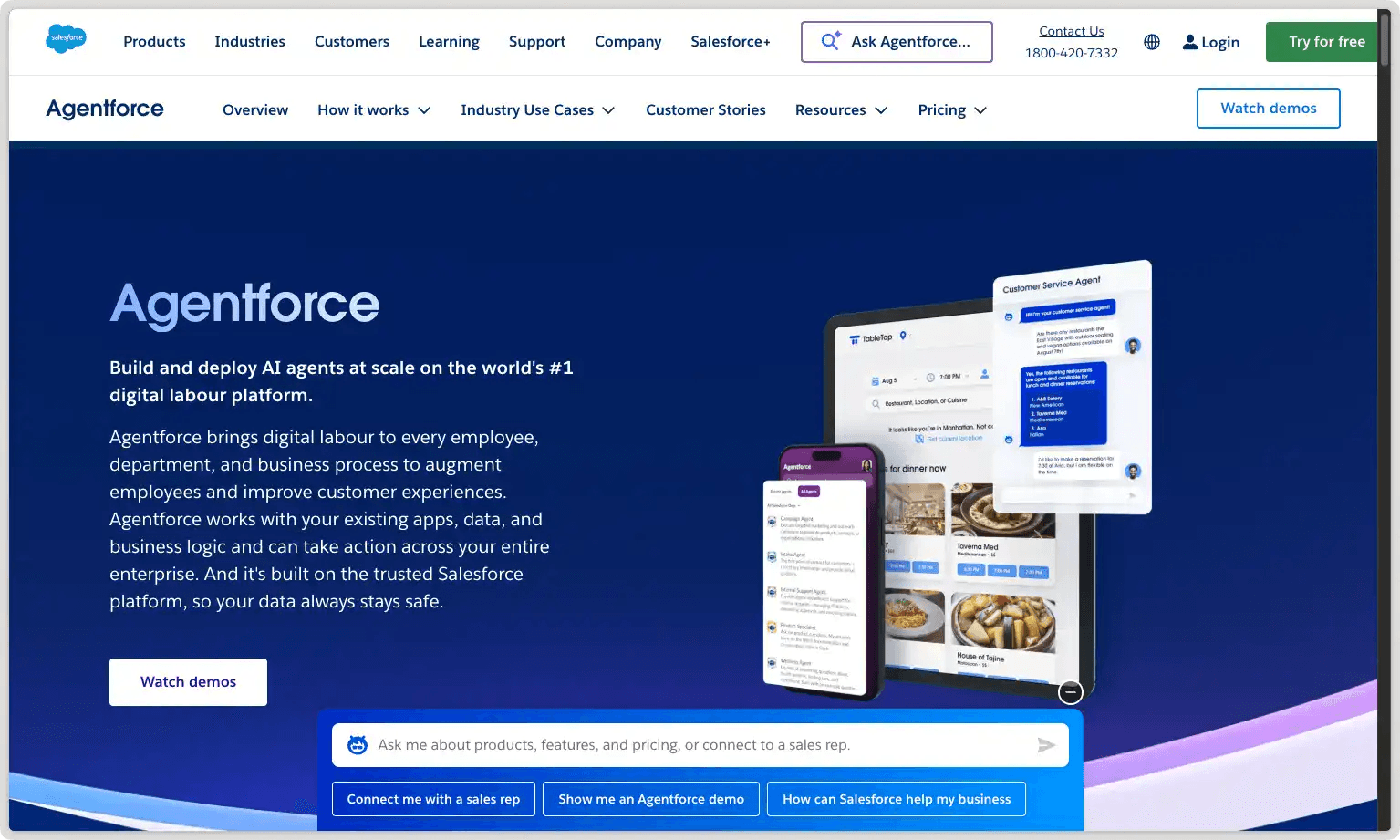
Agentforce is Salesforce's agentic AI layer. It builds autonomous agents that sit inside Sales Cloud, Service Cloud, or Commerce Cloud and take multi-step actions: qualifying leads, booking meetings, sending follow-up emails, updating records, handling handoff.
The Lead Nurturing agent (previously called the SDR agent) is the sales-relevant piece. Salesforce describes it as an autonomous agent that handles initial outreach, follow-up, answering questions, and booking meetings. Qualification criteria are written as explicit rules against CRM fields.
The problem is getting there. Setup requires an admin or consultant, even for experienced developers. Implementation costs run $50K to $150K for professional services, plus $10K to $25K per month for ongoing consulting, with timelines of 4 to 16 weeks depending on the number of agents.
The pricing model has also changed three times in roughly 18 months. It started at $2 per conversation (September 2024), moved to Flex Credits at $0.10 per action (May 2025), and then added per-user licenses at $125/user/month in late 2025/2026.
As one G2 reviewer put it, the price is not clear and hard to find, and adoption remains low because of confusion.
The agents also degrade on low-quality CRM data. If your Lead object has duplicates, incomplete fields, or stale records, Agentforce makes confident wrong decisions.
Pricing
Foundations (free tier): $0 — 200,000 Flex Credits for Enterprise Edition+
Flex Credits: $500 per 100K credits — ~$0.10 per standard action (20 credits each)
Conversations: $2 per conversation — Original model, still available
Agentforce User License: $5/user/month — Base access
Agentforce Add-ons: $125–$150/user/month — Full agent builder features
Cons: Implementation requires consultants ($50K-$150K+). Pricing model has shifted three times in 18 months. Agent quality degrades on dirty CRM data.
8. Intercom Fin AI
4.5/5 on G2
Best for: support-heavy teams that want outcome-based pricing and are experimenting with AI-driven lead qualification.
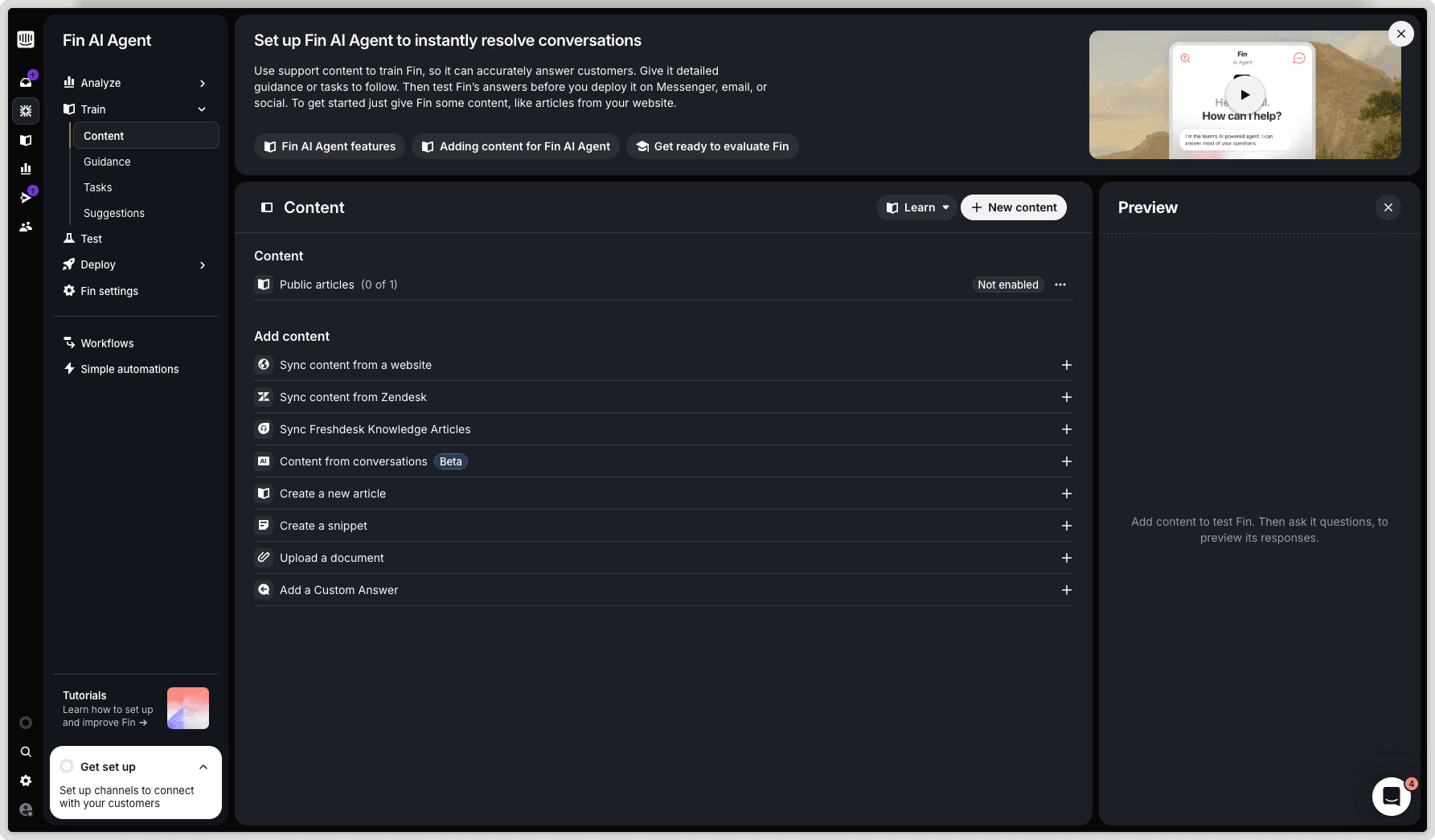
Core Functionalities (Sales-Focused)
Fin for Sales with real-time visitor qualification (needs/budget/timeline)
AI playbook generation from your pricing page URL
Native meeting booking in Messenger + Calendly integration
Lead data enrichment via CRM + real-time web research
Multi-channel: chat, email, WhatsApp, SMS, phone, Slack
45+ language auto-detection
Human handoff with full conversation context and routing rules
Intercom started as a customer messaging platform. Fin is its AI agent, and it is genuinely good at what it was built for: resolving support tickets across chat, email, WhatsApp, SMS, phone, and Slack. It answers questions using RAG (retrieval-augmented generation), grounded in your Help Center, docs, PDFs, and snippets.
In April 2026, Intercom launched Fin for Sales, which extends the agent into lead qualification. It engages visitors, qualifies them against criteria you define (needs, budget, timeline), enriches data via CRM and real-time web research, and books meetings natively or via Calendly. You can generate a qualification playbook from your pricing page URL. It supports 45+ languages with automatic detection.
Here is something I found while going through the pricing: Intercom charges $0.99 per outcome for support resolutions. For a sales lead qualification, the cost is $9.99 per qualified lead. That is 10x the support outcome. There is a 50-outcome minimum (~$49.50 per month floor).
And the bill grows as the AI gets better, which is the core tension.
Reddit users and community reports describe bills jumping from $4,000 to $9,000 per month as Fin resolved more conversations autonomously. The AI improving is supposed to be good news. With outcome pricing, it's also a cost event.
One more thing: Salesforce signed a definitive agreement to acquire Fin (Intercom renamed itself to Fin in May 2026) in June 2026. The deal is expected to close in Q4 of Salesforce's fiscal 2027. Pricing is unchanged for now, but worth watching for post-acquisition repackaging.
Pricing
Per resolution/handoff: $0.99 — Support outcomes
Per lead qualification: $9.99 — Sales outcomes
Minimum: 50 outcomes/month — ~$49.50 floor
Standalone (non-Intercom): $49/month base — Includes 50 resolutions, then $0.99 each
Intercom seats: ~$29–$139/seat/month — Billed separately from outcome fees
Escalated conversations (human handoff) are not billed.
Cons: Outcome pricing means the bill rises as the AI improves. Real-world resolution rate is significantly below marketing claims. The $9.99 per qualified lead cost is steep at scale.
9. HubSpot Breeze
4.4/5 on G2
Best for: teams already on HubSpot Service Hub Professional or Enterprise that want AI bolted onto their existing CRM.
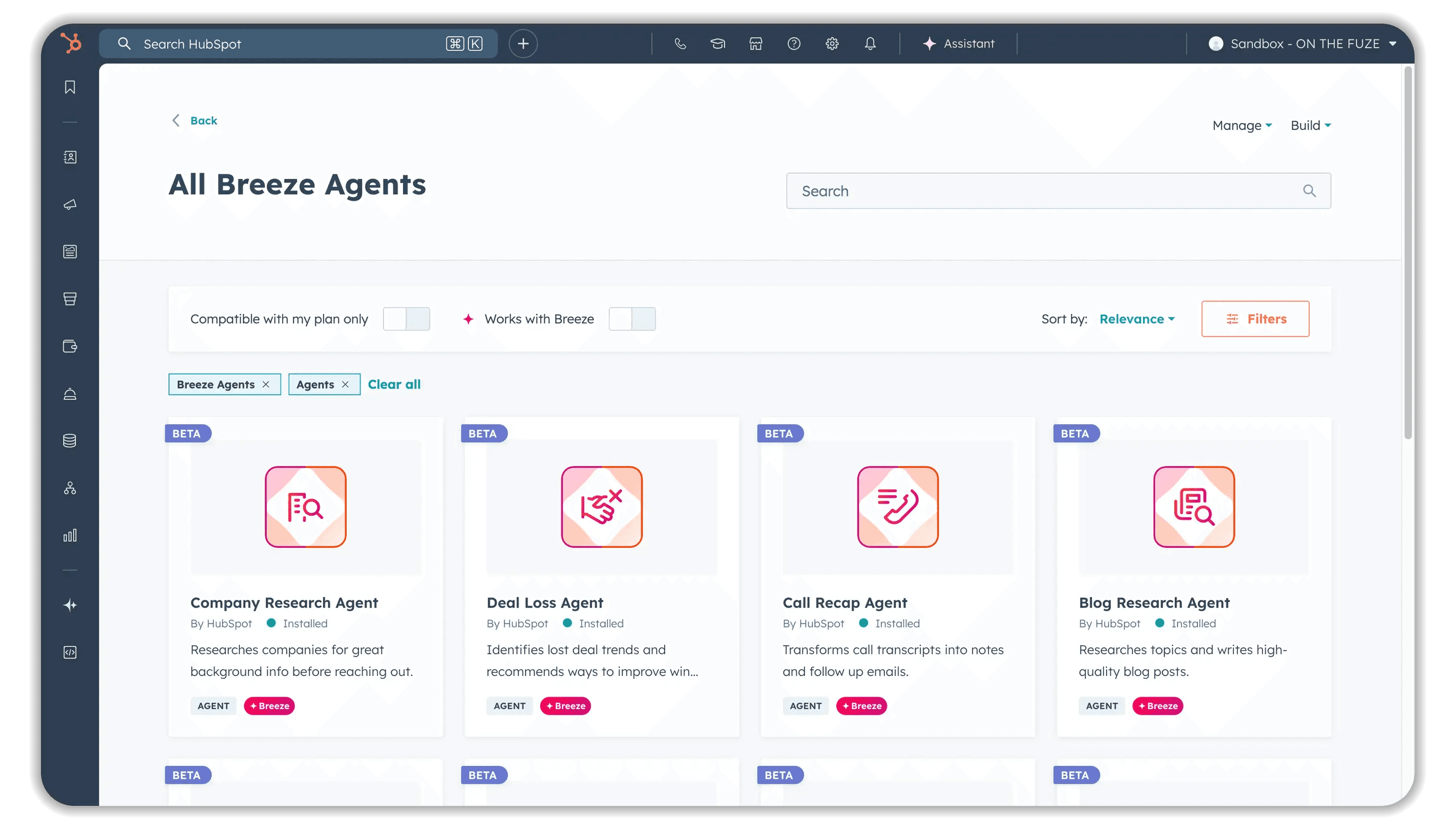
Core Functionalities (Sales-Focused)
Prospecting Agent with buying-signal monitoring (funding, hiring, leadership changes)
Customer Agent for knowledge-grounded visitor qualification
Native HubSpot CRM context (full contact/deal/company data)
AI-drafted personalized outreach sequences
Meeting booking via HubSpot Meetings scheduler
Human handoff with Audit Cards preserving decision context
HubSpot's Breeze splits into two agents: the Customer Agent (support-focused) and the Prospecting Agent (sales-focused). The Customer Agent answers questions using your knowledge base and CRM context. The Prospecting Agent monitors accounts for buying signals like funding rounds, leadership changes, and hiring surges, then drafts personalized outreach.
The sales angle is the Prospecting Agent. At $1.00 per qualified lead, it surfaces accounts showing intent and builds outreach sequences automatically. The Customer Agent, at $0.50 per resolved conversation, handles the support side and can qualify visitors against criteria you set. Both log decisions in an "Audit Card" inside HubSpot.
Because Breeze lives inside HubSpot's CRM, it has full context on every contact. Conversation history, deal stage, company properties, it's all there. For teams already deep in HubSpot, that context is the value. No data sync, no connector, no mapping exercise.
But the "resolved" definition is where things get tricky. HubSpot counts a conversation as resolved when the agent shares any knowledge source or takes an action with no human handoff within 72 hours. Lowcode Agency's analysis pointed out that this means the business pays whether or not the question was actually answered. If the customer comes back after the 72-hour window, it can trigger a new billable resolution on the same issue.
The AI is also gated behind expensive hubs. You need Service Hub Professional at ~$90/seat/month or Enterprise at ~$150/seat/month. Plus onboarding fees ($1,500 for Pro, $3,500 for Enterprise). For a team not already on HubSpot, you are buying a CRM to access a chatbot.
Pricing
Customer Agent: $0.50/resolved conversation — “Resolved” = content shared, no handoff in 72 hours
Prospecting Agent: $1.00/qualified lead — Buying signal detection + outreach
Included credits: 500 (Starter), 3,000 (Pro), 5,000 (Enterprise) — Monthly allocation
Required: Service Hub Pro: ~$90/seat/month — Plus ~$1,500 onboarding
Required: Service Hub Enterprise: ~$150/seat/month (10-seat minimum) — Plus ~$3,500 onboarding
28-day free trial available.
Cons: "Resolved" definition allows double-billing on the same issue. AI gated behind $90+/seat Hub plans. Not worth it purely as a chatbot if you're not already on HubSpot.
Let’s build your chatbot today!
Launch a no-code WotNot agent and reclaim your hours.
Let’s build your chatbot today!
Launch a no-code WotNot agent and reclaim your hours.
How to Pick the Right One
Different sales motions need different tools. Here is the shortest path to the right one.
If you run B2B outbound and need to find prospects: Apollo.io. It is a database and sequencing tool, not a chatbot, but it is the best value for US-focused SDR teams.
If you run B2B inbound on Salesforce with a six-figure budget: Qualified (Piper). Best-in-class inbound AI SDR. But only if you have Salesforce, the traffic, and the budget.
If you run a Shopify or e-commerce store: Tidio. Native Shopify integration with Lyro AI is hard to beat for cart recovery and product-question deflection. Just model the full bill across all three meters before committing.
If your sales motion is Instagram or Messenger DM funnels: ManyChat. It invented the comment-to-DM flow and still owns it.
If you are already deep in HubSpot: HubSpot Breeze. The CRM context is the value. But only if you're already on Service Hub Pro or Enterprise.
If you are already deep in Salesforce and have an admin team: Agentforce. Multi-step agentic actions are more advanced than anything else here. Just budget for the implementation.
If you want no-code, omnichannel, flat-priced sales + support without lock-in: WotNot. Lead qualification, meeting booking, WhatsApp, Messenger, and multi-LLM AI on a predictable monthly plan. No per-resolution surprises, no CRM lock-in, no consultant required.
If you need support ticket deflection (not sales): Intercom Fin. They are excellent at what they do. Just know they were built for support first.
FAQs
FAQs
FAQs
What is the best AI chatbot for sales?
What is the difference between an AI SDR and a sales chatbot?
Which chatbot is best for small businesses?
Do sales chatbots actually increase revenue?
ABOUT AUTHOR

Hardik Makadia
Co-founder & CEO, WotNot
Hardik leads the company with a focus on sales, innovation, and customer-centric solutions. Passionate about problem-solving, he drives business growth by delivering impactful and scalable solutions for clients.

Start building your chatbots today!
Curious to know how WotNot can help you? Let’s talk.
Start building your chatbots today!
Curious to know how WotNot can help you? Let’s talk.