17 min read
7 Best ManyChat Alternatives in 2026

Hardik Makadia

Let’s build your chatbot today!
Launch a no-code WotNot agent and reclaim your hours.
*Takes you to quick 2-step signup.
Looking for a ManyChat alternative does not always mean a bad experience. Sometimes teams simply hit the edge of what the platform was built to do.
After working with hundreds of businesses on conversational AI deployments, I have seen this pattern repeat consistently. The teams looking for a ManyChat alternative almost always fall into one of three groups.
The first group has hit a pricing ceiling. ManyChat's cost structure makes sense at low volume. It stops making sense when you scale.
The second group needs to go beyond Meta. Instagram and Facebook Messenger are where ManyChat lives. If your customers are on WhatsApp, your website, or SMS, you are working around the tool rather than with it.
The third group has outgrown the flow-builder model entirely. They are not looking for a smarter script. They want an AI agent that can reason through a conversation, take action across systems, and hand off to a human without losing context.
The alternatives to ManyChat are reviewed against one of those three situations. If you know which group you are in, you will know which tool belongs on your shortlist.
What ManyChat Does Well and Where It Falls Short
ManyChat earned its reputation for a reason. The flow builder is genuinely easy to use. You can have a working bot on Instagram or Facebook Messenger in under an hour without touching a line of code. For small businesses running social media-driven marketing campaigns, that speed and simplicity is real value.
The limitations only become visible once you push beyond that original use case. We covered the platform end to end in our full ManyChat review, but here are the three limits that send most teams looking elsewhere.
1. Channel dependency on Meta platforms
ManyChat is built around Instagram, Facebook Messenger, and WhatsApp. If those are your primary channels, that is fine. But over 90% of marketers use their website as a primary lead generation channel.
The moment your customers want to reach you through website chat, SMS, or any non-Meta channel, you are either adding a separate tool or going without.
For teams managing support across multiple touchpoints, that dependency creates gaps that compound over time.
2. A flow-builder model showing its age
ManyChat's automation is built on decision trees. You map out every possible path, anticipate every question, and script every response. That works well when interactions are predictable and linear.
But it breaks down the moment a conversation goes off-script, which happens constantly in real customer interactions.
AI-native platforms handle those deviations without failing. ManyChat routes them to a dead end or a human.
3. Pricing that does not scale cleanly
ManyChat's free plan is useful for people who are just getting started. But not for quite long.
The jump to paid plans, and the cost structure beyond that is where teams start doing the maths and coming up short. The free plan now covers just 25 active contacts a month, down from 1,000 before March 2026. From there, paid plans run $17 to $199 per month depending on how many contacts are included, and every tier bills extra per contact once you go over, which is where costs get hard to predict as you scale. (ManyChat pricing, checked September 2026.)
At higher contact volumes, the pricing compounds in ways that are difficult to forecast, which makes budgeting unpredictable as you grow.
If one of these three limitations is what brought you here, the rest of this list will give you a direct answer for your situation.
Here is a quick overview of all six platforms before the full reviews.
Tool | Best For | Free Plan | Starting Price | Key Differentiator |
AI automation with human handoff | No (14-day trial) | $29/month | Multi-LLM AI agent with zero-restart handoff across all channels | |
Meta channel automation | No (7-day trial) | $69/month | Single flat-rate plan covering WhatsApp, Instagram, Facebook, and TikTok | |
Enterprise AI-first support | No (14-day trial) | $29/seat/month + $0.99/AI resolution | Fin AI agent deployable on top of existing helpdesks | |
SMB live chat and AI hybrid | Yes | $24.17/month | Free plan available with conversation-based pricing | |
Conversational lead capture | Yes (100 chats/month) | €40/month | Replaces static forms with interactive conversational flows | |
CRM-connected bot on a budget | Yes | $0 (Free plan) | Native HubSpot CRM integration, no additional tool required | |
AI appointment setting in Meta DMs | No (7-day trial, card required) | $25/month | AI setter that qualifies leads and books calls inside the DM thread |
(All prices based on monthly billing. Annual billing reduces costs across all platforms. Landbot prices in euros.)
The Best ManyChat Alternatives in 2026
Every platform below is reviewed against a specific use case. The goal is not to give you the longest list. It is to give you the right shortlist.
1. WotNot

WotNot is a no-code AI agent platform used by teams across SMBs and enterprises for customer support, lead qualification, onboarding, and sales automation.
What separates it from ManyChat is how far the automation actually goes. ManyChat gives you a script. WotNot gives you an agent that can reason through a conversation, take action across backend systems, and complete the interaction end-to-end. You can create a whole knowledge base for your AI agents to train in the platform’s AI Studio.
The part most platforms get wrong is what happens when the AI reaches its limit. Most escalations feel like a restart for the customer. The agent picks up cold, asks the same questions the bot already asked, and the customer has to repeat everything.
WotNot is built specifically around that moment. The agent sees intent, collected data, and the full conversation history before typing a single word. The conversation continues rather than restarting.
If WhatsApp is the channel you are trying to replace ManyChat on, WotNot's WhatsApp chatbot runs the same agent you deploy everywhere else, with no separate build.
Capabilities
AI Chatbot and automation across website, WhatsApp, Facebook Messenger, Instagram, and SMS
AI Studio: multi-LLM support (OpenAI, Anthropic, Gemini, Mistral), train on your own knowledge base
Live Chat with zero-restart human handoff
Outbound Bots and proactive campaigns
Voicebot
CRM integrations (Salesforce, HubSpot, Zoho)
Appointment booking (Google Calendar, Outlook, Calendly)
Where it stands out
Zero-restart handoff across every channel, not just website chat
No model lock-in: switch between OpenAI, Anthropic, Gemini, and Mistral without retraining
One build deploys across every channel without separate configurations
Flat monthly pricing with no per-resolution fees
The honest trade-off
WotNot's depth means a real learning curve. If you are switching from ManyChat purely to run Instagram DM automation on a simpler tool, WotNot has more capability than you will use on day one. It is built for teams ready to move beyond flow-builders, not teams looking for a lighter version of one.
Best for
Teams that have outgrown ManyChat's flow-builder model and need autonomous AI agents, clean human handoff, and multi-channel deployment that goes well beyond what a script-based tool can handle.
Pricing
Lite: $29/month — 1,000 chats, 1,000 AI credits, no-code agent builder, Zapier integration
Starter: $99/month — 5,000 chats, 5,000 AI credits, AI Studio, all LLM models, integrations, ticketing support
Premium: $299/month — 10,000 chats, 10,000 AI credits, Live Chat, HTTP requests, hide branding, customize chat widget
Enterprise: Custom — unlimited chats, unlimited credits, professional services, InfoSec and legal review, SSO integration, custom integrations, priority support
(All plans include a 14-day free trial.)
Start building, not just reading
Build AI chatbots and agents with WotNot and see how easily they work in real conversations.
Try WotNot for Free
Start building, not just reading
Build AI chatbots and agents with WotNot and see how easily they work in real conversations.

Start building, not just reading
Build AI chatbots and agents with WotNot and see how easily they work in real conversations.
Start building, not just reading
Build AI chatbots and agents with WotNot and see how easily they work in real conversations.

2. Chatfuel

Chatfuel is a no-code messaging automation platform built specifically for Meta channels: WhatsApp, Instagram, Facebook Messenger, and TikTok DMs. If ManyChat is what you know and Meta channels are where your customers are, Chatfuel is a good direct switch available.
The interface is clean, and the visual flow builder is genuinely easy to use. Its Fuely AI engine, based on GPT-class models, automates FAQs, lead qualification, bookings, reminders, and follow-ups while handing off to human agents in live chat when needed.
For teams that want to stay inside the Meta ecosystem but need something slightly more capable or better priced than ManyChat, Chatfuel covers the same ground with a few meaningful additions.
Capabilities
Visual flow builder for Facebook, Instagram, WhatsApp, and TikTok DMs
Fuely AI engine for FAQ automation, lead qualification, and appointment booking
Live chat with human handoff
Broadcast and re-engagement campaigns
Integrations with Shopify, Google Sheets, Zapier, Calendly, and Kommo CRM
Website chat widget
Where it stands out
Official Meta partnership with deep integrations across Instagram, WhatsApp, and Facebook Messenger
AI engine handles bookings, reminders, and follow-ups beyond basic FAQ deflection
Flat $69/month covers all channels with no per-seat or per-conversation fees, making costs predictable regardless of volume
7-day free trial with no credit card required
The honest trade-off
Chatfuel lives inside the Meta ecosystem. If you're looking for a more versatile solution that goes beyond social media automation, you will hit its ceiling quickly.
Website chat is available, but it is not where the platform is strongest. Teams needing omnichannel support beyond Meta channels will need a different tool.
Best for
Teams already running ManyChat for Instagram or Facebook automation who want a comparable tool with a cleaner interface, AI-assisted flows, and more predictable pricing.
Pricing
One plan: $69/month — all channels included (WhatsApp, Instagram, TikTok, Facebook, website widget), AI agent, CRM, smart booking, unlimited team members
7-day free trial available
(All channels included in one plan. No per-seat or per-conversation fees.)
3. Intercom

Intercom is an AI-first customer service platform built around Fin, its AI agent. It handles support across live chat, email, WhatsApp, social, and phone from one workspace.
The reason it appears on a ManyChat alternatives list is not that it competes on the same ground. It does not.
Intercom is for teams that have moved past marketing automation entirely and need a platform built around AI-driven support at scale. If ManyChat was handling your customer-facing conversations and you have realized you need something built for resolution rather than campaigns, Intercom is worth evaluating. Fin also works as a standalone product, deployable on top of Zendesk or Salesforce without requiring a full platform migration.
If the price is what gives you pause, we break down the cheaper options in our guide to Intercom alternatives.
Capabilities
Fin AI Agent across live chat, email, WhatsApp, SMS, social, and phone
Shared inbox and ticketing system
Workflow automation builder
Knowledge base and help center
AI Copilot for human agents
450+ integrations, including Salesforce, HubSpot, Zendesk, and Freshworks
Where it stands out
Fin validates responses before sending, which reduces inaccurate answers in customer-facing conversations
Resolution-based pricing means you only pay when Fin actually resolves a conversation
The honest trade-off
Billing is genuinely complex. The $0.99 per Fin outcome fee compounds on top of per-seat costs. During high-volume periods, costs become difficult to forecast. It is also a significant step up in complexity and cost from ManyChat. Teams switching from ManyChat primarily because of price will find that Intercom moves costs in the wrong direction entirely.
Best for
Teams that have outgrown marketing automation tools entirely and need a platform built for AI-driven customer support across multiple channels at scale.
Pricing
Essential: $29/seat/month (billed annually) + $0.99 per Fin outcome
Advanced: $85/seat/month (billed annually) + $0.99 per Fin outcome
Expert: $132/seat/month (billed annually) + $0.99 per Fin outcome
Fin standalone (on Zendesk/Salesforce): $0.99 per outcome, 50 outcomes minimum per month
(All prices billed annually. 14-day free trial.)
4. Tidio

Tidio is a customer service platform that combines live chat, AI automation, and a help desk in one interface. It is built primarily for SMBs and e-commerce teams that need website chat and basic AI automation without enterprise complexity.
For teams switching from ManyChat, Tidio covers website chat and some social channel integrations, but it approaches automation differently.
Rather than social media-first marketing flows, it focuses on customer support conversations on your website, Shopify store, or help desk. If conversation-based billing is the part you are unsure about, our roundup of Tidio alternatives compares the pricing models side by side.
Capabilities
Live chat with human agents
Lyro AI agent for automated support conversations
Flows: rule-based chatbot automation
Help desk and ticketing
Integrations with Shopify, WordPress, Wix, Facebook Messenger, Instagram, and Zapier
Mobile apps for iOS and Android
Where it stands out
Conversation-based pricing rather than per-seat, which keeps costs predictable for small teams
Quick setup: most teams are live within an hour
Lyro AI handles up to 67% of routine queries, according to the platform's published case studies
The honest trade-off
The advertised starting price of $24.17/month is not what most teams actually pay. Lyro AI is a separate add-on starting at $32.50/month for 50 conversations. Flows automation is also separate, starting at $24.17/month for 2,000 visitors reached.
Teams using both live chat and AI automation typically land between $80 and 150 permonth.The jumpfrom Growth(49.17/month) to Plus ($749/month) is steep for teams that need more than the Growth plan's conversation limits.
Best for
Small e-commerce and SMB teams that need a website live chat with basic AI automation, and want a free starting point before committing to a paid plan.
Pricing (Customer Service Platform)
Starter: $24.17/month — 100 billable conversations, 50 Lyro AI conversations included (one-off), live chat, and ticketing
Growth: $49.17/month — 250 billable conversations, advanced analytics, automatic assignment, user permissions
Plus: $749/month — custom conversation quota, departments, custom branding, dedicated success manager, OpenAPI
Premium: Contact for pricing — 3,000+ Lyro AI conversations, guaranteed 50% AI resolution rate, managed service, compliance, SSO
Add-ons:
Lyro AI Agent: from $32.50/month (50 AI conversations)
Flows automation: from $24.17/month (2,000 visitors reached)
(7-day free trial on Starter and Growth.)
5. Landbot

Landbot is a no-code chatbot builder that replaces static forms and landing pages with conversational flows. Instead of a form, visitors answer questions through a chat-style interface across website chat, Facebook Messenger, and WhatsApp.
It is a different kind of switch from ManyChat. Rather than replicating social media automation, Landbot is for teams that want to capture and qualify leads through conversation rather than forms. If you need those conversations to continue after the lead is captured, our list of Landbot alternatives covers tools built for that.
Capabilities
No-code visual flow builder for web, Facebook Messenger, and WhatsApp
Landbot AI Agents for automated conversations
WhatsApp opt-in tools and campaigns
Integrations with Stripe, Calendly, Mailchimp, Segment, Google Analytics, Zapier, and Slack
Human takeover with live chat handoff
A/B testing for conversation flows
Custom code support (CSS/JS) on higher plans
Where it stands out
Replaces static forms with conversational flows that typically improve lead capture rates
WhatsApp Business Number included on WhatsApp Pro plan
Conversation-based pricing means you are not paying per seat
Free sandbox plan available with 100 chats per month, no credit card required
The honest trade-off
Landbot is built for lead capture and form replacement, not customer support or post-sale workflows. It does not have a native helpdesk or ticketing system. Teams that need ongoing support conversations rather than one-time lead qualification flows will hit the ceiling quickly. Pricing is also in euros, which adds unpredictability for teams budgeting in USD.
Best for
Teams that want to replace contact forms and landing page forms with conversational flows that qualify leads before handing off to a sales rep or booking tool.
Pricing
Sandbox: Free forever — 100 chats/month, 1 seat
Starter: €40/month — 500 web and Messenger chats, 100 AI chats, 2 seats
WhatsApp Pro: €200/month — 2,500 web and Messenger chats, 500 AI chats, 3 seats, 10,000 WhatsApp messages
Business: from €400/month — custom chats, 5 seats, dedicated success manager, priority support
Note: Landbot prices in euros. Prices shown are monthly billing. Annual billing saves 30%.
6. HubSpot Chatbot Builder

HubSpot's chatbot builder is a free alternative to ManyChat, a rule-based bot that lives inside HubSpot's CRM.
It handles lead qualification, meeting booking, and basic support routing directly from your website. For teams already running HubSpot for sales or marketing, it removes the need for a separate chat tool entirely.
The free version covers the basics: scripted conversation flows, CRM data integration, and live chat handoff. It does what it does within the HubSpot ecosystem cleanly. Outside that ecosystem, there is limited reason to choose it. We put the free bot up against the paid options in our HubSpot chatbot comparison.
Capabilities
Rule-based chatbot flows (free on all plans)
Lead qualification and meeting booking bots
Support ticket creation and routing
Live chat with human handoff
CRM-connected: pulls and updates contact data in real time
Breeze Customer Agent: AI-powered conversations with knowledge base (Professional and above)
1,000+ integrations via HubSpot marketplace
Where it stands out
Free plan available with no credit card required
Native CRM integration means every chat conversation updates contact records automatically
No additional tool required for teams already on HubSpot
Quick setup with pre-built templates for lead qualification, meetings, and support
The honest trade-off
The free chatbot is rule-based, not AI-powered. Getting AI that reads from a knowledge base and handles natural language requires Service Hub Professional at $90/seat/month, plus a mandatory $1,500 onboarding fee. Beyond that, Breeze Customer Agent costs $1 per conversation after 30 included per month. For teams evaluating HubSpot purely as a chatbot tool, the real cost at any meaningful volume is significantly higher than the free plan suggests.
Best for
Teams already using HubSpot for sales or marketing who want a basic chatbot without adding another tool to their stack, and are not yet ready to pay for AI-powered conversations.
Pricing
Free: $0 — rule-based chatbot flows, 1 inbox, basic CRM integration
Service Hub Starter: $15/seat/month (billed annually) — removes HubSpot branding, basic automation
Service Hub Professional: $90/seat/month (billed annually) — Breeze Customer Agent AI, knowledge base, SLA tracking. One-time onboarding fee: $1,500
Service Hub Enterprise: $150/seat/month (billed annually, 10-seat minimum) — advanced AI, custom reporting. One-time onboarding fee: $3,500
Breeze Customer Agent: $1 per AI conversation beyond 30 included per month (Professional and above)
(14-day free trial on paid plans. Free plan available.)
7. SetSmart
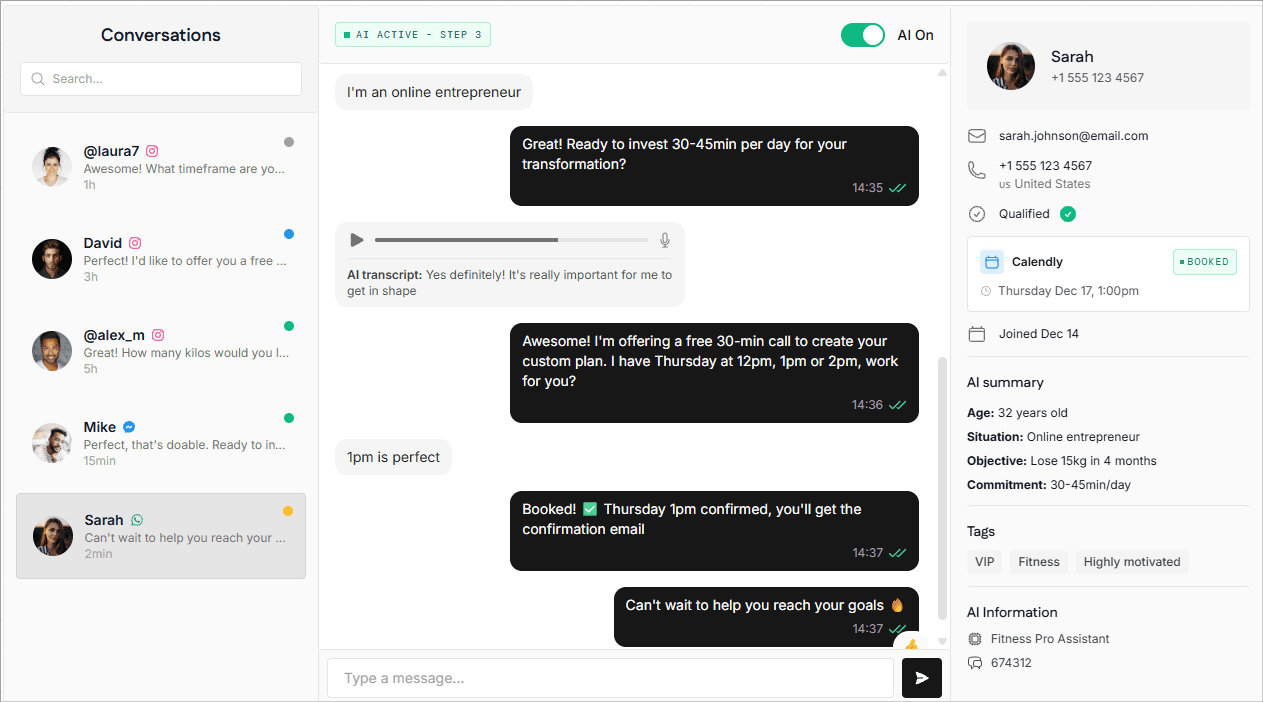
SetSmart is not a chatbot builder, and it does not pretend to be one. It calls itself an AI setter: a bot that answers inbound DMs on Instagram, WhatsApp, and Facebook Messenger, qualifies the person on the other end, and books the call without ever sending them to a link.
That is the whole product. It is a narrow tool, and that narrowness is the point.
If your DMs exist to turn strangers into discovery calls, this solves the specific thing ManyChat's decision trees keep getting wrong. A prospect asks something you did not script, and a ManyChat flow hits a wall. SetSmart's AI answers it, handles the objection, then proposes real slots from your calendar inside the same thread.
SetSmart launched in 2025 and the independent review record is thin: a 4.5 rating from 23 Trustpilot reviews (as of September 2026), and a single review on G2. That is not enough to call a pattern. Reviewers who do write about it keep praising one thing above the product itself, which is how much hands-on help the founder gives during setup. Read that however you like.
Capabilities
AI conversations across Instagram DM, WhatsApp, and Facebook Messenger via official Meta APIs
Lead qualification against your own criteria (goal, budget, timing)
In-chat call booking with Calendly, Cal.com, iClosed, and GoHighLevel
Automatic follow-ups on unanswered threads
Comment-to-DM triggers, voice notes, and image understanding
Zapier, Make, REST API, and an MCP server
Owner takeover: switch the AI off in a conversation with one click
Where it stands out
Books the call in the thread instead of dropping a scheduling link and hoping
The agent is configured in plain language, built from your offer or existing sales pages
Multilingual replies and variable response delays, so the thread does not read like a bot
No per-contact billing, so a big contact list costs nothing on its own
The honest trade-off
It is Meta-only. No website chat, no email, no helpdesk, no ticketing. If your customers reach you anywhere other than a DM, SetSmart does not cover it.
The billing also trades one problem for another. ManyChat charges per contact, SetSmart charges per AI message, with automatic paid top-ups once you cross your limit. Go viral on a Reel and your bill moves without you touching anything. On the Pro plan, 3,000 messages costs $297 with top-ups, which is the same as the Scale plan that includes 4,000.
One more thing worth knowing: reviewers describe real training effort to get the agent replying well, which is a distance from the ten-minutes-to-live framing.
Best for
Solo coaches, consultants, and course creators who get leads in Instagram or WhatsApp DMs and close on a booked call. Wrong for anyone who needs support conversations, website chat, or a free plan.
Pricing
(as of September 2026, from SetSmart's pricing)
Light: $25/month — 250 AI messages, hard cap with no auto top-ups, no free trial
Pro: $97/month — 1,000 AI messages, then automatic top-ups at $100 per 1,000, 7-day trial
Scale: $297/month — 4,000 AI messages, then automatic top-ups at $70 per 1,000, 7-day trial
All plans include every channel, booking, follow-ups, and integrations. Annual billing gives two months free.
(The 7-day trial requires a credit card. Unused messages do not roll over.)
Let’s build your chatbot today!
Launch a no-code WotNot agent and reclaim your hours.
Let’s build your chatbot today!
Launch a no-code WotNot agent and reclaim your hours.
How to Choose the Right ManyChat Alternative
The wrong way to evaluate these tools is to compare feature lists. Most of them overlap significantly at the surface level.
The right way to start with the specific reason you are leaving ManyChat and work backwards from there.
Four questions will get you to the right shortlist faster than any comparison chart.
1. Are you switching because of price or because of capability?
These are different problems that point to different tools.
If price is the issue, Chatfuel covers the same Meta channel ground as ManyChat at a flat $69/month with no contact volume surprises. HubSpot's free chatbot handles basic lead qualification and meeting booking at no cost if you are already in that ecosystem.
If capability is the issue, the flow-builder model itself is the problem, not the price. Switching to a cheaper flow-builder solves nothing. WotNot and Intercom are built around AI agents that reason through conversations rather than following scripts.
2. Which channels do your customers actually use?
This question eliminates more tools faster than any other.
If your customers are primarily on Instagram, Facebook Messenger, or WhatsApp, Chatfuel is the most direct switch.
If your customers reach you through your website, email, or non-Meta channels, you need a platform that was not built around Meta's ecosystem. WotNot, Tidio, Intercom, and Landbot all operate independently of Meta.
3. Do you need a flow-builder or an AI agent?
This is the most important distinction on this list and the one most teams skip.
A flow-builder maps out conversation paths in advance. It works until the customer goes off-script. An AI agent interprets what the customer is trying to accomplish and works through it, even when the conversation takes an unexpected direction. It can take action across backend systems, collect data mid-conversation, and hand off to a human without the customer repeating themselves. That is a fundamentally different architecture, not just a smarter chatbot.
WotNot is built around that model specifically. One build deploys across the website, WhatsApp, Facebook Messenger, Instagram, and SMS. The AI reasons through the conversation, and when a human needs to step in, the agent sees everything before typing a word.
If you are building simple, predictable interaction sequences, a flow-builder is fine, and Chatfuel, Landbot, or HubSpot will serve you well.
If the conversation needs to go further than a script can take it, that is where the category distinction matters. From what I have seen across deployments, WotNot is where that conversation starts.
4. What does your support operation look like today?
If you have a small team handling website chat and e-commerce support, Tidio gives you live chat, basic AI, and a help desk in one interface without enterprise complexity.
If you have an existing helpdesk on Zendesk or Salesforce and want to add AI on top without migrating, Intercom's Fin works as a standalone layer.
If you are already running HubSpot across sales and marketing, adding Service Hub removes the need for a separate tool entirely.
If you need AI automation and human handoff to work together across multiple channels from a single platform, without separate tools for each, WotNot is built specifically for that setup.
The Right Tool Starts With the Right Question
Most teams switching from ManyChat spend too much time comparing features and not enough time asking why they are switching in the first place.
If the answer is price, a cheaper tool in the same category solves the problem. If the answer is channels, a platform that is not built around Meta's ecosystem solves the problem. If the answer is capability, no amount of switching between flow-builders will get you where you need to go. That requires a different category of tool entirely.
The teams that make the right switch are the ones that are honest about which limitation actually brought them here. Everything else follows from that answer.
If you have outgrown the flow-builder model and need AI automation and human support to work together across multiple channels without the gaps showing, WotNot is worth exploring.
FAQs
FAQs
FAQs
What is the best free alternative to ManyChat?
Is ManyChat still worth using in 2026?
What are the main limitations of ManyChat?
Which ManyChat alternative is best for Instagram automation?
Is WotNot a good ManyChat alternative?
ABOUT AUTHOR
Hardik Makadia
Co-founder & CEO, WotNot
Hardik leads the company with a focus on sales, innovation, and customer-centric solutions. Passionate about problem-solving, he drives business growth by delivering impactful and scalable solutions for clients.

Start building your chatbots today!
Curious to know how WotNot can help you? Let’s talk.
Start building your chatbots today!
Curious to know how WotNot can help you? Let’s talk.