Let’s build your chatbot today!
Launch a no-code WotNot agent and reclaim your hours.
*Takes you to quick 2-step signup.
McDonald's pulled its AI drive-thru pilot in 2024 after a viral video showed the bot repeatedly adding unwanted items to a customer's order. Meanwhile, Wendy's FreshAI is rolling out in 500 to 600 U.S. locations after a 100-restaurant pilot that staff and customers both responded to positively.
Both restaurant chatbots. Wildly different results.
The difference was not the chatbot itself. It was knowing exactly what to hand off to a bot and what to protect with a human. That distinction is the entire game in the restaurant industry right now.
If you have looked into using a restaurant chatbot, you have probably run into two camps. One side says AI will solve all your operational problems. The other insists bots will destroy the dining experience. Neither camp gives you a practical, honest answer.
In this article, we have tried to include a clear framework for every major touchpoint in your restaurant operations, real examples from brands that got it right and wrong, and a ready-to-deploy chatbot template to get started today.
The Real Problem Restaurant Chatbots Can Solve
69% of restaurants are now adopting AI, and 97% say they are sharpening their focus on guest experience through digital tools. But before you decide what to automate, it helps to understand why restaurants are turning to AI chatbots in the first place.
1. Managing Bookings and Orders
Every missed booking, abandoned order, and unanswered call is lost revenue. During peak hours, when staff are busiest, phones ring unanswered, orders get delayed, and customer questions pile up.
Average weekly restaurant spending fell to approximately $90 in 2026, down $25 from mid-2025 levels, which means diners are spending more carefully than ever. Restaurants cannot afford the friction.
2. Improving the Guest Experience
41% of consumers expect restaurants to use technology to streamline the guest experience, whether through online ordering, automated communications, or digital payment solutions.
Guests today arrive with high customer expectations, wanting to find what they need quickly, order in their preferred language, and be done. Most restaurant operations were not built to deliver that consistently at scale.
3. Retaining Guests and Building Loyalty
Acquiring a new customer costs five times more than keeping an existing one. Yet most restaurant chatbot strategies focus entirely on bringing guests and ignore everything post-meal.
53% of consumers regularly redeem loyalty rewards, which is a great way to retain loyalty. However, restaurants can’t keep track of these campaigns, and customers need to be reminded of them for them to come back to redeem them.
4. Increasing Operational Efficacy
Peak hours, catering inquiries, slow nights, and a whole bundle of job applicants create operational lag that compounds quietly over time.
65% of restaurant operators say they need faster answers to keep up with operational questions on a near-daily basis, and most do not have the systems to get them.
5. Your Staff Is Stretched Too Thin
According to the National Restaurant Association, 77% of operators struggle to recruit and retain staff. That means your front-of-house team is stuck answering phone calls, handling menu questions, and managing reservation requests instead of focusing on the guests.
A chatbot takes that repetitive load off their plate. Your staff gets back to people. Your guests get better service. That is what operational efficiency actually looks like in hospitality.
Let’s build your chatbot today!
Launch a no-code WotNot agent and reclaim your hours.
Let’s build your chatbot today!
Launch a no-code WotNot agent and reclaim your hours.
The Automation Decision Framework: What To Hand Off And What To Retain
This is an interesting section you don't want to skip.
Most resources would tell you to automate, automate, and automate.
But what to AI and what not to AI, that is the question.
Well, we have cracked the code on this one.
The logic is simple. High volume plus low emotional stakes equals automation. Low volume plus high emotional stakes equals protect with a human.
Automate Freely: The Low-Stakes, High-Volume Interactions
These are the interactions where your guests do not want warmth. They want speed and consistency at scale.
Table reservations
Order taking
Menu FAQs
Hours and location queries
Waitlist management
Order status updates
Delivery tracking
Promotional push notifications
Restaurants often pair these campaigns with eye-catching food visuals. AI image generation using nano banana models can help create campaign-specific dish images for seasonal promotions without requiring a new photoshoot for every menu update.
Restaurants using chatbots for food ordering see 25% more completed orders during peak times and 30% faster response times compared to human-only support. That lift is entirely from removing friction from interactions that never needed a human to begin with.
Automate With Care: Complaints, Refunds, and Feedback
These interactions start simple and can escalate fast.
Your restaurant chatbot can handle the tier-one response, but the moment an interaction becomes emotionally charged or financially complex, a human needs to take over.
The Air Canada case is a useful cautionary tale here:
A tribunal ordered Air Canada to compensate a passenger after its chatbot provided incorrect refund information. The ruling held the brand legally responsible for everything on its website, including chatbot responses.
For restaurants handling allergy situations or refund disputes, that kind of liability can bring legal repercussions and should not be left to human agents.
Customer service automation works best for first-touch inquiries.
Human teams are still necessary for anything complex or sensitive. Build your escalation logic before you build anything else.
Never Automate: Milestone Moments and Critical Issues
There are touchpoints in hospitality that no chatbot should touch.
For example, VIP guest recognition, allergy-related and dietary escalations, complaint de-escalation beyond the first acknowledgment, and personalized in-person dining recommendations.
Any conversation where your guest is visibly upset are the interactions where a human response is non-negotiable.
At Wendy's, even with FreshAI running in the drive-thru, a human employee monitors every session and steps in when the bot cannot address a request.
To sum it up, restaurant operations have multiple aspects that can be automated to make things more efficient. However, some tasks call for human sensitivity and tact. The table below more or less makes it clear that both approaches are useful to run a hospitality business successfully.
Operational Element | Better With a Chatbot | Better With a Human |
Reservations | 24/7 booking, instant confirmations | VIP and large-group reservations |
Order Taking | Fast, consistent, high-volume orders | In-person ordering and guest interaction |
Customer Inquiries | FAQs, hours, menu, location, order status | Complex or sensitive requests |
Upselling | Consistent add-ons and recommendations | Relationship-driven upselling |
Complaints & Refunds | Acknowledge, triage, and route | Resolution and negotiation |
Loyalty & Retention | Points, offers, and win-back campaigns | Personalized guest recognition |
Feedback Collection | Automated post-visit surveys | Reviewing and acting on feedback |
Allergy & Dietary Requests | Identify and escalate | Own the conversation entirely |
How Restaurant Chatbots Affect Revenue
Most restaurant operators think of them as cost-cutting tools. But if you look from a different direction, a restaurant chatbot can generate revenue actively, not just reduce expenses. Here is how.
1. Increase Order Value Through Smart Upselling
A trained server upsells when they remember to, have time, and have the relevant info. And they have to do this during the rush hours.
A custom chatbot upsells every single time, consistently, without fatigue.
During the ordering flow, it can:
Recommend complementary dishes and drinks
Suggest meal upgrades and add-ons
Promote seasonal specials
Personalize recommendations based on previous orders
Unlike staff, the bot never forgets, gets busy, or skips the suggestion.
Result: Restaurants using chatbots report median order value increases of up to 20% within the first week of deployment.
2. Turn Promotions Into Timely Conversations
Most promotions fail because they reach the wrong person at the wrong time.
Chatbots change that.
They can trigger promotions based on customer behavior when connected to your CRM or loyalty program software:
Win-back offers for inactive guests
Birthday rewards
Happy hour promotions during slow periods
Personalized offers based on order history
Instead of sending mass campaigns, restaurants can engage guests on channels they already use, like WhatsApp, Messenger, or mobile apps, where they're most likely to respond.
This also gives restaurants more flexibility to coordinate chatbot campaigns with broader marketing efforts, including work handled by a food and beverage marketing agency, such as seasonal promotions or customer retention campaigns.
Result: Higher engagement, better redemption rates, and more repeat visits.
3. Automating Your Loyalty Program
The customer relationship shouldn't end when the meal does.
A chatbot can continue the conversation by:
Collecting post-visit feedback
Updating loyalty points automatically
Resolving negative experiences before they become public reviews
Re-engaging guests who haven't returned
Every interaction enriches customer data, making future recommendations and promotions more relevant.
Result: Higher customer satisfaction, stronger retention, and a loyalty program that runs without manual effort.
4. Capture More Orders and Reservations
Restaurants lose a lot of money because they cannot handle the influx of queries and calls.
A chatbot stays available 24/7, handling reservations, takeout orders, and delivery inquiries across channels. Whether a customer wants to book a table at midnight or place an order during a busy lunch rush, the bot captures the opportunity instead of letting it slip away.
Result: More completed bookings, fewer missed orders, and higher conversion from customer intent to transaction.
Restaurant Chatbot Mistakes That Hurt Customer Experience
If you have tried a restaurant chatbot and it did not work, one of three things probably happened.
Mistake 1: Building a Bot With No Escalation Path
What goes wrong: The bot gets stuck, misunderstands a request, or loops endlessly. The customer gets frustrated and leaves.
The fix: Every chatbot needs a clear escalation path. If the bot detects confusion, frustration, complaints, or repeated failed responses, it should hand the conversation to a human immediately, with the chat history attached.
Mistake 2: Deploying Without Connecting to Your Actual Systems
What goes wrong: Omissis a table that isn't available, shows outdated menu items, or provides incorrect delivery estimates. Customers don't blame the integration. They blame the restaurant.
The fix: Connect the chatbot to your reservation platform, POS, delivery systems, and menu database first. Then build the conversation flows around that data.
Mistake 3: Automating the Wrong Touchpoints on a Vendor's Recommendation
What goes wrong: Restaurants try to automate everything, including allergy questions, complaints, refund requests, and VIP interactions.
Those are often the conversations where mistakes are most expensive.
The fix: Automate routine tasks. Escalate sensitive ones.
Keep humans involved for issues like:
Allergy and dietary inquiries
Complaint resolution
Refund requests
VIP guest interactions
How to Launch Your First Restaurant Chatbot?
You now have a framework. You know what to automate and what to protect. The question is where to start.
Table bookings are high volume, low variance, and guests expect speed with a simple and prompt reaction. There is no better first automation for a restaurant.
Build it Yourself with a No-Code Platform
You do not need a developer or an IT team to get a reservation chatbot live. Platforms like Landbot and WotNot all offer no-code builders that let you set up conversation flows, connect to your existing systems, and deploy to your website or WhatsApp, or via SMS and call without writing a single line of code.
You can check out our detailed guide on the process, explaining how to create a chatbot.
Here is how to structure your reservation chatbot flow:
Step 1: Start with a simple greeting and give the guest two or three clear options, like book a table, view the menu, or speak to someone.
Step 2: Create a sequence that collects details such as date, time, group size, and special dietary requirements (if any), one question at a time, not all at once.
Step 3: Link the bot to your reservation system or Google Sheets so it checks live slot availability before confirming anything.
Step 4: Write a confirmation that includes all booking details and tells the guest exactly what to expect next.
Step 5: Schedule two automated follow-ups: one 24 hours before and one 2 hours before the reservation.
Step 6: Build a short branch that lets guests modify or cancel without needing to call or message your staff.
Step 7: Set a keyword or fallback rule that hands the conversation to a human the moment the bot cannot handle it.
The flow is simple enough, but we do understand it might be too much if chatbot designs are a new realm for you.
Or Start With a Ready-Made Template
If you want to skip the build entirely, WotNot's restaurant reservation chatbot template covers the full booking flow out of the box.
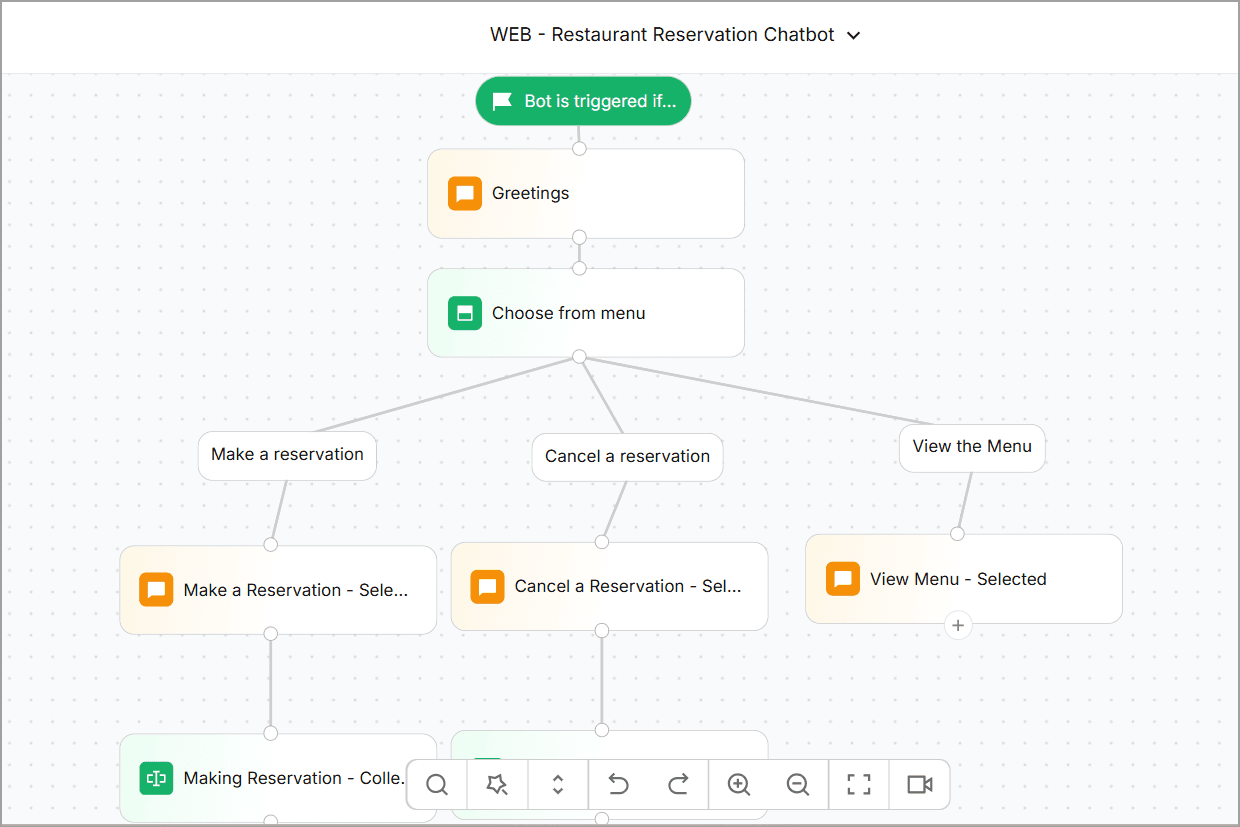
It handles reservations, cancellations, sends instant confirmations, fires automated reminders, and reschedules without any staff involvement.
All you have to do is select the channel you want the bot to work on and select this template. You can customize it to your restaurant and deploy it in under an hour.
Start building, not just reading
Build AI chatbots and agents with WotNot and see how easily they work in real conversations.

Start building, not just reading
Build AI chatbots and agents with WotNot and see how easily they work in real conversations.
Start building, not just reading
Build AI chatbots and agents with WotNot and see how easily they work in real conversations.

When to Upgrade to a Custom AI Agent
Once your reservation automation is running and you are ready to expand, WotNot's AI agent builder lets you connect everything: food ordering, loyalty CRM, complaint routing, upselling logic, and customer support into a single conversational AI agent that handles the full customer journey.
39% of service organizations are now using agentic AI specifically, a significant jump from basic chatbot automation.
Which Channels Should Your Restaurant Chatbot Be On?
Your chatbot is only useful if it is where your guests already are. Here is where to deploy it and why.
WhatsApp:
The highest-engagement channel for most restaurants, especially for reservations, order updates, and post-visit follow-ups. Guests are already using it daily, and conversations feel personal rather than automated.Your Website:
The first place a guest lands when they search for you. A chatbot here handles menu questions, takes bookings, and answers FAQs before the guest bounces or picks up the phone. It works hardest during off-hours when no one is available to respond.Instagram DMs:
Where discovery happens, especially for younger audiences. Guests who find you through a reel or a tagged post often message directly to ask about reservations or the menu. A chatbot here captures that intent before it goes cold.Facebook Messenger:
Still the dominant channel for older demographics and local community groups. Useful for promotions, event announcements, and handling customer inquiries from guests who found you through a Facebook page or ad.SMS:
Best used for reminders and time-sensitive alerts: reservation confirmations, delivery updates, and win-back offers. Not a primary conversation channel, but highly effective when used for short, triggered messages.
Conclusion
The restaurants that get automation right are not the ones with the most sophisticated technology. They are the ones that made a clear decision about what their chatbot is for and what it is not for.
A chatbot handles the volume. Your staff handles the relationship. Neither works as well without the other.
If you are starting today, reservations are your first move. Get that right, measure the impact, and build from there. WotNot's restaurant reservation chatbot template gives you a working starting point in under an hour, no developer, no long setup, and no guesswork.
When you are ready to go further, the AI agent builder is there. But you do not need to think about that yet.
Start small. Start with what actually costs you the most right now. The rest follows.
FAQs
FAQs
FAQs
Will a chatbot make my restaurant feel less personal?
How do chains like Wendy's and Domino's manage chatbot quality across hundreds of locations?
Can a chatbot upsell as effectively as a trained server?
How do I connect a chatbot to my reservation system or POS?
How does a restaurant chatbot handle complaints and refund requests?
ABOUT AUTHOR

Hardik Makadia
Co-founder & CEO, WotNot
Hardik leads the company with a focus on sales, innovation, and customer-centric solutions. Passionate about problem-solving, he drives business growth by delivering impactful and scalable solutions for clients.

Start building your chatbots today!
Curious to know how WotNot can help you? Let’s talk.
Start building your chatbots today!
Curious to know how WotNot can help you? Let’s talk.