

Let’s build your chatbot today!
Launch a no-code WotNot agent and reclaim your hours.
*Takes you to quick 2-step signup.
Most businesses today are present on multiple channels. A chatbot on the website, WhatsApp open for queries, Instagram DMs for engagement, and email for support.
But being present everywhere is not the same as being connected everywhere.
If a customer starts a conversation on Instagram and follows up on WhatsApp, does it pick up where it left off? According to the Futurum Group, 54% of customers leave a brand when they have to repeat their issue multiple times.
And why wouldn't they? When businesses have spread themselves across every channel, customers naturally assume that their concern travels with them. The expectation of a connected experience is set by the businesses themselves.
So the disconnect of not having a bot hurts both sides. The customer loses patience. The business loses the customer. An omnichannel chatbot solves exactly this.
This guide covers what an omnichannel chatbot actually is, how it differs from a multichannel setup, why the distinction matters for revenue and retention, and how to implement one without overcomplicating it.
What Is an Omnichannel Chatbot?
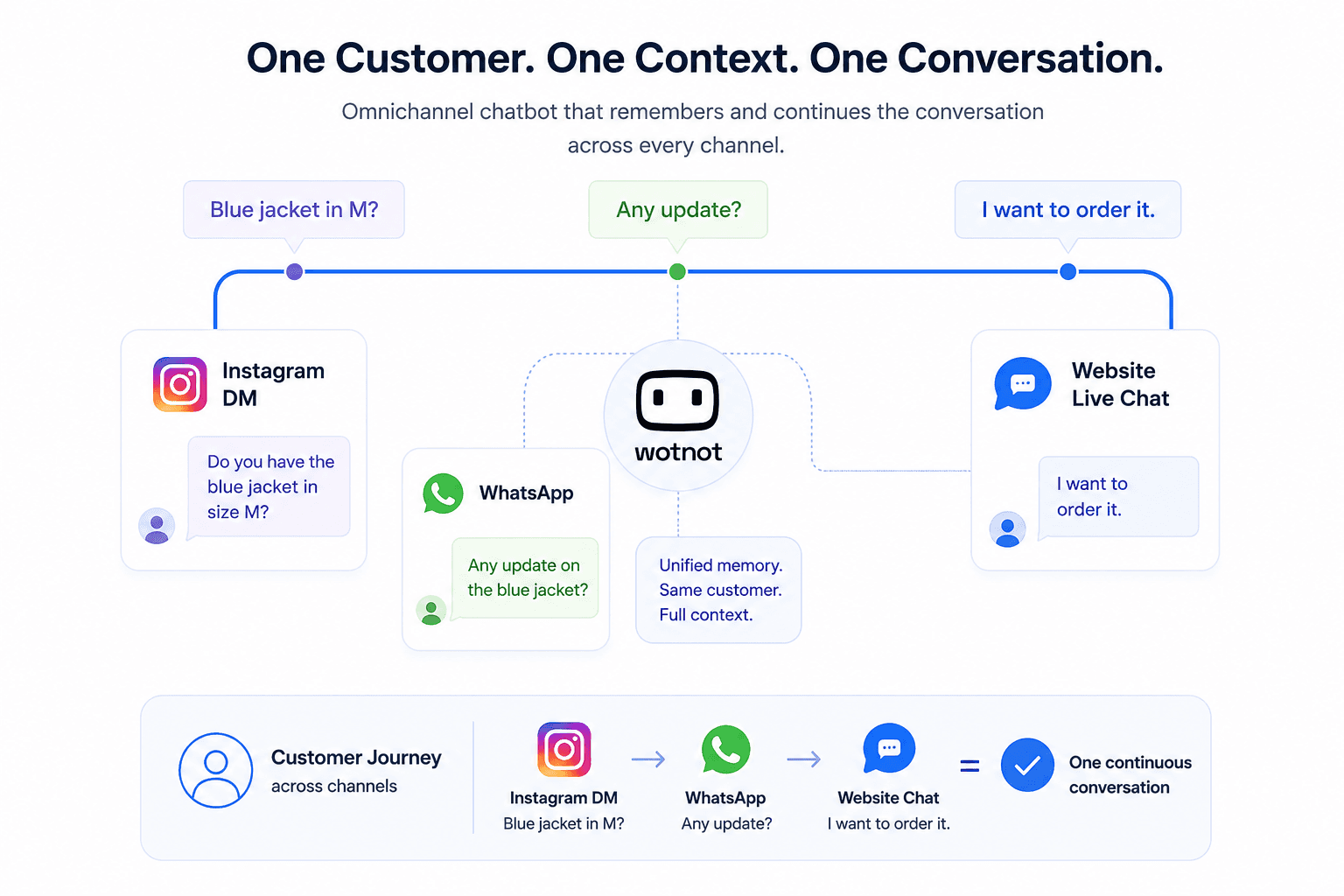
An omnichannel chatbot is a single AI-powered assistant that operates across multiple communication channels while maintaining a unified conversation history.
Whether the customer reaches out on your website, WhatsApp, Messenger, Instagram, SMS, or phone, the chatbot recognizes them, remembers what was discussed, and continues the conversation as if it never switched channels.
The keyword here is unified. This is not the same bot installed separately on five different platforms. It is one centralized system where the customer's identity, context, and conversation history follow them regardless of where they show up next.
Here is what that looks like in practice:
A customer messages on Instagram: "Do you have the blue jacket in size M?"
The next day, they follow up on WhatsApp: "Any update on the blue jacket?"
Later, they visit the website and open chat: "I want to order it."
With a regular chatbot on each platform, these are three separate conversations. The customer explains themselves three times. With an omnichannel chatbot like WotNot, the system knows this is the same person, remembers the jacket inquiry, and picks up from "I want to order it" without asking a single clarifying question. Three channels, one continuous conversation.
Let’s build your chatbot today!
Launch a no-code WotNot agent and reclaim your hours.
Let’s build your chatbot today!
Launch a no-code WotNot agent and reclaim your hours.
Multichannel vs Omnichannel: The Distinction That Changes Everything
This is where most businesses get confused, and honestly, where most vendors make the confusion worse because "omnichannel" looks better on a landing page than "multichannel."
Multichannel | Omnichannel | |
Present on multiple channels | Yes | Yes |
Conversations connected across channels | No | Yes |
Customers repeat themselves when switching | Yes | No |
Unified conversation history | No | Yes |
Single dashboard for all channels | Rarely | Yes |
Consistent experience across channels | Varies | Yes |
Approach | Channel-centric | Customer-centric |
Multichannel means your chatbot exists on multiple platforms. Website, WhatsApp, Instagram, email. But the conversations on each platform live in their own silo. If a customer talks to the bot on your website and then messages on WhatsApp, the WhatsApp conversation starts from zero. The bot doesn't know what happened on the website. The customer repeats themselves. Your team has no unified view of what this person has already asked or been told.
Omnichannel means those channels are connected through a single system. The conversation carries across platforms. The customer's identity, history, and context follow them regardless of where they reach out next. Your team sees every interaction in one dashboard. And the chatbot treats every touchpoint as part of one continuous relationship, not as isolated interactions happening in parallel.
I think the simplest way to test which one you actually have is this: if a customer switches channels mid-conversation and has to start over, you are multichannel. If they pick up where they left off, you are omnichannel.
When Omnichannel Actually Matters for Your Business
Not every business needs a chatbot omnichannel on day one. If all your customer conversations happen on a single channel, a well-built chatbot on that one channel would serve the purpose.
Omnichannel becomes worth the investment when specific patterns start showing up.
Your customers are reaching out on multiple channels and expecting continuity:
They message on Instagram, follow up on WhatsApp, and get frustrated when nobody connects the dots. If this is happening, your customers are already treating your channels as one experience. Your system just hasn't caught up yet.Your team is stitching conversations together manually:
Someone on the support team is checking WhatsApp, then switching to the website dashboard, then scrolling through email, trying to piece together what the same customer said across three different places. That manual stitching is invisible overhead that grows with every channel you add.Your customers are getting inconsistent answers depending on which channel they use:
When each channel runs its own chatbot or its own set of responses, small inconsistencies creep in over time. The website chatbot says returns are accepted within 14 days. The WhatsApp bot says 30 days because nobody updated it after the policy changed. The customer gets two different answers from the same business, and here is where trust takes a hit. A unified backend eliminates this because every channel pulls from the same source of truth.
When these patterns show up, the business case for an omnichannel chatbot stops being theoretical.
Research backs this up: omnichannel customers shop 1.7 times more than single-channel shoppers, and according to SAP's 2026 Engagement Index, nearly two-thirds of consumers say seamless cross-channel experiences define the brands they love most. The gap between fragmented and connected is a gap your customers are already measuring you on.
How to Get Omnichannel Right
When I read most articles on this topic, they all tell you to deploy on every channel at once. And I think that is exactly how businesses get omnichannel wrong. Because being omnichannel is a different ball game than deploying on all channels at once. One is about connection. The other is just about presence.
Start with the two channels where your customers already are:
Look at where your conversations are actually happening today. If most of your volume comes through your website and WhatsApp, start there. Build the omnichannel connection between those two, get the experience right, and expand once the foundation is solid. This is an ideal approach that will yield you the real ROI.
I have seen businesses launch on seven channels simultaneously and end up with a mediocre experience on all of them because nobody had the bandwidth to maintain quality everywhere at once.Adapt the experience per channel, not just the presence:
This is something most vendors skip entirely. WhatsApp conversations tend to be shorter and more direct. Website chat allows richer interactions with images, carousels, and forms. Instagram DMs carry a more casual tone, and customers expect quicker back-and-forth.
A good omnichannel chatbot solution keeps the same backend intelligence and conversation context across all channels but adjusts how it communicates based on where the customer is. Same brain, different body language.Unify the dashboard before you unify the channels:
If your team is still switching between five different tools to manage conversations, adding more channels will make the chaos worse.
The first step is getting everything your team already handles into a single place where they can see all conversations, regardless of channel. That operational foundation is what makes omnichannel work in practice, not just in theory.
WotNot is built around this approach. You design conversation flows once in the no-code builder and deploy across web, WhatsApp, Messenger, Instagram, SMS, and phone from a single platform. Your team manages everything from one unified dashboard, and when the bot reaches its limit, live chat handoff carries full context regardless of which channel the customer started on. And if setting all of this up sounds like more than your team has bandwidth for, WotNot's managed services team handles it for you.
Pro Tip: Before you add a new channel, ask yourself: Do we have the capacity to maintain a quality experience on it?
Every channel you add is a channel you need to monitor, update, and keep consistent. An omnichannel chatbot delivering an excellent experience on three channels is worth far more than one delivering a forgettable experience on eight.
Start building, not just reading
Build AI chatbots and agents with WotNot and see how easily they work in real conversations.

Start building, not just reading
Build AI chatbots and agents with WotNot and see how easily they work in real conversations.
Start building, not just reading
Build AI chatbots and agents with WotNot and see how easily they work in real conversations.

What to Look For in an Omnichannel Chatbot
When you start evaluating platforms, these are the things that actually matter in practice:
Single builder, all channels:
If you have to rebuild the conversation flow separately for each channel, you don't have an omnichannel platform. You have a multichannel tool with shared branding.Context that actually carries across:
Test this during the trial. Start a conversation on one channel, switch to another, and see if the bot picks up where you left off. If it doesn't, the "omnichannel" on the landing page is marketing, not architecture.Handoff with full history:
When the bot reaches its limit and transfers to a human through live chat, the agent should see the entire conversation regardless of which channels it touched. If the customer re-explains themselves, the handoff is broken.Integration with your existing tools:
Does the platform connect to your CRM, helpdesk, and calendar natively? An omnichannel chatbot that can't push data into the systems your team already uses creates a new silo instead of eliminating one.Cross-channel analytics:
Can you see how conversations perform across all channels in one report? If you need to pull data from five different dashboards to understand your customer journey, the platform is adding visibility problems, not solving them.
At the end of the day, omnichannel is not about how many channels you are on. It is about whether your customer notices the switch. If they don't, you have got it right. If you want that experience live without building it yourself, WotNot deploys across web, WhatsApp, Messenger, Instagram, SMS, and phone from a single builder with managed services to set it up for you.
FAQs
FAQs
FAQs
What is the difference between multichannel and omnichannel chatbots?
Multichannel means the chatbot exists on multiple platforms, but conversations stay separate. Omnichannel means conversations are connected across platforms. The simplest test: if a customer switches channels and has to start over, that is multichannel. If they pick up where they left off, that is omnichannel.
Which channels should an omnichannel chatbot cover?
How does an omnichannel AI chatbot improve customer experience?
ABOUT AUTHOR

Hardik Makadia
Co-founder & CEO, WotNot
Hardik leads the company with a focus on sales, innovation, and customer-centric solutions. Passionate about problem-solving, he drives business growth by delivering impactful and scalable solutions for clients.



Start building your chatbots today!
Curious to know how WotNot can help you? Let’s talk.
Start building your chatbots today!
Curious to know how WotNot can help you? Let’s talk.