Let’s build your chatbot today!
Launch a no-code WotNot agent and reclaim your hours.
*Takes you to quick 2-step signup.
The question "Should I use a chatbot or conversational AI?" comes up in almost every conversation I have with businesses evaluating their first AI deployment.
And honestly, I think the question itself is a bit misleading because it frames them as competing options when they are actually different stages of the same journey.
A chatbot is where most businesses start. Conversational AI is where some businesses need to go. The important part is knowing when you have outgrown one and actually need the other, because upgrading too early wastes money and upgrading too late frustrates customers.
This guide breaks down the real chatbot vs conversational AI differences, when each one fits, and the hybrid reality most businesses actually live in.
What Is a Chatbot?
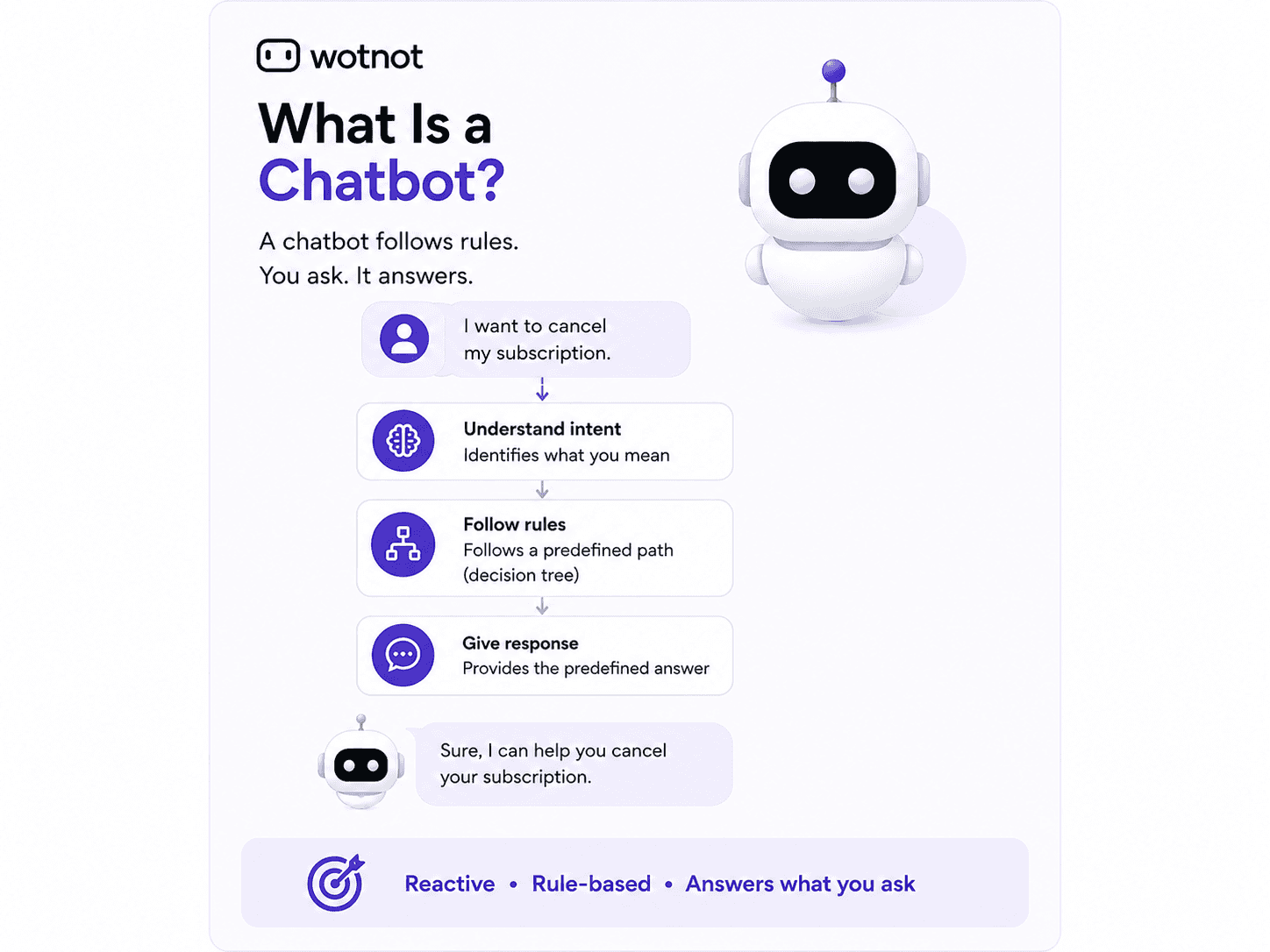
A chatbot is a software program designed to simulate conversation with users.
In its simplest form, it follows predefined rules: if the customer says X, the bot responds with Y. Think of it as a decision tree that talks.
Modern chatbots have evolved beyond those rigid scripts. AI-powered chatbots use natural language processing to understand intent rather than matching exact keywords, which means the customer can type "I want to cancel" or "how do I stop my plan," and the bot understands both are the same question. But even the smartest chatbot is fundamentally reactive. It waits for a question, answers it, and waits for the next one.
The most common use cases are answering FAQs, capturing leads, booking appointments, routing inquiries, and handling order status checks. If you are looking to understand how to set one up practically, our guide on chatbot automation covers the full playbook from scoping to deployment.
Let’s build your chatbot today!
Launch a no-code WotNot agent and reclaim your hours.
Let’s build your chatbot today!
Launch a no-code WotNot agent and reclaim your hours.
What Is Conversational AI?
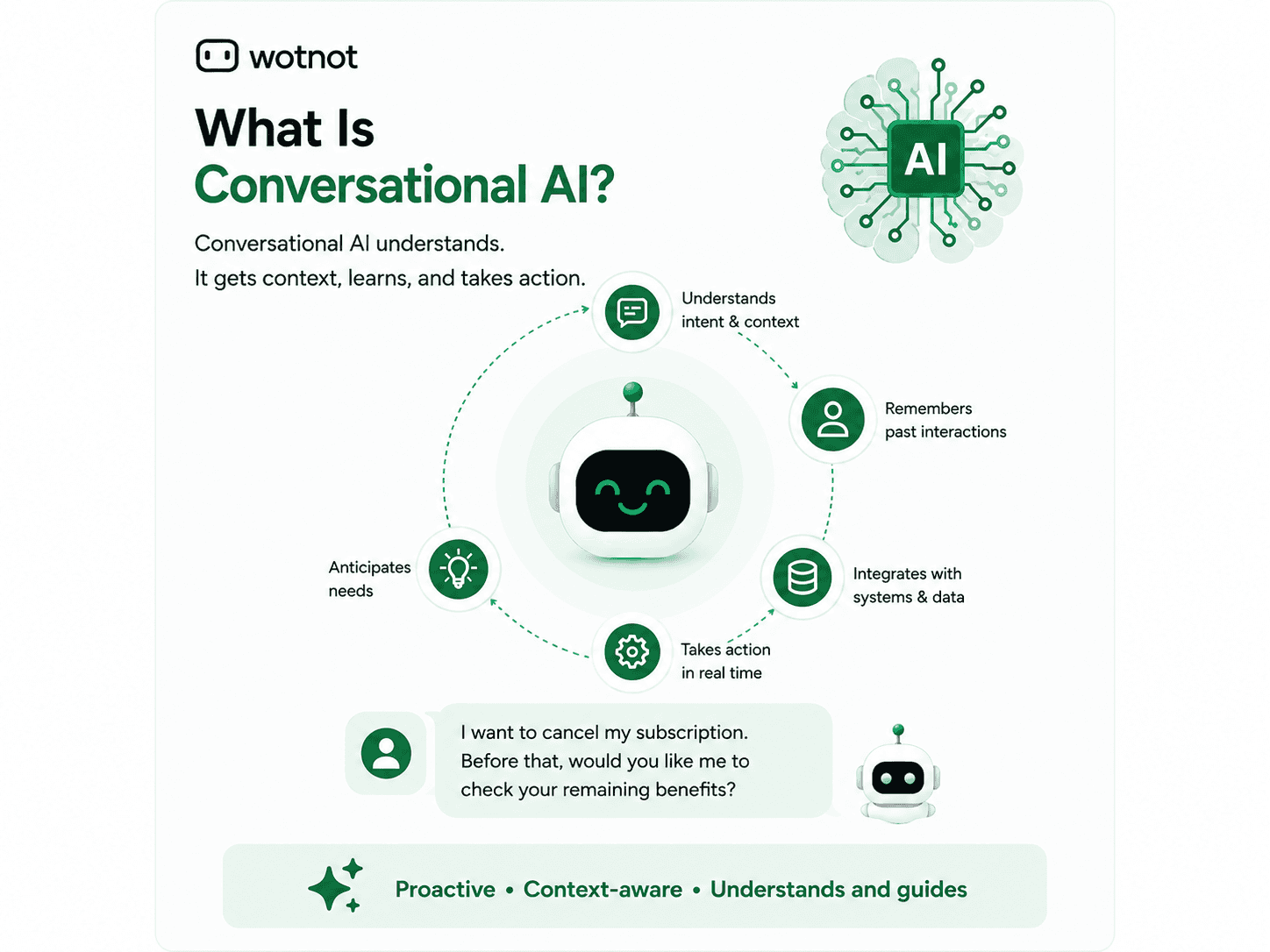
Conversational AI is the broader technology that powers intelligent, human-like conversations.
It combines natural language processing, large language models, machine learning, and context awareness to understand not just what the customer said but what they meant and what they might need next.
Where a chatbot follows a predefined path, conversational AI navigates. It retains context across multiple messages, so the customer doesn't have to repeat themselves. It learns from past interactions to improve over time. It integrates with backend systems like your CRM, calendar, and helpdesk to take real actions within the conversation. And it handles complex, multi-turn exchanges where the customer changes direction or adds new information halfway through.
The simplest way I can put it: a chatbot automates conversations. Conversational AI understands them.
That understanding is what powers the more advanced AI applications businesses are deploying today, from handling phone calls and appointments to guiding customers through complex decisions.
The Real Differences Between Chatbots and Conversational AI
Every article on conversational AI vs chatbot gives you a comparison table. I, too, have one prepared, but first I want you to know what actually changes in practice because the differences between chatbots and conversational AI are less about the technology under the hood and more about what the customer experiences on the other end.
The way I think about it, there are three levels, not two.
Level 1: Rule-based chatbot
The customer interacts through buttons, menus, or exact keyword matches. The bot follows a strict path, and if the customer asks something outside that path, it breaks.
Think of it as a vending machine: press a button, get a fixed result. Cheap to build, predictable, and perfectly fine for structured queries like FAQs or order tracking, where the answer is the same every time.
Level 2: AI-powered chatbot
The customer can type naturally, and the bot understands intent. It connects to a knowledge base, retrieves relevant answers, and handles a wider range of questions without needing exact phrasing.
But it is still reactive. It answers what you ask and doesn't remember your last conversation or suggest what you might need next. Most businesses deploying chatbots today sit at this level.
Level 3: Conversational AI
The customer has a real conversation. The system remembers context from past interactions, personalizes responses based on history, takes actions across your CRM and calendar, handles complex multi-step workflows, and knows when to hand off to a human with full context.
This is where chatbots evolve into AI receptionists, AI concierges, and autonomous agents that don't just respond but actually resolve.
Note: The jump from Level 1 to Level 2 is about understanding language better. The jump from Level 2 to Level 3 is about understanding the customer better. That second jump is where the real investment lives, but also where the real value is.
Start building, not just reading
Build AI chatbots and agents with WotNot and see how easily they work in real conversations.

Start building, not just reading
Build AI chatbots and agents with WotNot and see how easily they work in real conversations.
Start building, not just reading
Build AI chatbots and agents with WotNot and see how easily they work in real conversations.

Chatbot vs Conversational AI: At a Glance
Aspect | Chatbot | Conversational AI |
Understanding | Keyword or intent matching | Full context and sentiment awareness |
Conversation flow | Linear, single-turn | Dynamic, multi-turn with memory |
Personalization | Same response for everyone | Tailored by customer history |
Actions | Answers questions | Answers, acts, coordinates, recommends |
Learning | Manual updates | Improves from interactions |
Complexity handled | Simple, predictable queries | Complex, nuanced conversations |
Failure mode | Breaks when off-script | Escalates gracefully with context |
Best for | FAQs, lead capture, routing | Support, sales, onboarding, guided experiences |
When a Chatbot Is a Better Choice
A chatbot is not a lesser product. For a lot of businesses, it is the right product.
If your customers generally know what they need and the bot just has to get them there faster, a chatbot handles that well. Someone checking their order status doesn't need a multi-turn conversation with memory and personalization. They need a quick answer. Someone booking an appointment doesn't need the AI to remember their last three visits. They need an open time slot confirmed.
The pattern is consistent across businesses where chatbots deliver real value: the queries are predictable, the answers are structured, and the volume is high enough that automating them frees your team up for the conversations that actually need a human.
One Reddit user framed it in a way that stuck with me: a well-trained chatbot can be 90% as effective as conversational AI with 10% of the headaches. That is not a knock on conversational AI. It is a reminder that simpler is often better when the use case doesn't demand complexity.
If your support inbox is mostly repetitive questions with consistent answers, start with a chatbot. You can always move up when the need is real.
When You Need Conversational AI
The signals are usually pretty clear when a chatbot is no longer enough. You just have to know where to look.
Your customers are asking questions the bot can't handle, and instead of waiting for a human, they are dropping off entirely.
Your team is spending more time maintaining and updating scripted flows than the bot is saving them.
Conversations are getting complex enough that a single intent match doesn't resolve the issue, and the customer needs multiple steps coordinated within one interaction rather than being bounced between channels.
The clearest signal is when your customer's need shifts from information to guidance.
When someone asks, "What are your pricing plans?" a chatbot handles that fine. When someone asks, "Which plan is right for my situation?" they need something that understands their context, weighs their options, and walks them toward a decision. That is where conversational AI earns its place, and where applications like AI concierges come from.
The move from chatbot to conversational AI is not about having better technology for its own sake. It is about serving a customer whose needs have outgrown what a scripted flow can handle. If that is happening in your business, you will feel it in your drop-off rates and your customer feedback before you see it in any dashboard.
The Hybrid Reality Most Businesses Live In
The current scenario is that most businesses in production are not running a pure chatbot or pure conversational AI. They are running something in between. A chatbot that handles the predictable volume with a few conversational AI capabilities added for the queries that need more intelligence. A scripted flow for lead capture that hands off to an AI-powered engine for support tickets. A rule-based booking bot that connects to an LLM when the customer says, "I'm not sure what I need."
This hybrid approach is not a compromise. It is the most pragmatic way to deploy.
You get the reliability and low cost of a chatbot for the 80% that is predictable, and the intelligence of conversational AI for the 20% that isn't. Trying to run everything through conversational AI when most of your volume is simple FAQ queries is like hiring a specialist for every task when most of the work needs a generalist.
WotNot is built for exactly this kind of progression. The no-code builder handles chatbot flows for structured, predictable interactions. AI Studio with RAG and multi-LLM support handles the conversational AI layer for the complex ones.
You start with what your business needs today and add intelligence as your customers demand it, without switching platforms or rebuilding from scratch.
Simple First. Smart Later.
Most businesses don't need conversational AI on day one. A well-scoped chatbot that handles the repetitive 80% delivers real value from week one and gives your team breathing room to focus on the conversations that actually need them.
The intelligence layer earns its place when you start seeing the gaps. Meaning, when conversations get more complex, customers need guidance rather than just answers, and your scripted flows are struggling to keep up with how people actually talk to your business.
WotNot handles both sides from a single builder. Start with the chatbot. The conversational AI layer is there when your business is ready for it.
Start simple. You will know when it is time for smart.
FAQs
FAQs
FAQs
What is the difference between a chatbot and conversational AI?
Can a chatbot become conversational AI?
When should a business upgrade from a chatbot to conversational AI?
ABOUT AUTHOR

Hardik Makadia
Co-founder & CEO, WotNot
Hardik leads the company with a focus on sales, innovation, and customer-centric solutions. Passionate about problem-solving, he drives business growth by delivering impactful and scalable solutions for clients.

Start building your chatbots today!
Curious to know how WotNot can help you? Let’s talk.
Start building your chatbots today!
Curious to know how WotNot can help you? Let’s talk.