
Let’s build your chatbot today!
Launch a no-code WotNot agent and reclaim your hours.
*Takes you to quick 2-step signup.
Most AI chatbots speak Arabic. Far fewer understand it.
Arabic is one of the world's most linguistically diverse languages. A customer in Riyadh, Cairo, and Casablanca may all ask the same question in completely different ways. Add the fact that many people switch between Arabic and English in the same conversation, and the challenge becomes obvious.
Now the problem is: a chatbot that responds in Arabic might look impressive in a demo. But real customer conversations are rarely written in perfect Modern Standard Arabic (MSA). They happen in regional dialects, colloquial phrasing, and mixed-language messages, especially on channels like WhatsApp.
This is where the gap starts to show. Technically, the bot supports Arabic, but it does not understand how people actually communicate.
And that distinction matters because businesses are not deploying chatbots to pass some language tests. They are deploying them to help real customers, and if the chatbot cannot understand the way those customers naturally speak, automation quickly becomes frustrating.
At the end of the day, customers do not care whether your chatbot supports Arabic. They care whether it understands them.
This guide explains what an Arabic chatbot is, why Arabic is one of the most challenging languages for conversational AI, what to look for in a platform, and how to deploy one that actually works for your market.
What Is an Arabic Chatbot?
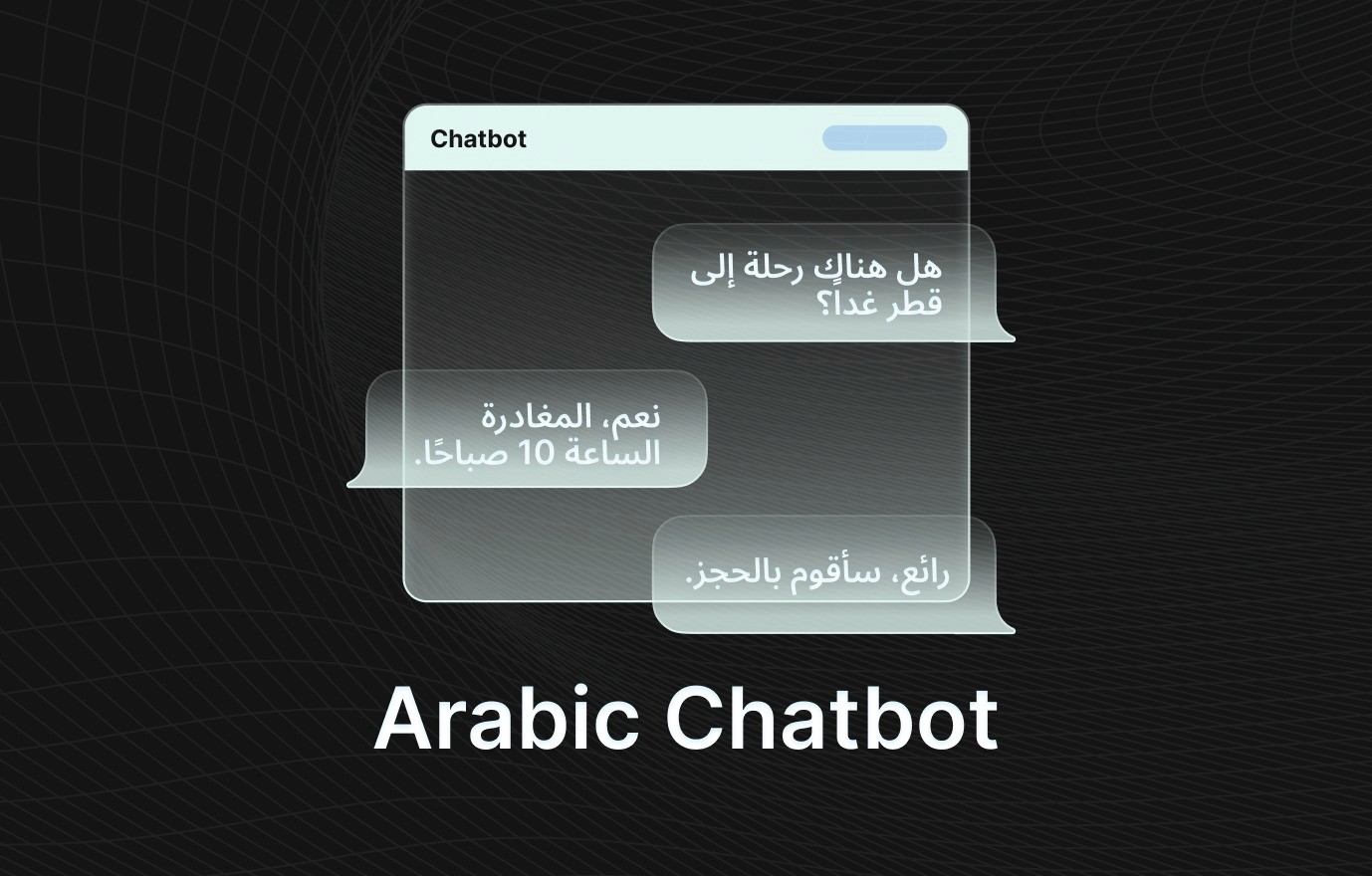
An Arabic chatbot is a conversational AI assistant designed to communicate with customers in Arabic across channels like websites, WhatsApp, mobile apps, and social media.
Businesses use Arabic AI chatbots to automate customer interactions such as answering support queries, qualifying leads, booking appointments, sharing product information, and handling frequently asked questions.
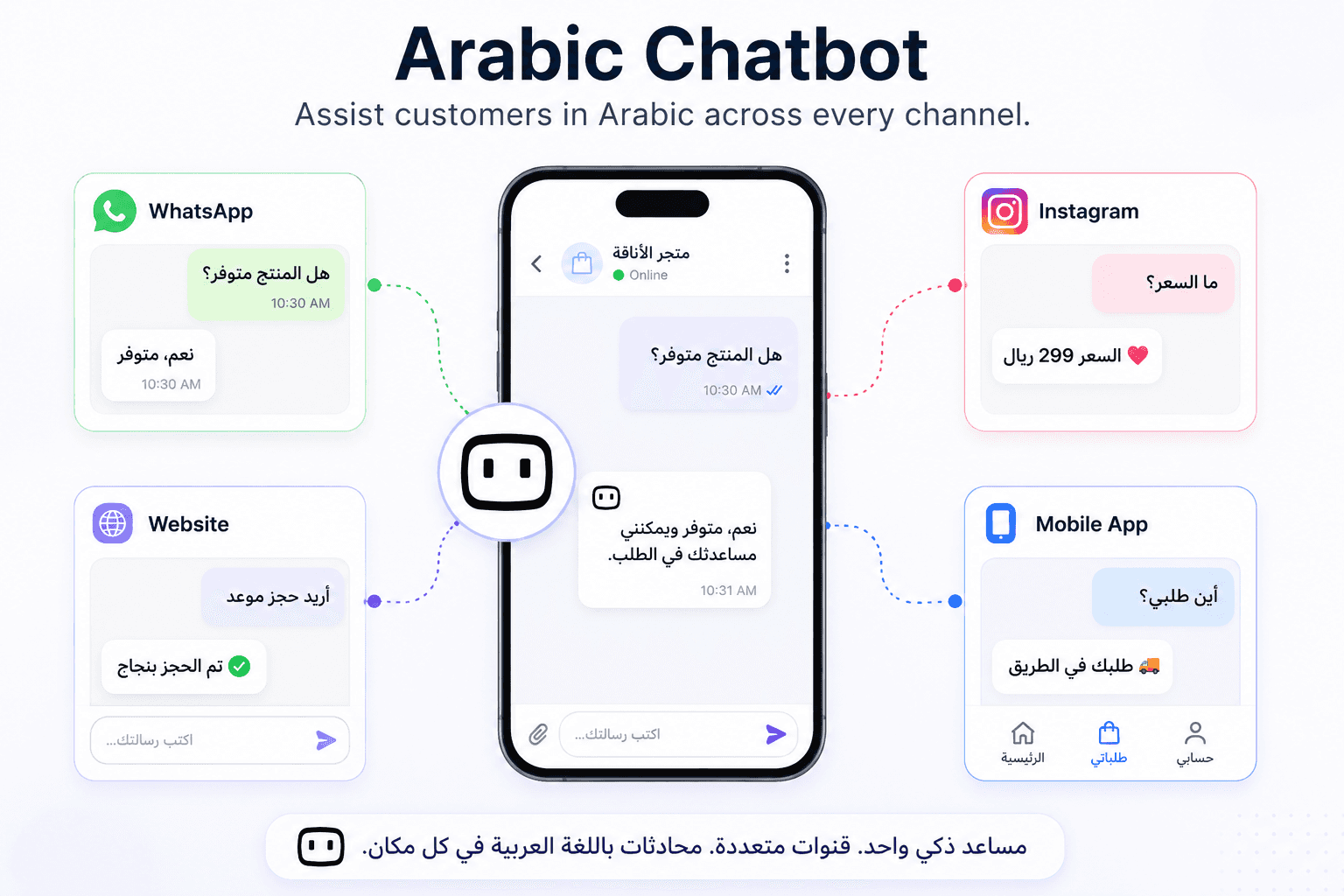
You can deploy Arabic chatbots across multiple channels while maintaining consistent responses and availability, helping businesses provide instant assistance without increasing support workload.
The real challenge, however, is not getting a chatbot to speak Arabic. It is about understanding how Arabic-speaking customers actually communicate. That's where things become more complex.
Why Arabic Is One of the Hardest Languages for Chatbots
Before evaluating any platform, you should understand what makes Arabic uniquely challenging for conversational AI. This context will save you from choosing a platform that demos well but breaks in production.
1. The dialect divide is real and it matters
Arabic is not one language in practice. Gulf Arabic, spoken in the UAE, Saudi Arabia, and Kuwait, sounds and reads differently from Egyptian Arabic, which is different again from Levantine Arabic in Jordan and Lebanon, which is different again from Maghrebi Arabic across Morocco, Tunisia, and Algeria.
A chatbot trained on MSA or on one dialect may genuinely struggle to understand a customer from a different region.
And I reckon most businesses serving customers across multiple Arabic-speaking countries don't realize this until the bot starts misreading intent.
2. Code-switching is the norm, not an edge case
In MENA markets, customers routinely mix Arabic and English in the same message.
Something like "Can you send me the invoice عن طريق الإيميل؟" is a completely normal WhatsApp message.
Most chatbot NLP engines treat this as a language error or get confused about which language model to apply, rather than understanding it as natural bilingual communication that millions of people use every day.
3. Right-to-left text adds a layer that most platforms underestimate
Arabic runs right-to-left, while numbers and embedded English words run left-to-right.
This bidirectional rendering creates UI and processing challenges that chatbot platforms originally built for English often handle poorly.
The result is broken text, misaligned chat bubbles, or garbled responses that make the experience feel unpolished even when the AI behind it is solid.
4. Formal versus informal carries brand implications
A government services chatbot needs to respond in formal MSA. A fashion brand on Instagram needs to sound casual and local.
The tone and dialect register your chatbot uses signals to the customer whether your brand actually understands its audience or is just running messages through a translator and hoping for the best.
Practitioner Insight: If you are deploying an Arabic chatbot for the first time, start with WhatsApp and your top 10 most repetitive customer queries. That combination alone covers the highest volume on the channel your customers already prefer. Expand to other channels and use cases once that foundation is working well.
Start building, not just reading
Build AI chatbots and agents with WotNot and see how easily they work in real conversations.

Start building, not just reading
Build AI chatbots and agents with WotNot and see how easily they work in real conversations.
Start building, not just reading
Build AI chatbots and agents with WotNot and see how easily they work in real conversations.

How to Deploy an Arabic Chatbot
If you already know how to create a chatbot, the fundamentals don't change for Arabic. The flow builder, the integrations, the knowledge base setup, all of that stays the same.
What changes is the preparation underneath it, and that preparation is what determines whether your Arabic chatbot actually works for your customers or just looks like it should. Let’s see how to use an Arabic language chatbot:
1. Figure out which dialect your customers speak before you build anything
This sounds obvious, but I have seen businesses skip it and build their entire knowledge base in MSA because that felt like the safe, universal choice. It is not.
If your customers are in Saudi Arabia, your bot needs to understand Gulf Arabic. If they are in Egypt, Egyptian Arabic. If you serve multiple regions, you need to know which dialect dominates your ticket volume and start there.
You can check this by simply reading your last 50 WhatsApp messages or support tickets. The language your customers already use is the language your bot needs to understand.
2. Build your knowledge base in the way your customers actually write, not in formal Arabic
This is where most Arabic chatbot deployments quietly fail. The business writes perfectly structured MSA articles for the knowledge base, and then the customer types something like "وين طلبي" in the Gulf dialect or mixes in English mid-sentence.
The bot retrieves the formal article, but the match is weak because the language gap is too wide.
Write your FAQ answers in the way your customers ask the questions. If they say "وين" instead of "أين", your knowledge base should reflect that.
3. Deploy on WhatsApp first
Why WhatsApp and not your website or app? Because in most Arabic-speaking markets, this is where the majority of customer conversations occur, and expectations for quick, natural responses are highest.
Once WhatsApp is working well, expanding to your website or Instagram is a much smaller step because the conversation logic and knowledge base are already proven.
4. Test with real customer messages before you go live
Take 20 actual messages from your inbox, the messy ones with dialect, code-switching, and typos, and run them through the bot. If it comfortably understands 15 out of 20, you are in good shape. If it struggles below 10, the Arabic NLP is not ready for your market yet.
This test takes 30 minutes and will tell you more about the platform's Arabic capability than any demo ever will.
5. Verify RTL rendering on every channel you plan to use
Open the chatbot on WhatsApp, on mobile web, and on desktop.
Arabic text should display correctly without broken alignment or garbled characters in all three. This is a five-minute check that saves you from launching something that looks unprofessional to every Arabic-speaking customer who interacts with it.
If this feels like more complexity than your team has bandwidth for, that is a normal reaction. Arabic chatbot deployment genuinely requires more preparation than English.
WotNot's managed services team handles this setup based on your specific market and dialect requirements, so you get the Arabic chatbot live without navigating the NLP and dialect complexity yourself.
Arabic Customers Don't Need a Smarter Bot. They Need One That Speaks Their Language.
The technology to build a good Arabic chatbot exists today. The challenge was never the AI. It was always the language, and specifically, the gap between how Arabic is formally written and how Arabic-speaking customers actually communicate.
Businesses that close that gap first, by understanding their customers' dialect, building their knowledge base around real conversations, and testing with real messages before going live, are the ones whose Arabic chatbots actually earn trust instead of testing it.
If you want that chatbot live without navigating the dialect and deployment complexity yourself, WotNot's managed services team builds it for you based on your specific market. Start with WhatsApp and your 20 most common customer queries. The rest builds from there.
FAQs
FAQs
FAQs
What is an Arabic chatbot?
How to use an Arabic language chatbot for business?
Does the Arabic language support chatbot include dialect understanding?
Which is the best AI chatbot for Arabic?
ABOUT AUTHOR

Hardik Makadia
Co-founder & CEO, WotNot
Hardik leads the company with a focus on sales, innovation, and customer-centric solutions. Passionate about problem-solving, he drives business growth by delivering impactful and scalable solutions for clients.

Start building your chatbots today!
Curious to know how WotNot can help you? Let’s talk.
Start building your chatbots today!
Curious to know how WotNot can help you? Let’s talk.