

Let’s build your chatbot today!
Launch a no-code WotNot agent and reclaim your hours.
*Takes you to quick 2-step signup.
A chatbot that greeting you, asking the right questions, and getting to a solution in under a minute is no accident. Behind every smooth interaction sits a carefully mapped chatbot conversation flow - a structure that determines what the visitor’s next course of action will be.
This guide is a builder's guide, covering what chatbot conversation flows are, how they work under the hood, what elements they're made of, how to build and deploy one from scratch, templates for the six most common bot types, best practices, limitations, and when to evolve beyond flow-based bots entirely.
By the end, you'll have a clear mental model of how to create your own chatbot flow, irrespective of the objective.
Let's get into it.
What Is a Chatbot Conversation Flow (and How Does It Actually Work)?
A chatbot conversation flow is a structured path of conversation that is intended to take place between a human and a chatbot. Bots don’t really understand human language, so these flows are designed to connect human input to a suitable response or action and then execute it, guiding the conversation ahead.
These conversation flows are how chatbots can talk to you.
It is composed of all the predefined routes that determine what a bot says, when it says it, and what action it takes based on the choices made by the human it's talking to.
These paths are intentionally designed to guide people to specific outcomes, such as scheduling a meeting or collecting their email addresses, or tapping into their intent for future targeting.
A conversation flow can be short and simple or long-drawn decision trees that include multitudes of steps, questions, all the possible answers for each question, and the corresponding result for each answer.
Every flow-based chatbot functions on its individual conversation flow.
Here is a very simple and small chatbot conversation flow:
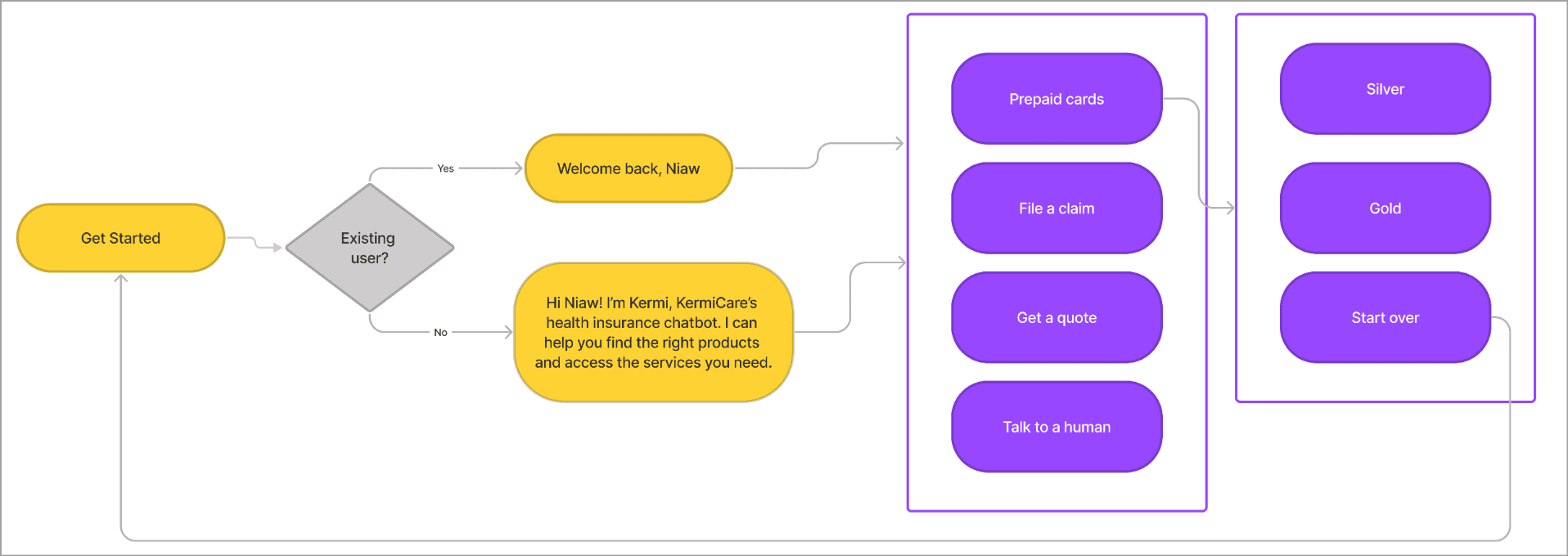
Flow-based chatbots operate on a three-part model.
Trigger: A user provides input, clicking a button, typing a keyword, or selecting an option
Condition: The bot checks that input against a set of predefined conditions.
Response: If it matches, the bot routes to the appropriate response node. If it doesn't, the bot needs a fallback.
Unlike AI-powered bots, a flow bot is completely dependent on how the flow is designed.
There's no model learning from context. The designer carries full responsibility for every edge case. Gartner data shows that rule-based chatbots still account for roughly 40% of deployed enterprise chatbots globally, which makes flow design a skill with massive real-world relevance.
Let’s build your chatbot today!
Launch a no-code WotNot agent and reclaim your hours.
Let’s build your chatbot today!
Launch a no-code WotNot agent and reclaim your hours.
The Building Blocks: Nodes and Branches
Every chatbot conversation flow is made up of connected nodes. The main types:
Element | Purpose |
Start node | Greeting or entry point |
Decision node | Buttons, conditions, or text choices |
Action node | API calls, knowledge base lookup |
Fallback node | Handles unexpected inputs |
End node | Issue solved, transferred to the agent, or conversation ends |
Experts suggest that a well-designed customer support chatbot flow typically has 15 to 25 nodes and handles 70 to 80% of Tier-1 queries without escalation. That's the benchmark to keep while designing a chatbot conversation flow.
When do Chatbot Designs fail?
No conversation flow design can be fool-proof. Things can go out of the scope of the bot in the following scenarios:
No-match: The user's input doesn't match any condition in the current node
Dead end: The flow reaches a terminal node without resolving the user's goal
Loop trap: The user gets routed back to a node they've already visited, stuck in a circle
Each needs a designed exit: a graceful fallback message, a re-prompt with narrower options, or a live chat handoff trigger.
A majority of chatbot abandonment happens at moments when the flow doesn’t have a fallback designed, not because it cannot answer the visitor’s question.
Why Conversation Flow Design Matters for Chatbot Success
Most teams spend 80% of their chatbot budget on platform selection and 20% on how the conversation is actually designed. That division makes no sense.
Here's what poor flow design costs users:
Abandoned sessions without any query resolutions
Unnecessary escalations to human agents
Low CSAT scores indicate higher frustrations
Wasted automation investment that doesn't bring any ROI
Throwing money at the chatbot platforms will not help you achieve better results because the technology is the same. The chatbot design is the only variable.
Here's what a clear conversational flow actually does:
Reduces friction: Fewer repeated questions, less confusion, and faster completion of tasks like bookings, returns, or order tracking.
Lowers pressure on customer support: Common queries get deflected automatically, while complex issues route to human agents with full context.
Produces better analytics: Well-structured flows make it easy to spot gaps, see where users drop off, and iteratively improve the bot.
Maintains brand consistency: Consistent flows across channels - webchat, WhatsApp, in-app messenger - protect a unified brand voice and service quality.
Getting the right from the start is what separates a bot that generates ROI from one that becomes a cautionary tale in your next quarterly review.
Where Conversation Flow Chatbots Work Best
Flow-based bots aren't the right tool for every situation. But in the right context, they outperform AI bots on reliability, auditability, and deployment speed. Here's the decision filter.
High-Volume, Low-Variance Use Cases
Flow bots shine when the conversation scope is narrow and predictable. Appointment booking, FAQ deflection, lead generation, order status checks, etc., are scenarios where you could write every possible user question on a single whiteboard.
Regulated and Compliance-Sensitive Environments
Here's an underrated advantage most chatbot comparisons miss: in banking, insurance, and healthcare, AI-generated responses carry compliance risk. Flow bots, where every word is pre-approved and auditable, are often mandated or strongly preferred.
Forrester found that 47% of financial services firms cite "auditability of bot responses" as a top selection criterion when evaluating chatbot vendors. If your industry has a legal team that reviews everything customer-facing, a flow bot is your friend.
Early-Stage Deployments With Limited Training Data
AI bots need data: conversation history, labeled intents, and entity examples. If you're launching a new product or expanding into a new market, you likely don't have any of that yet. A flow-based chatbot deploys from day one with zero training data and still performs reliably.
Time-to-deployment for flow-based bots averages 2 to 3 weeks versus 8 to 12 weeks for AI-trained bots in enterprise settings. When it comes to swift deployment, the bot with a mapped-out conversational flow wins.
Flow Bot vs. AI Bot: Quick Decision Matrix
Scenario | Flow Bot | AI Bot |
Narrow, predictable intents | Ideal | Unnecessary |
Wide, varied user intents | Struggles | Ideal |
Compliance-sensitive industries | Preferred | Risky |
No existing training data | Deploy now | Not ready |
Fast time-to-launch | 2-3 weeks | 8-12 weeks |
Multilingual at scale | Heavy to maintain | Better fit |
How to Create a Chatbot Conversation Flow
Most guides on this topic tell you to open your chatbot tool and start building. That's like telling someone to build a house without a blueprint.
The most important work in chatbot design happens before you touch any software.
Before we dive into the steps, I need you to make sure that before you actually build a chatbot, make sure you have the following vitals figured out:
Step 1: Define the Bot’s Primary Role
Start with the outcome, not the feature. What is the user trying to accomplish? What is the business trying to achieve?
Force yourself to complete this sentence: "This bot exists to [do X] for [user Y] so that [outcome Z]." Everything else in the flow design comes from that.
A lead generation bot and a customer support bot may live on the same platform but need completely different flow structures. A lot of failed chatbot deployments can be traced back to unclear initial use-case scoping, not technical failure.
Step 2: Map the User Journey Before Touching Any Tool
Whiteboard the conversation first. List every question a user might ask, every answer the bot needs to give, and every action that needs to fire. Identify where branches occur and where the flow ends versus escalates to a human agent.
Start with the happy path, the ideal conversation where everything goes right, and then design the fallbacks. This is the most valuable step in your project.
When you map conversations, ask yourself three questions at every node:
What is the user's goal right now?
What could go wrong here?
What does the fallback look like?
Step 3: Define the Bot's Personality and Tone
Before you start, decide how your bot sounds. A bot with no defined tone defaults to something generic and forgettable, or worse, robotic and off-brand.
Start with two decisions:
Personality: Is your bot formal or casual? Warm or efficient? Playful or serious? A healthcare bot and a sneaker brand bot should sound nothing alike.
Tone guardrails: Pick 3 words that describe the voice. Example: friendly, concise, reassuring. These become your filter for every message you write.
Then write sample dialogs before you build anything.
This is the fastest way to find out if your bot's voice actually works. Write out 3–5 short exchanges the way you want them to sound, not the way a system would generate them.
Example: A formal support bot:
User: My order hasn't arrived yet.
Bot: I'm sorry to hear that. Could you share your order number so I can look into this right away?
Example: A casual e-commerce bot:
User: My order hasn't arrived yet.
Bot: Ugh, that's frustrating! Drop your order number here, and I'll track it down for you, no sweat.
Same intent. Completely chatbot personalities.
A few quick rules:
Write how your audience talks, not how your legal team writes
Keep messages short
Decide upfront: does your bot have a name? A name creates personality instantly.
Haven't named your bot yet? Generate a few chatbot name options here before you lock in its personality.
Be consistent — a bot that's casual in the greeting and stiff in the fallback feels broken
Not sure where to start? Generate a starting personality for your bot - pick the archetype closest to yours, then adjust the tone guardrails from there.
Once you've got 5 sample dialogs that feel right, you have your style guide. Every node you build should match that baseline.
Step 4: Build in Your Chatbot Platform
If you are new to the game and want to test the waters without spending weeks in the process, use a no-code chatbot builder like WotNot. Here, you can map out your chatbot conversation flow using simple drag-and-drop nodes, set conditions, and preview the result in real time without writing any code.
Translate your whiteboard map directly into the builder, one node at a time.
Keep flows modular by creating separate flows for each use case instead of one complex flow. Each flow should have a clear entry point, a clear exit, and a clear fallback.
Step 4: Test With Real Users, Then Iterate
Your first version will have gaps. Some responses will feel robotic. Some branches won't anticipate how a real person phrases things. That's expected and fine, as long as you catch them before your users do.
Test with 5 to 10 real users before launch. Watch where they drop off. Capture the moments where they type something unexpected. Treat the conversation flow design as a continuous process, not a one-time build.
Pre-Launch Chatbot Conversation Checklist
|
Start building, not just reading
Build AI chatbots and agents with WotNot and see how easily they work in real conversations.

Start building, not just reading
Build AI chatbots and agents with WotNot and see how easily they work in real conversations.
Start building, not just reading
Build AI chatbots and agents with WotNot and see how easily they work in real conversations.

Chatbot Conversation Flows by Type: Templates and Use Cases
Different bot types follow fundamentally different flow patterns. Here are the six most common ones, with the key nodes, flow path, and success metrics for each. Use these as starting templates, not finished products.
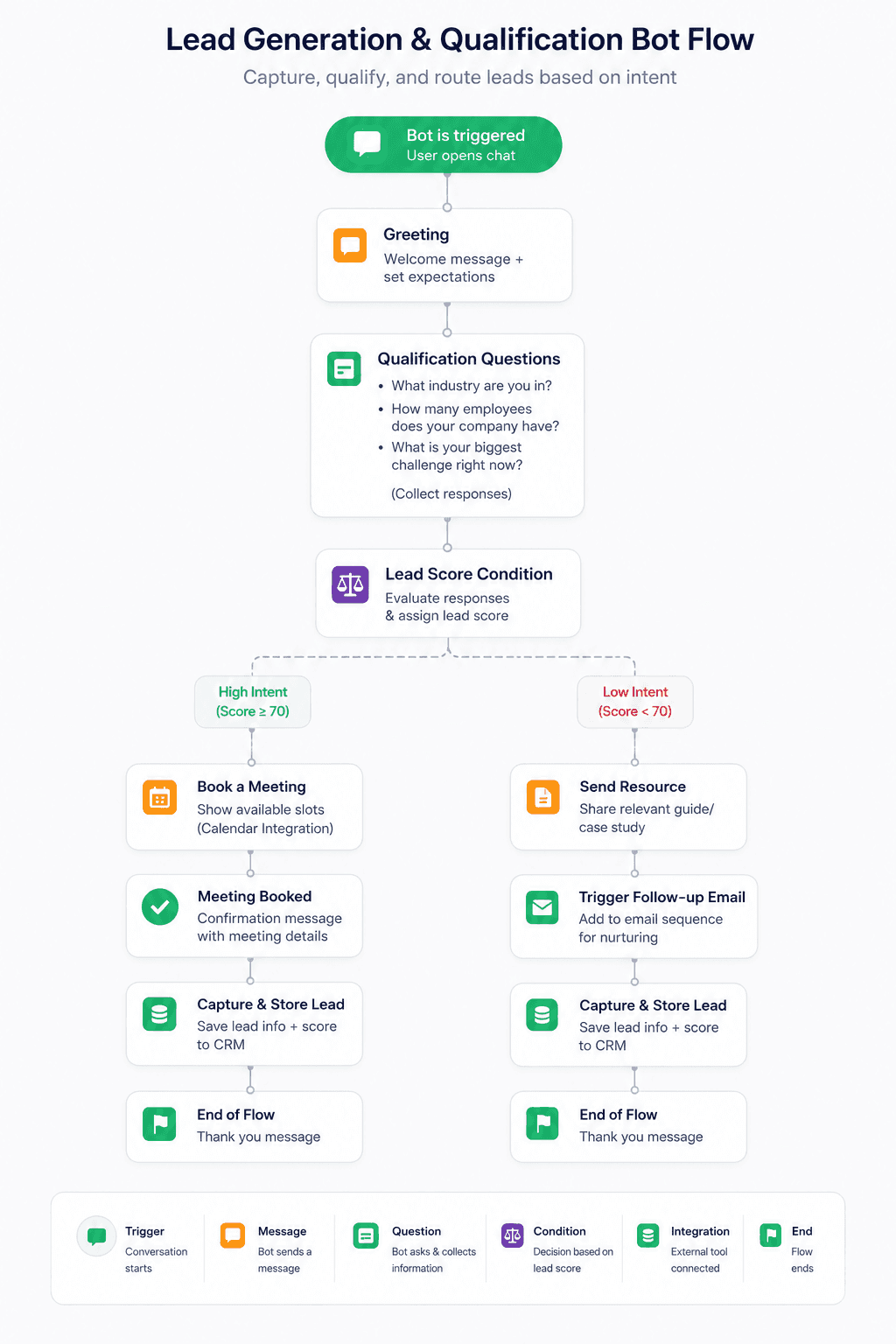
Lead Generation and Qualification Bot
What it does: Qualifies inbound visitors, collects key information, scores leads, and routes high-intent prospects to sales while sending low-intent visitors to a nurture sequence.
Flow path:
Greeting
--> Qualification questions (industry/company size/pain point)
--> Lead score condition
--> High intent: Book a meeting (calendar integration)
--> Low intent: Send resource + trigger follow-up email
Design tip: Keep the qualification questions to a maximum of 3 to 4. Every extra question is a drop-off risk. Ask only what you need to route the lead intelligently.
Customer Support and FAQ Deflection Bot
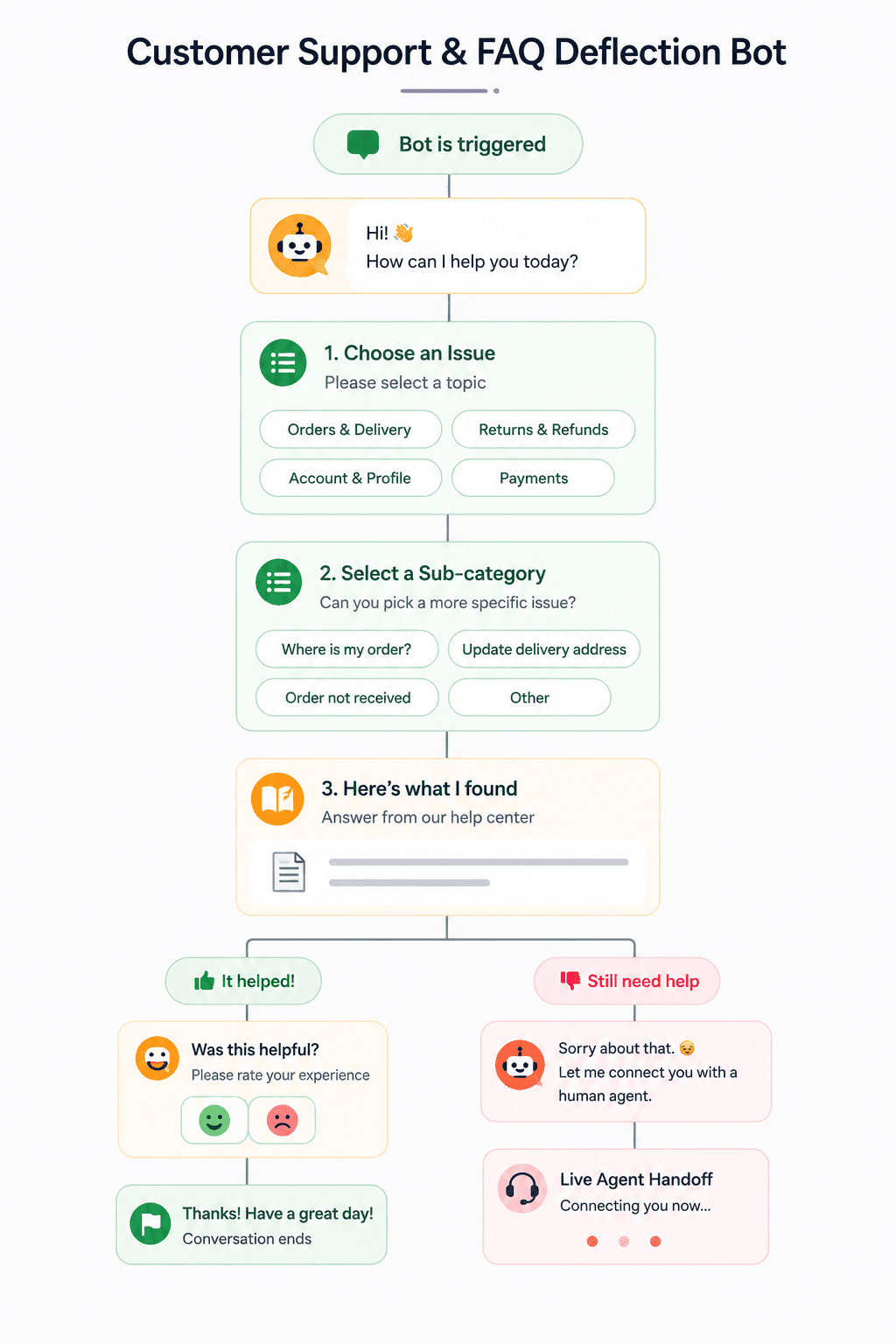
What it does: Handles common customer support queries at scale, deflecting Tier-1 issues while escalating complex issues to a live agent.
Flow path:
Issue category selection (button menu, Level 1)
--> Sub-category (Level 2)
--> Answer node (knowledge base response)
--> Resolved: CSAT prompt --> Exit
--> Unresolved: Fallback message --> Live agent handoff
Design tip: Name your menu categories using language from your actual support tickets, not your internal department names. For example, use "Billing questions" instead of "Finance queries".
Appointment and Demo Booking Bot
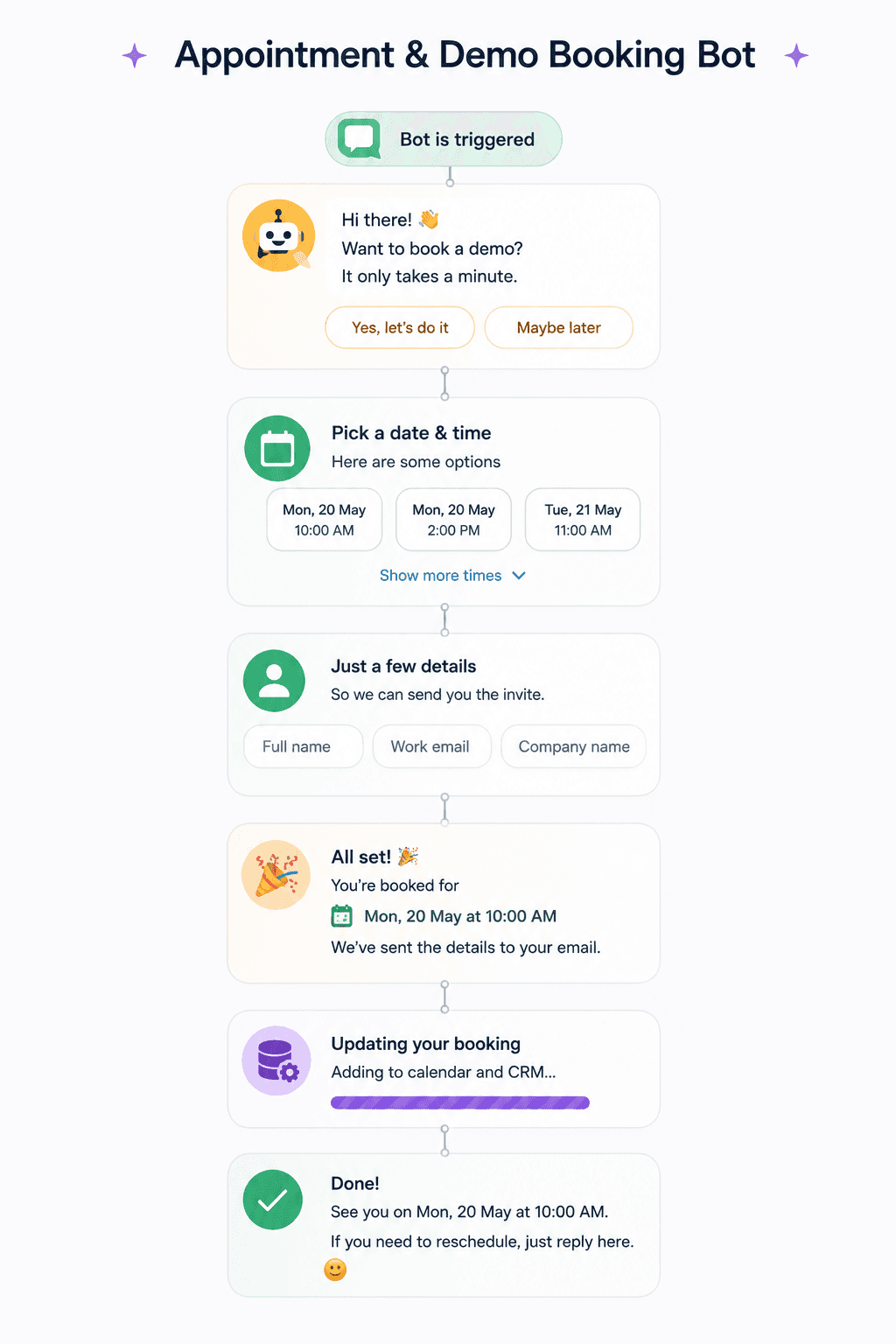
What it does: Guides users through scheduling a meeting, demo, or appointment without phone calls or back-and-forth emails.
Flow path:
Greeting + purpose confirmation
--> Date/time selection (calendar integration)
--> Contact details capture
--> Confirmation message
--> CRM + calendar update (action node)
--> Exit
Design tip: Always send a confirmation with the date, time, and a calendar link. Bookings without confirmations have significantly higher no-show rates.
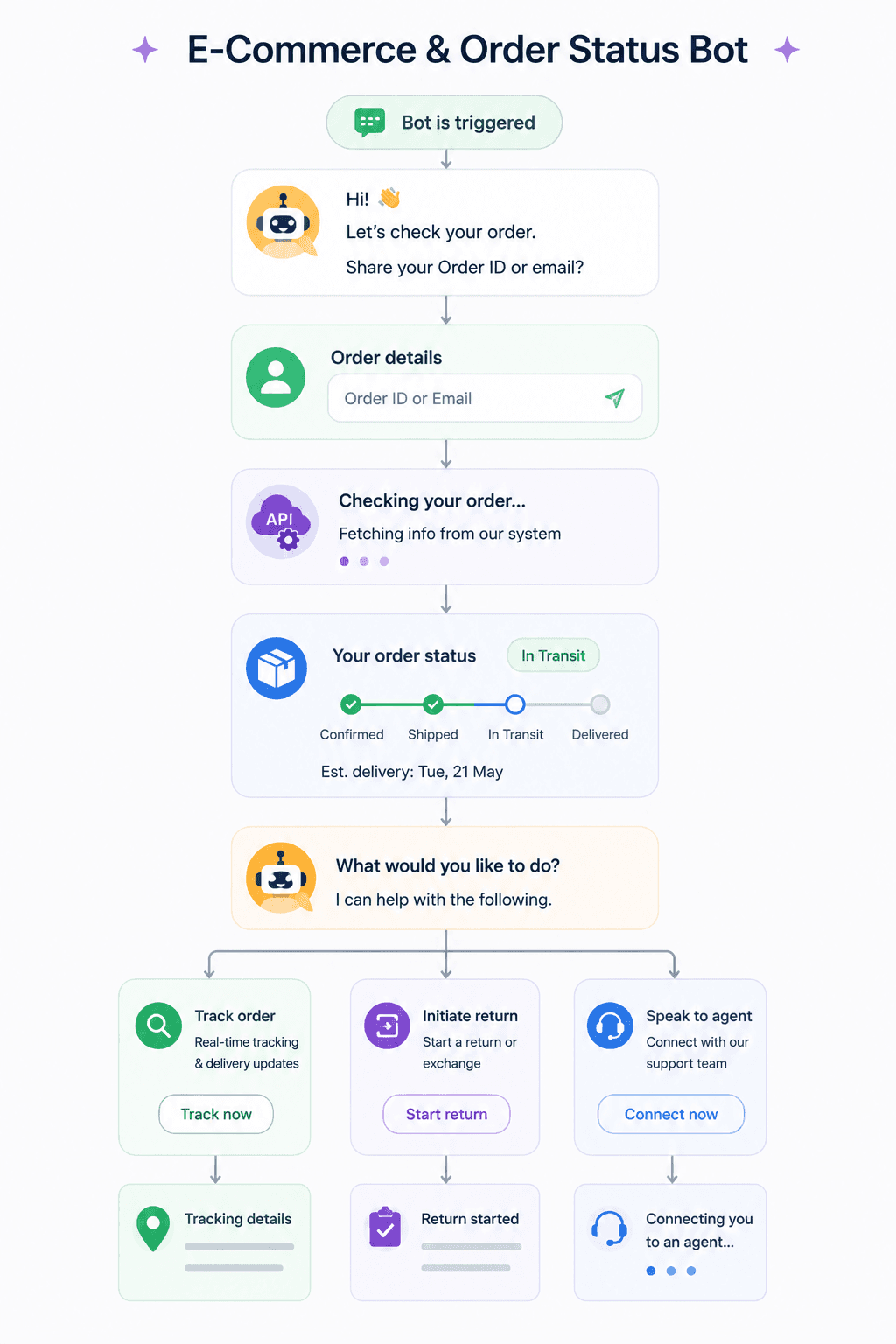
E-Commerce and Order Status Bot
What it does: Lets customers self-serve on order tracking, returns, and basic account queries, reducing repetitive ticket volume hitting your support team.
Flow path:
Entry
--> Order lookup (order ID or email capture)
--> API call to order management system
--> Status display
--> Options branch:
--> Track order
--> Initiate return
--> Speak to agent
Design tip: When an order is delayed or problematic, don't just display the status. Offer a proactive next step. "Your order is delayed. Would you like us to contact the carrier?" turns frustration into a positive interaction.
Problems and Limitations of Flow-Based Chatbots
Flow-based bots have real limitations. Know them upfront so you deploy them in the right places.
They Break When Users Go Off-Script
A flow bot can't infer intent from free text. A user who types "my package is late, and I'm really frustrated" instead of clicking "Order Status" may hit a dead end. Fallback design helps, but it doesn't eliminate the problem.
Maintenance Gets Heavy at Scale
One-purpose bots are easy to manage, but they get too complex when covering 50+ use cases across multiple channels. Every policy change or new product may require manual flow updates.
They Can Feel Rigid to Modern Users
User expectations have shifted, and they expect chatbots to understand varied phrasing, something flow bots can't do by design. Hence, you need to be strategic about where you deploy them and invest in designing a natural-sounding chatbot flow.
Not Built for Complex, Multi-Turn Conversations
Flow bots work best for structured, bounded conversations. Nuanced troubleshooting or queries requiring context across multiple turns are where these bots are out of their depth. For those cases, a hybrid or AI-powered approach is almost always the better call.
When to Evolve From Conversation Flow to AI-Powered Agents
The solution to flow bot limitations isn't to replace them but to step up.
Signs You're Ready to Evolve
You're ready to move beyond a pure flow bot when:
More than 30% of sessions are ending at fallback nodes
Your support team is handling queries the bot was supposed to contain
Users are consistently typing free-text instead of using buttons
Your use case requires remembering context from earlier in the conversation
You're expanding into channels or languages that make manual flow maintenance unsustainable
None of these are signs that flow bots failed. There are signs that your chatbot program has matured to the point where the next layer is worth investing in.
Hybrid Chatbot Architecture
A hybrid chatbot combines a flow-based structure for predictable use cases with NLP or AI handling for free-text input and complex queries.
Keep your well-designed flows for the use cases they handle well. Add AI intent recognition as an entry layer that routes users to the right flow before the flow logic kicks in.
The best of both worlds is the most effective approach.
If you're evaluating chatbot development frameworks, look for platforms that support hybrid architectures natively, so you can start with flows and layer in AI without migrating your entire setup.
Conclusion
A chatbot conversation flow is the invisible architecture that determines whether a bot is helpful or not.
The fundamentals aren't complicated. Define the job. Map before you build. Keep paths short. Write conversationally. Design the failure path as carefully as the happy path. Measure and iterate. Apply those six principles consistently, and your flows will outperform most of what's deployed today.
These chatbots are a reliable and compliance-friendly support vertical that most businesses need before they're ready for full AI. And as hybrid architectures become the standard, the ability to design a clean, structured flow will only become more valuable.
Ready to build your first chatbot conversation flow?
Start your free trial at WotNot, which lets you design, build, and deploy chatbots within hours, not weeks.
FAQs
FAQs
FAQs
What is the difference between a chatbot conversation flow and a chatbot script?
A chatbot script is a linear document covering what the bot says in sequence. A chatbot conversation flow is the full interactive architecture: branching logic, conditions, fallback paths, action nodes, and exit points that govern what the bot says based on what the user does. A script is one path. A flow is the complete map of all possible paths.
How many nodes should a chatbot conversation flow have?
Can flow-based chatbots handle multiple languages?
What is the difference between a flow-based chatbot and an AI chatbot, and which should I choose?
Can I use a chatbot conversation flow template, or should I build from scratch?
ABOUT AUTHOR

Hardik Makadia
Co-founder & CEO, WotNot
Hardik leads the company with a focus on sales, innovation, and customer-centric solutions. Passionate about problem-solving, he drives business growth by delivering impactful and scalable solutions for clients.



Start building your chatbots today!
Curious to know how WotNot can help you? Let’s talk.
Start building your chatbots today!
Curious to know how WotNot can help you? Let’s talk.