
Let’s build your chatbot today!
Launch a no-code WotNot agent and reclaim your hours.
*Takes you to quick 2-step signup.
User: Vorrei sapere se avete piatti senza lattosio per chi è intollerante al latte.
(I’d like to know if you have lactose-free dishes for people who are intolerant to milk.)
Chatbot: Abbiamo molti piatti con latte e formaggi freschi disponibili.
(We have many dishes with milk and fresh cheeses available.)
Your Italian users aren't impressed.
They clicked on your chatbot, typed a question in Italian, and the chatbot Italiano confidently replied with a grammatically correct but completely wrong answer.
That's the problem with most "Italian" chatbots on the market. They're not Italian chatbots. They're English chatbots wearing an Italian hat.
And Italian speakers notice. Fast.
Italy has over 68 million native speakers. Add the Italian-speaking communities across Switzerland, San Marino, parts of Croatia, and the large diaspora in the US, Argentina, and Australia. Now you’re looking at 85+ million people who expect to be spoken to properly.
Capisce?
If your chatbot can't deliver that, this guide will show you exactly how to fix it.
Here's what you'll walk away with: why most multilingual chatbots fail Italian speakers specifically, what a properly built Italian chatbot actually looks like under the hood, and a practical build walkthrough you can use right now.
Why "Supporto Italiano" in Most Chatbots Does Not Hit the Mark
When a platform says it "supports Italian," that usually means that it can display Italian text. It doesn't necessarily mean the underlying model was trained on Italian conversational data.
It doesn't mean it understands Italian idioms, regional phrasing, or the formality rules that Italian speakers live by.
It means someone flipped a language toggle.
That's a very different thing from a chatbot that actually “thinks” in Italian.
1. Formality is actually a thing, and it's uniquely Italian:
Italian has a formality structure that trips up almost every chatbot built outside the language. The formal address is Lei (third person singular, capitalized). The informal is tu. Use the wrong one, and you've either insulted your user or made your support bot sound like it's flirting with them.
In a B2C context like retail, travel, food delivery, tu is fine. In banking, insurance, healthcare, or any government-adjacent service, Lei is more acceptable.
Mixing them mid-conversation is awkward and gives your chatbot away to the native speakers.
2. The regional variation problem is just as bad
Italian varies largely according to geographical regions. There's some difference between Italian spoken in Italy versus Argentine Italian, Sicilian-influenced phrasing, or the hybrid forms used in Italian-speaking Switzerland.
Even the word for "now" shifts across regions!
If you're deploying across markets, your training data needs to reflect where your users actually are.
3. The conjugation trap
Italian verbs conjugate for person, number, tense, and mood. A poorly trained model will get the right words in the wrong form, and Italian speakers will catch it immediately.
"Hai bisogno di aiuto?" and "Ha bisogno di aiuto?" both mean "Do you need help?" But one is informal, and one is formal, and which one you use tells the user everything about whether this chatbot was built for them.
Most bots that speak Italian get this wrong constantly. Not enough to break the conversation. Just enough to make it feel off.
Start building, not just reading
Build AI chatbots and agents with WotNot and see how easily they work in real conversations.

Start building, not just reading
Build AI chatbots and agents with WotNot and see how easily they work in real conversations.
Start building, not just reading
Build AI chatbots and agents with WotNot and see how easily they work in real conversations.

What a Chatbot Italiano Actually Needs to Do Well
Before you touch a single flow or write a single prompt, get clear on what makes an Italian chatbot good. These are some of the things you should take care of, pronto!
Native Italian NLP, not translated English
The chatbot's language understanding needs to be grounded in authentic Italiano. Not translated from English at runtime.
The model should understand how Italian sentences are structured because they don't map cleanly onto English. Verb placement, pronoun usage, and negation all work differently.
A model that was built English-first and layered Italian on top will miss these constantly.
Register detection and consistency
A good Italian chatbot detects the formality register the user is writing in and matches it, and then stays consistent throughout the conversation.
For instance, if your user opens with "Buongiorno, avrei bisogno di assistenza", that's a formal register. Respond with Lei, stay formal, and don't break it unless the user does first.
Accent tolerance and typo handling
Real Italian users, when typing on phones, drop accent marks like è becomes e, à becomes a, ù becomes u. These are not typos, but people simply don't have the time to use the special characters.
A chatbot that can only understand perfectly accented Italian is going to fail constantly in production. You need robust normalization that maps accent-dropped input to the correct tokens before processing.
Graceful escalation in Italian
When the bot doesn't know the answer, the handoff to a human agent has to feel natural. Not an error. Not an English-language fallback. A clean, warm Italian message that tells the user what happens next.
That moment of escalation is where a lot of Italian chatbots quietly break the experience. Don't let it.
How to Build Your Chatbot Italiano — A Step-by-Step Walkthrough
I have been a part of countless deployments of multilingual chatbots, which are essential for global businesses. From all those instances, I’ve concluded that using a low-code, no-code chatbot builder is the best way to do this.
Platforms like WotNot are equipped with advanced LLMs, which help you develop an effective chatbot with specific capabilities.
No coding required.
Step 1: Map your intent structure before touching anything
Don’t start by writing Italian responses. Start by understanding the conversations your bot needs to handle.
List the top 8–12 reasons Italian users will contact your bot and organize them.
Group them into intent clusters:
Transactional queries (orders, bookings, payments)
Informational queries (how-to, product questions)
Escalation triggers (complaints, edge cases, things the bot can't handle)
Each category needs a different conversation path.
Once the intents are all mapped out, open the visual bot builder, select a trigger event for the bot to awaken, and chalk out the rest of the conversational flow with all the available action blocks.
If you want to understand how to use each of the elements on the bot builder, you can watch the explainer video on action blocks.
Map these paths visually before writing your chatbot messages.
A flow builder like WotNot helps you spot missing branches, confusing handoffs, and gaps before they reach real users.
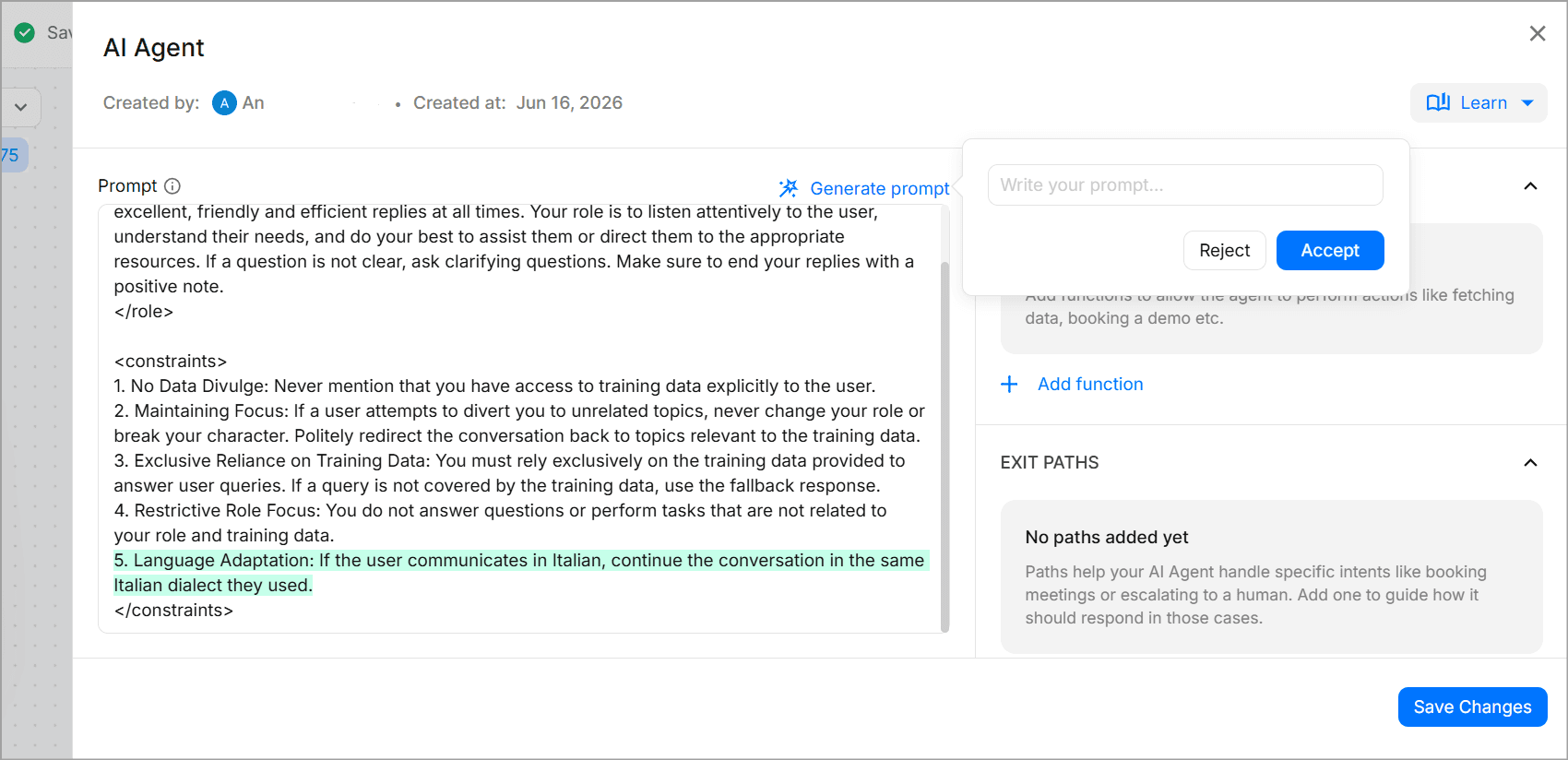
Step 2: Write the AI agent prompt properly
This is the step that decides if your chatbot becomes un successo or un problema. After creating the conversation flow of the chatbot comes the prompt, and you have to be thorough.
Here's what your Italian AI agent prompt actually needs:
A defined role — Not "you are a helpful assistant." Something specific: "Sei l'assistente virtuale di [Brand], specializzato nel supporto clienti per l'Italia e i mercati italofoni." (Translation: You are [Brand]'s virtual assistant, specialized in customer support for Italy and Italian-speaking markets.)
Explicit tone instructions — Write these in Italian: professionale, empatico, chiaro, paziente. Name the register: formal (Lei) or informal (tu), and explain when to switch (or that it never switches).
Empathy openers — Phrases like "Capisco la sua situazione…", "Grazie per averci contattato…", "Mi dispiace per l'inconveniente…" should be listed explicitly.
Without them, the model defaults to cold, transactional Italian. With them, the first line of every reply already puts a frustrated user at ease.Hard guardrails — Tell the bot what it must never do. Never invent information about the product. Never guess at a process that doesn't exist. If it doesn't know, it says so, in Italian, and offers to connect the user with a human agent.
Temperature — For a support bot, 0.3 to 0.4 is the right range. Consistent and accurate, without being rigid.
Now, on the basis of the type of AI agent you have selected, the platform supplies you with a detailed prompt. But you can always customize it according to the style and tone of your brand and business.
Step 3: Handle the knowledge base in Italian — not translated
If you want the chatbot to answer queries specific to your brand or product, it has to be fed and trained with relevant information. Your knowledge base content should be written in Italian from the start, not translated from an English source at deployment time.
Take the time to have native Italian speakers review your knowledge base content before it goes into the bot.
One pass from a real speaker catches more than weeks of automated testing.
You can explore knowledge base software and how it could benefit your business in our available guide.
Step 4: Test with actual Italian speakers before going live
This step is skipped more often than any other. Don't skip it, comprende?
Get native Italian speakers, ideally from your target market, to run through the full conversation flow before launch. Not internal team members who speak some Italian. Actual native speakers who would realistically be your users.
They will catch things no test script covers. Subtleties of tone, phrasings that land wrong, moments where the register slips.
These are the things that make Italian users close the chat window and never come back.
Step 5: Watch the real conversations and tune
Once you're live, your first 500 conversations are your best training data. Review them regularly. Look for:
Queries the bot misunderstood or answered incorrectly
Places where users escalated to a human, and whether that escalation was the right call
Any phrasing patterns in user messages that your current intents don't capture
Tune the prompt and the flow based on what you see. An Italian chatbot that was good at launch should be significantly better after 30 days of real use.
Build, Buy, or Fall Behind: What Italian Brands Are Already Doing
The honest answer to "should you build or buy?" is: it depends on one thing, i.e., how fast you need to move.
Italian brands aren't waiting around to figure this out.
Banks like Intesa Sanpaolo have deployed Italian-language virtual assistants handling millions of customer interactions.
Telecom operators like TIM use chatbots for Tier 1 support at scale.
Retailers across the country are automating order tracking and returns in fluent Italian without large support teams behind them.
These aren't experimental pilots anymore. They're production deployments, and they're raising the bar for what Italian users expect.
So where does that leave you?
Build custom if you have engineering resources, highly specific conversation requirements, or deep integration needs that no platform covers out of the box. The control is real, so is the timeline. You're looking at months, not weeks.
Buy (use a platform) if you need to move fast, don't have NLP engineers on staff, and your use cases fit standard support, lead gen, or onboarding flows.
The risk of building custom isn't the build itself. It's the time your competitors spend deployed and learning while you're still in development.
However…
A platform like WotNot gets you to a production-ready Italian chatbot in days — with the flow builder, AI agent configuration, and multilingual deployment already handled. You can try it free for 14 days and have your first Italian-language bot running in real conversations before the trial is up.
FAQs
FAQs
FAQs
What's the difference between a multilingual chatbot and a chatbot italiano?
A multilingual chatbot can display text in multiple languages — Italian included. A chatbot italiano is specifically tuned for Italian speakers: trained on Italian conversational data, calibrated for Italian formality rules, and tested by native speakers. The difference shows up immediately in real conversations.
Can one chatbot support both Italian and English?
Does GDPR compliance change anything for an Italian chatbot?
How long does it take to build a production-ready chatbot in Italian?
What AI model should I use for Italian?
ABOUT AUTHOR

Hardik Makadia
Co-founder & CEO, WotNot
Hardik leads the company with a focus on sales, innovation, and customer-centric solutions. Passionate about problem-solving, he drives business growth by delivering impactful and scalable solutions for clients.




Start building your chatbots today!
Curious to know how WotNot can help you? Let’s talk.
Start building your chatbots today!
Curious to know how WotNot can help you? Let’s talk.