

Let’s build your chatbot today!
Launch a no-code WotNot agent and reclaim your hours.
*Takes you to quick 2-step signup.
Most AI workflows today follow a fixed path.
You define the steps, the AI executes them, and the process works well as long as every decision has already been mapped out. That's exactly how most chatbot automation works today: the AI follows predefined instructions to complete predictable tasks.
But the moment the workflow needs to decide what to do next, instead of following a predefined rule, it reaches its limits. Tasks get escalated, customers get stuck, and processes that should have been automated end up back in human hands.
Agentic AI workflows are built for that gap.
Instead of following instructions, the AI pursues an outcome. It reasons through the problem, uses tools, adapts when conditions change, and knows when to involve a human. That shift from “follow these steps” to “achieve this result” is what makes them fundamentally different.
But, now, shall I be upfront with you?
According to research by McKinsey, nearly two-thirds of enterprises have experimented with agents, but fewer than 10% have scaled them to deliver tangible value. The hype is real, but so are the gaps. I bring you this guide that covers both.
What Is an Agentic AI Workflow?
An agentic AI workflow is a system where autonomous AI agents plan, reason, use tools, and execute multi-step tasks to achieve a specific outcome, adapting their approach in real time rather than following a fixed sequence.
The simplest way to understand the difference
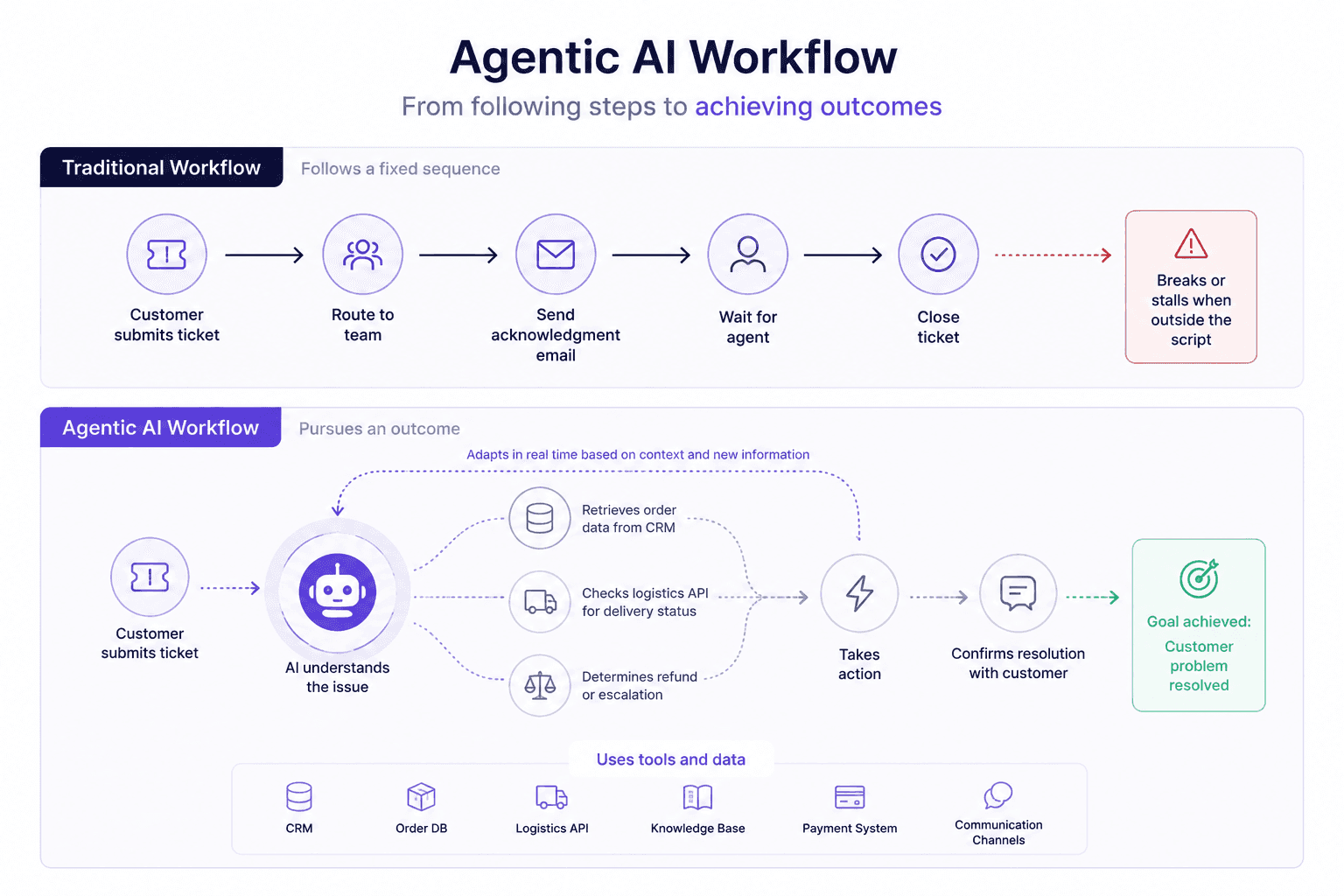
A traditional workflow handles a customer support ticket like this: customer submits ticket → route to team → send acknowledgment email → wait for agent → close ticket. Every step is predefined. If something falls outside the script, it stalls.
An agentic workflow handles the same ticket like this: customer submits ticket → AI understands the issue → retrieves relevant order data from the CRM → checks logistics API for delivery status → determines whether to issue a refund or escalate → takes action → confirms resolution with the customer.
In the second flow, the steps were not predefined, but the AI agent figured them out based on the goal: resolve this customer's problem.
Traditional workflows follow steps. Agentic AI workflows pursue outcomes.
That single distinction explains almost everything about why this concept matters. The AI is not executing a playbook someone wrote. It is working toward a result, deciding along the way what tools to use, what information to retrieve, and what actions to take. When the AI agent use cases are complex enough that you cannot predefine every path, agentic workflows become the only architecture that scales.
Quick note: AI agents and agentic AI workflows are not the same thing. An AI agent is one autonomous unit that can think and act on its own. An agentic AI workflow is what happens when you coordinate multiple agents, tools, and decision points into a system that works toward a goal together. Agent = the player. Workflow = the game plan. Most real-world deployments need both.
Let’s build your chatbot today!
Launch a no-code WotNot agent and reclaim your hours.
Let’s build your chatbot today!
Launch a no-code WotNot agent and reclaim your hours.
How Agentic AI Workflows Actually Work
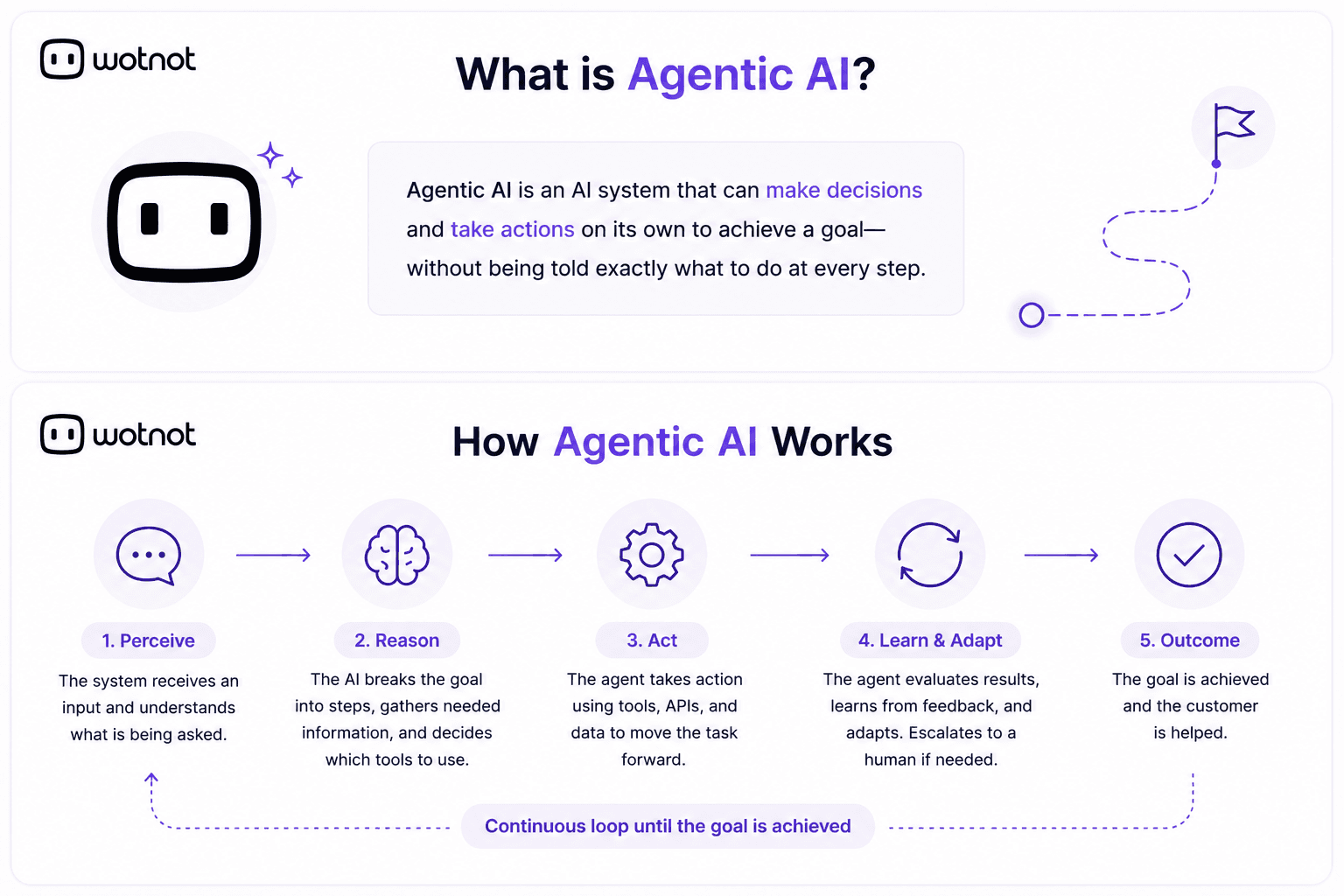
If you strip away the jargon, every agentic workflow runs in the same loop.
Perceive: The system receives an input. A customer message, a support ticket, a data trigger, a scheduled event. It ingests the information and understands what is being asked.
Reason: This is where it stops being traditional automation. The AI doesn't look up a predefined response. It breaks the goal into smaller steps, decides what information it needs, and figures out which tools to use. If it needs order data, it calls the CRM. If it needs delivery status, it checks the logistics API. The reasoning layer is what makes the workflow agentic rather than scripted.
Act: The agent executes. It pulls the data, processes a refund, sends a confirmation, updates a record, books an appointment, or whatever the situation requires. Not because someone programmed that exact sequence, but because the reasoning layer determined it was the right move.
Learn and adapt: The agent evaluates its own output. Did the action resolve the problem? Did the customer respond positively? If something didn't work, it adjusts. Over time, this feedback loop makes the workflow smarter. And if at any point the agent determines it is out of its depth, it escalates to a human with full context rather than guessing its way through.
That loop, perceive → reason → act → learn, runs continuously. It is not a one-shot process. The agent might cycle through it multiple times within a single customer interaction, adjusting its approach based on what it discovers at each step.
Where Agentic AI Workflows Actually Deliver
The concept makes sense on paper. But the question every business leader asks is: where does this actually work today? These four use cases are where agentic workflows are delivering measurable results, not in demos but in production.
1. IT Helpdesk and Internal Support
An employee messages: "My VPN isn't connecting." A traditional bot runs through a scripted decision tree: restart your device, check your internet, contact IT if the problem persists.
An agentic workflow approaches it differently. It checks whether the employee's VPN credentials have expired, whether there is a known network outage affecting their office location, and whether their device has a pending security update blocking the connection. Based on what it finds, it takes a different path each time. Sometimes it resets credentials automatically. Sometimes it flags a network issue and notifies the infrastructure team. The resolution isn't scripted; it is figured out simply because agentic AI doesn’t have to follow any steps; it is directed towards a goal.
For businesses already using a knowledge base chatbot for internal support, agentic workflows are the natural next step. The knowledge base gives the agent information. The agentic layer gives it the ability to act on that information rather than just surface it. This becomes particularly valuable in environments using ZTNA security, where access decisions need to adapt to changing users, devices, and network conditions.
2. Lead Qualification and Sales
A lead fills out a form on your website. Traditional automation scores it based on a few fields and drops it into a sales queue.
An agentic workflow does something meaningfully different.
It pulls the lead's company data, checks whether they match your ideal customer profile, looks at any past interactions they have had with your brand, and evaluates their timing and budget signals. And then it decides: is this lead best sent directly to a sales rep right now, or should it enter a nurture sequence first?
That decision-making layer is what separates agentic from automated. The workflow doesn't just move data from one place to another. It makes a judgment call based on context.
3. Claims Processing
An insurance claim comes in. In a traditional workflow, it enters a queue and waits for a human reviewer.
An agentic workflow reads the claim document, extracts the relevant details, cross-references them against the policy terms, verifies the supporting evidence, and checks for inconsistencies. If the claim is straightforward and everything checks out, it approves it automatically. If something looks unusual, it flags the specific concern and escalates with a recommendation rather than just passing along a raw file.
The value here is not replacing human judgment entirely. It is making sure humans spend their judgment on the claims that actually need it, instead of manually processing the 70% that are routine.
4. Employee Onboarding
Let’s assume that a new hire starts on Monday. Now in most companies, that triggers a chain of manual coordination: HR sends the offer letter and collects documents, IT provisions a laptop and creates system accounts, the manager schedules the first week, facilities assigns a desk and access card.
Each team works independently, often via email, and there are chances that things regularly fall through the cracks.
An agentic workflow coordinates all of this into a single process. It triggers each task at the right time, tracks completion across teams, follows up automatically when something stalls, and gives the new hire a single point of contact for questions. One goal, multiple systems, zero manual stitching.
Start building, not just reading
Build AI chatbots and agents with WotNot and see how easily they work in real conversations.

Start building, not just reading
Build AI chatbots and agents with WotNot and see how easily they work in real conversations.
Start building, not just reading
Build AI chatbots and agents with WotNot and see how easily they work in real conversations.

The Honest Reality About Agentic Workflows in 2026
The introduction already gave you the number: fewer than 10 percent of enterprises have scaled agentic AI to deliver tangible value. Here is why that gap exists.
The most dangerous moment in an agentic AI project is when the prototype impresses stakeholders. Because the demo looks magical. The AI reasons through a problem, calls the right APIs, and delivers a clean result.
And then it goes to production, where real users ask unexpected things, data is messy, and edge cases show up that nobody anticipated. The gap between demo and production in agentic AI is wider than in any previous generation of automation because you can’t exactly determine the system’s behavior. The same input can produce different execution paths, which makes failures harder to trace and harder to reproduce.
Most reliability problems are architecture problems, not prompt problems. I have seen teams spend months refining prompts, trying to make their agents more accurate, when the real issue was how the workflow was structured.
Remember one thing: Reliability comes from modular design, rigorous state management, and deterministic guardrails, not from better prompts alone.
Also, data is the blocker that most teams underestimate. As discussed, eight in ten companies cite data limitations as the primary roadblock to scaling agentic AI. Fragmented systems, inconsistent data quality, and workflows designed for humans rather than agents. If your data foundation is not ready, the agentic layer built on top of it will inherit every weakness underneath.
The organizations that succeed redesign their workflows. The ones that fail layer agents onto legacy processes. Bolting an AI agent onto a process built for manual execution doesn't make it agentic. It makes it a more expensive version of what you already had. And the cost of getting this wrong is not trivial. Gartner predicts that over 40% of agentic AI projects will be canceled by the end of 2027 due to escalating costs, unclear business value, or inadequate risk controls.
Start With One Workflow. Prove It Works. Then Expand.
The businesses that successfully scaled agentic AI all started the same way: with one high-volume workflow where the AI genuinely needs to reason and adapt, guardrails from day one, and expansion only after results proved themselves.
At WotNot, we build AI agents that sit at this intersection. AI Studio handles the reasoning layer, CRM, and helpdesk integrations, giving the agent the ability to act, and live chat ensures a human is always available when the agent reaches the limit. If you want agentic capabilities in your customer workflows without building the infrastructure yourself, our managed services team handles the setup.
Traditional workflows follow steps. Agentic AI workflows pursue outcomes. The technology is ready. The question is whether your workflows are designed for it.
ABOUT AUTHOR

Hardik Makadia
Co-founder & CEO, WotNot
Hardik leads the company with a focus on sales, innovation, and customer-centric solutions. Passionate about problem-solving, he drives business growth by delivering impactful and scalable solutions for clients.



Start building your agents today!
Curious to know how WotNot can help you? Let’s talk.
Start building your agents today!
Curious to know how WotNot can help you? Let’s talk.