11 min read
White Label SaaS: What It Is & How to Profit

Bhavyadeep Sinh Rathod

Let’s build your chatbot today!
Launch a no-code WotNot agent and reclaim your hours.
*Takes you to quick 2-step signup.
Everyone's out here trying to build the next big SaaS product.
Hiring developers. Burning cash. Waiting 6-12 months to launch something that might fail.
And then there's this other group of people that quietly makes money by not building anything from scratch.
They take software that already exists, slap their brand on it, and sell it as their own.
Their customers love it. Their margins? Even better.
That's White Label SaaS.
And honestly, it might be one of the most underrated business models right now.
Especially if you're an agency, a consultant, or anyone sitting with an audience, but with no product.
This guide breaks down everything: what it is, how to pick the right one, how it works, and the 10 most practical platforms you can actually profit from today.
Let's get into it.
What is White Label SaaS & Why It’s More Relevant in the Current Meta?
White-label SaaS is a business model where you take an existing software product, rebrand it as your own, and sell it to your customers.
You don’t have to build the product.
You don’t have to manage the infrastructure.
You don’t have to deal with ongoing development.
Instead, you focus on what actually drives revenue. Which is distribution, sales, and customer relationships.
Now… This isn’t a new concept.
But the way businesses are using it today has changed.
Building software used to be a competitive advantage. Now, it’s becoming a cost center.
More businesses are realizing that hiring and maintaining a developer team is not cost-efficient. At least not when their competitors are literally vibe-coding or setting up the whole platform on a white-label basis.
And this model works especially well if you:
Run an agency (marketing, automation, consulting)
Have an existing client base
Understand a specific niche or industry
Want to add recurring revenue without building a product
Because instead of selling one-time services, you’re now selling ongoing solutions. It's also why categories like white-label social media tools are blowing up scheduling, publishing, and managing multi-platform content under your own brand is a fast path to recurring revenue.
Let’s build your chatbot today!
Launch a no-code WotNot agent and reclaim your hours.
Let’s build your chatbot today!
Launch a no-code WotNot agent and reclaim your hours.
What Kind of White Label Is Most Profitable in SaaS?
Not all white-label plays are equal. Some will make you a decent side income. Others can scale into a full business. And some will have a high CPA (cost per acquisition) that you won’t be able to profit from.
The most profitable white-label SaaS tends to sit at the intersection of three things:
1. High recurring need
The software solves a problem that doesn't go away. Customer support doesn't go away. Lead generation doesn't go away, which is exactly why b2b lead generation tools remain one of the stickiest categories to resell. Scheduling and email marketing are evergreen. Avoid anything trendy or one-time-use.
2. Agencies or consultants as your target customer
If you're reselling to businesses (especially agencies) they'll pay monthly without blinking because the software is baked into their service delivery. They need it to run. That's the stickiest kind of customer.
3. High perceived value, low underlying cost
Chatbots. AI writing tools. Reputation management. CRMs. These have high perceived value to the end buyer, but the underlying license cost is manageable. Margin is one of the most important factors in maximizing your profit in a white-label (or any business in general).
Though here's a worth-mentioning counterpoint from Greg Isenberg (founder, podcast host, and someone who's bootstrapped multiple SaaS businesses to seven figures).
In a recent post on building a $100K/month SaaS solo, he made the case that early on, you should trade margin for distribution. You can give partners and affiliates a much bigger cut than feels comfortable, because volume and momentum compound faster than a fat margin on a small client base.
The same logic applies to white-label resellers. If you're starting out, don't optimize for max margin on client #1. Optimize for getting to client #20 fast, then tighten the pricing as you stack value (bundles, support, integrations). The margin compounds with retention, not with markup.
Now… Here are some white-label categories that tend to succeed more than others.
Category | Avg. Reseller Margin | How Hard to Sell | Client Stickiness | Market Saturation |
Chatbot & Conversational AI | High | Low to Medium (can need demo) | Very High + ops dependent | Low-Medium |
Email Marketing & Automation | Medium | Low + sells itself | High | High |
SEO & Content Tools | Medium-High | Medium | Medium. Results-dependent | Medium |
CRM & Sales Automation | High | High, long sales cycle | Very High | High |
Reputation & Review Management | High | Low, pain is obvious | High | Low |
Client Reporting Dashboards | Medium | Low, agencies get it instantly | Medium | Medium |
Scheduling & Booking | Medium | Low | Medium-High | Medium |
Helpdesk & Customer Support | Medium-High | Medium | Very High | Low-Medium |
How to Set Up Your SaaS Business With White Label? (Step-by-Step)
Ok… this is simpler than most people think. Here's the actual flow:
Note: This comes after the part where you finalize which niche you want to target.
Step 1: Find a platform with a white label or reseller program
Not every SaaS offers this. You're specifically looking for platforms that let you use a custom domain, remove their branding, and add yours. Some call it "white label," some call it "reseller," some call it "agency plan."
Step 2: Sign up for the white label/reseller tier
This usually comes at a higher price point than a regular subscription. Because you're getting the right to resell. This is your cost base. Know it well.
Step 3: Set up your branded instance
You'll typically get a custom domain (e.g., app.youragency.com), your own logo, colors, and sometimes even a custom email domain for notifications. The end user never sees the original platform's name.
The end user never sees the original platform's name. To really sell that independence, you also need a consistent set of image assets, marketing graphics, and social content that make your offering feel like a self-built product, not a reskinned platform.
Step 4: Set your pricing
You decide what to charge your clients. If your license costs $300/month for up to 20 client accounts, and you charge each client $79/month, you've already covered your cost with 4 clients. The rest is margin.
Step 5: Onboard your clients
You handle the customer relationship entirely. Support, onboarding, and billing… all will be handled by you. The underlying platform handles the infrastructure.
Step 6: Scale by adding more clients
Most white-label plans are tiered by the number of seats or sub-accounts. As you grow, you either move up a tier or negotiate a custom deal. Your margins generally improve as you scale.
Step 7: Stack complementary white labels (optional but powerful)
Many successful resellers don't stop at one product. They usually build a mini-suite that includes a chatbot + CRM + reporting. And offer it as a bundled solution. For example, if you focus on the tourism niche, introducing an interactive hospitality marketing tool for an engaging travel brochure lets your clients instantly turn static PDFs into trackable, web-ready digital catalogs. Similarly, businesses offering content and marketing services can use a video editing API as part of their technology stack to automate video creation and editing workflows for their clients. This dramatically increases average revenue per client and reduces churn.
Start building, not just reading
Build AI chatbots and agents with WotNot and see how easily they work in real conversations.

Start building, not just reading
Build AI chatbots and agents with WotNot and see how easily they work in real conversations.
Start building, not just reading
Build AI chatbots and agents with WotNot and see how easily they work in real conversations.

11 Most Practical White Label SaaS Platforms
Now that you know all about white labeling and the strings attached to it. It is time to move on to some SaaS platforms that provide white labeling.
I have sorted them as per their use cases and have shared a detailed review
1. WotNot
If you're working with clients who need to capture leads, handle support queries, or just stop losing website visitors, WotNot is one of the more solid chatbot platforms to white-label right now.
It's not just a chat widget. It's a full conversational AI and chatbot builder that you can deploy across the web, WhatsApp, and other channels.
Used for: Lead generation, customer support automation, appointment booking, WhatsApp marketing
Selling Points:
Strong white-label program built for agencies
Multi-channel deployment (web + WhatsApp + Facebook + more)
No-code bot builder
Good fit for mid-market businesses that need automation but can't afford enterprise conversational AI
Key Features: Drag-and-drop bot builder, AI-powered responses, CRM integrations, live chat fallback, analytics dashboard, and WhatsApp Business API support.
2. GoHighLevel
This one's basically become the agency world's open secret. GoHighLevel is a full CRM + marketing automation platform, and its entire reseller program is built around agencies making money.
It is like you're reselling a whole stack. CRM, email, SMS, funnels, booking, reputation management, memberships. All under your brand.
Used for: Full-stack marketing for local businesses, agencies managing multiple clients, coaching and consulting businesses
Selling Points:
Insane variety of features under one roof. You can literally replace 8 tools your client is paying for separately
Active reseller community and has tons of resources on how to actually sell it
SaaS mode lets you set your own pricing plans and sell them as your own product entirely
Key Features: CRM, pipeline management, email & SMS automation, website & funnel builder, reputation management, booking calendar, membership portals, white-label mobile app (paid add-on).
3. Semrush / SE Ranking (White Label Reporting Only)
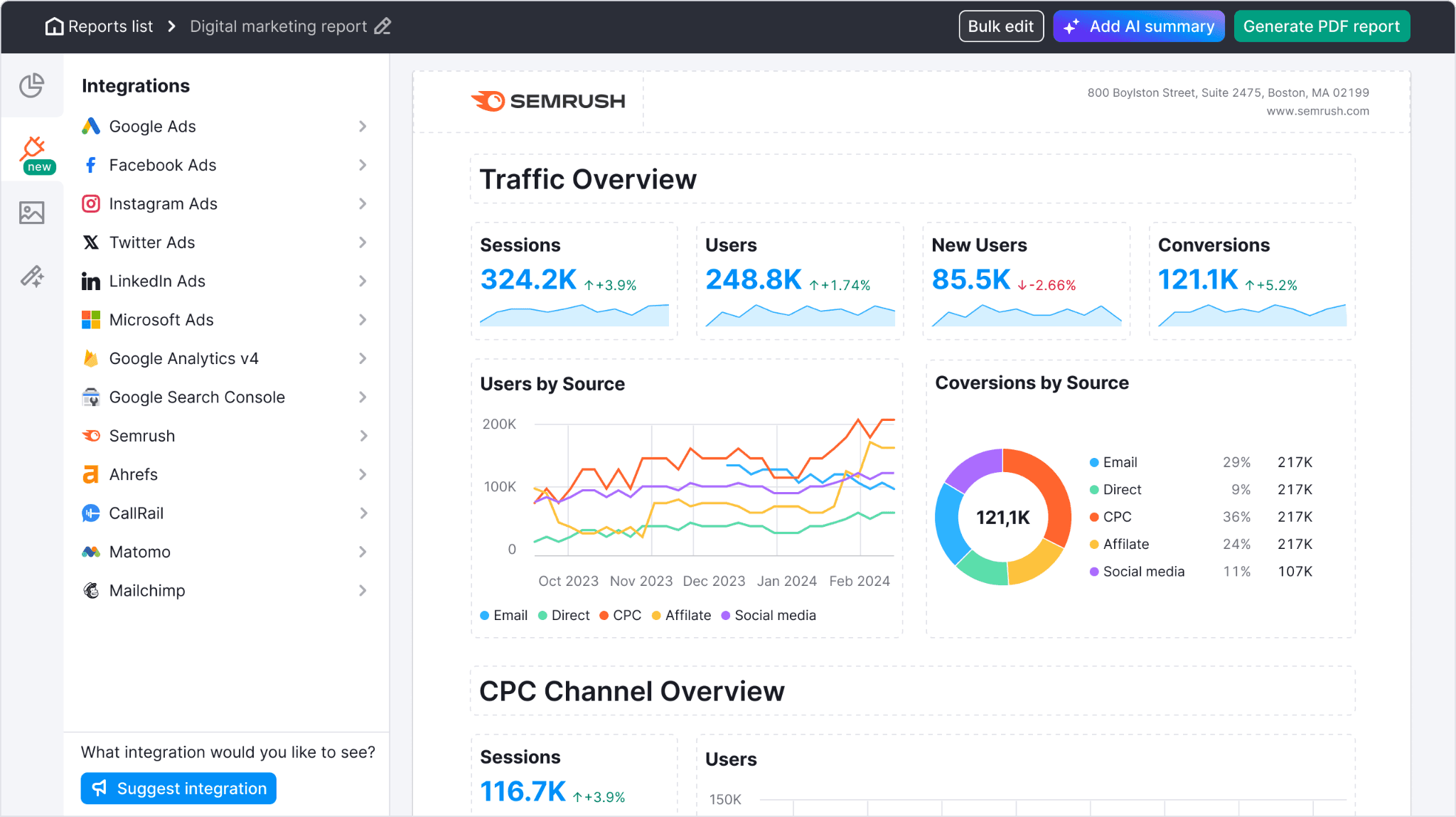
SEO agencies live and die by reporting. Clients want to see that something is happening, even when results take time. Semrush and SE Ranking's white-label reporting is one of the cleanest ways to deliver that.
You generate branded SEO reports with your logo, your colors, your domain and the client never knows SE Ranking is in the background. It's a small but highly defensible piece of your agency offering.
Used for: SEO agencies delivering rank tracking, site audits, and keyword reports to clients
Selling Points:
Affordable entry point compared to Ahrefs or SEMrush white-label equivalents
Automated reporting saves hours per client per month
Looks polished. Clients feel like they're getting a premium service
Key Features: White-label reports, rank tracking, site audit, backlink checker, keyword research, and a custom domain for the client portal.
4. Vendasta
Vendasta is built almost entirely around the white-label reseller model.
It gives you a marketplace of digital marketing products (SEO, reputation, listings, social, ads) that you can package and resell under your brand to local businesses. It’s like a white-label digital agency in a box.
Used for: Digital agencies, media companies, and telcos reselling marketing services to SMBs
Selling Points:
Massive product marketplace. You can build full-service bundles without stitching tools together yourself
Built-in CRM Integration for managing your business clients
Snapshot Report is a great lead gen hook (automated audit of a prospect's online presence)
Key Features: White-label marketplace, reputation management, local listings, social marketing, CRM, snapshot reports, and task management for fulfillment teams.
5. ActiveCampaign (via Reseller Program)
Email marketing and automation are perennial needs. ActiveCampaign has a reseller program that lets agencies offer it under a somewhat customized experience, and the platform itself is one of the strongest in the mid-market space for automation depth.
Used for: Email marketing, marketing automation, CRM, sales automation by B2B and e-commerce clients
Selling Points:
One of the best automation builders in the market. Clients who use it tend to stick
High stickiness = low churn for you as a reseller
A strong deliverability reputation helps your clients' emails actually land
Key Features: Email campaigns, marketing automation, CRM, lead scoring, site tracking, SMS, split testing, e-commerce integrations.
6. SurferSEO / Scalenut (White Label Content & SEO)
Content is still king, and agencies are still being asked to produce it at scale. White labeling an AI-assisted content optimization tool means you can offer content briefs, SEO-optimized drafts, and content audits under your own brand.
Scalenut, in particular, has moved toward a white-label offer that makes sense for content agencies.
Used for: Content marketing agencies, SEO consultants, anyone offering blog + content services to clients
Selling Points:
Gives you a product to sell, not just a service to deliver
Clients can access their own branded portal to see content pipelines and briefs
Positions you as tech-forward compared to agencies just using Google Docs
Key Features: AI content generation, SEO brief creation, keyword clustering, content audit, NLP optimization, white-label client portal.
7. Simvoly
Website and funnel building for clients is tedious at scale unless you have the right infrastructure.
And Simvoly lets you white-label a full website + funnel builder, meaning you can offer "your own" website platform to clients rather than giving them a Wix or Squarespace login.
Used for: Agencies building websites and funnels for small business clients, coaches, and service providers
Selling Points:
You look like you built a proprietary platform, which gives a credibility bump
Recurring revenue from hosting fees you collect, not Simvoly
Membership and e-commerce built in (wider use case coverage)
Key Features: White-label website builder, funnel builder, e-commerce, memberships, A/B testing, email automation, and custom domains per client.
8. Helpwise / Freshdesk (Shared Inbox & Support)
If your clients are dealing with customer support volume across multiple channels (like email, WhatsApp, and web), a white-labeled shared inbox or helpdesk tool can become a genuinely valuable part of your stack.
Helpwise specifically has a reseller/white-label angle that works well for smaller agencies or consultants. It’s somewhat similar to WotNot (the tool I mentioned above at #1).
Used for: E-commerce brands, SaaS companies, service businesses managing multi-channel support
Selling Points:
Solves a painful operational problem which is pretty cool
Clients rarely churn off support tools once their team is trained on them
Easy to bundle with a chatbot product (like WotNot) for a full support suite
Key Features: Shared inboxes (email, WhatsApp, SMS, chat), collision detection, automation rules, canned responses, reporting, and team assignments.
9. Beamer / Notifia (User Engagement & Retention Tools)
Here's an underrated one. SaaS companies and product teams need ways to communicate with their users. Like changelog updates, announcements, NPS surveys, and feature adoption nudges. Beamer and similar tools solve this, and some offer white-label options.
If your clients are SaaS companies themselves, this is a smart niche play.
Used for: SaaS product teams, app developers, and digital product companies communicating with their user base
Selling Points:
Very specific pain point = less competition when pitching it
Product teams have a budget and understand the value quickly
Sticky product, and once integrated into a product, it stays
Key Features: In-app notifications, changelog/newsfeed, NPS & surveys, segmentation, push notifications, white-label branding.
10. Whatagraph (White-Label Performance Reporting)
Reporting is often the first thing clients complain about and the last thing account managers want to spend Friday afternoon doing. Whatagraph tackles this by connecting directly to search, social, and programmatic ad channels, pulling live numbers into custom-branded portals that clients can access anytime.
Beyond standard dashboard widgets, it belongs to the new generation of platforms with automated client reporting that write performance commentary on their own, turning chaotic cross-channel shifts into plain-English takeaways before your weekly client review.
Used for: Performance marketing agencies, media buyers, and growth consultancies managing recurring multi-channel reporting across client accounts.
Selling Points:
Built-in multi-source blending: Calculate blended ROAS and cross-channel CPA across Google, Meta, and TikTok without manual spreadsheet formulas.
Complete agency white-labeling: Host dashboards under your own custom domain with agency logos, color schemes, and scheduled PDF delivery.
Automated commentary: Generates plain-English narrative summaries to explain performance changes without account managers drafting notes by hand.
Key Features: Custom domain mapping, white-label client portals, multi-source data blending, automated AI summary generation, scheduled PDF and live-link sharing, role-based user permissions, pre-built agency templates.
11. DashThis / AgencyAnalytics
Reporting is messy and sometimes not that insightful. But it's one of the highest-value things an agency can deliver because it proves your work is working.
Both DashThis and AgencyAnalytics offer white-label reporting dashboards where you pull data from Google Analytics, Meta Ads, Google Ads, SEO tools, and more. And present it in a branded dashboard that your client logs into.
Used for: Digital marketing agencies, PPC managers, social media managers delivering performance reporting to clients
Selling Points:
Saves 5-10 hours per client per month on manual reporting
Clients see your value constantly which reduces churn and justifies retainers
Looks like you built a proprietary reporting platform
Key Features: White-label dashboards, 30+ integrations (Google, Meta, LinkedIn, HubSpot, etc.), automated report scheduling, custom domain & branding, client-shareable links.
Want to Get Started with Whitelebeling?
The timing honestly couldn't be better.
Tighter budgets mean businesses want trusted partners over expensive enterprise contracts.
AI overload means buyers are exhausted and gravitating toward focused, branded solutions.
And market consolidation means the window to carve out your niche is right now (before it gets crowded).
All you need to worry about is finding the right customers, solving their real problems, and building a brand they trust.
Pick a category that matches where you already have credibility. Start with one platform. Get your first 5 clients. Then stack from there.
The margin is real. The model works. The only question is which problem you're going to solve first.
FAQs
FAQs
FAQs
Is white-label SaaS legal?
How much can you make reselling white-label SaaS?
Do my clients know they're using a white-labeled product?
What's the difference between white-label and reselling?
Can I white-label multiple SaaS products?
ABOUT AUTHOR
Bhavyadeep Sinh Rathod
Content Editor, WotNot
He likes technology, chatbots, comedy, philosophy, and sports. He often cracks hilarious jokes and lightens everyone's mood in the team.

Start building your chatbots today!
Curious to know how WotNot can help you? Let’s talk.
Start building your chatbots today!
Curious to know how WotNot can help you? Let’s talk.


