25 min read
7 Best Ecommerce Help Desk Software for Managing Orders and Support

Hardik Makadia

Let’s build your chatbot today!
Launch a no-code WotNot agent and reclaim your hours.
*Takes you to quick 2-step signup.
At 10 orders a day, the founder handles support.
At 100 orders a day, a small team manages.
But when you get orders of around 1,000 or more, support becomes an entire operation, and you start feeling the need to streamline it.
By nature, eCommerce support questions are not complex. But they are veryyyy repetitive. And in case there’s a seasonal spike in sales, your support team might end up spending the entire day answering questions that should not need a human.
This is why you need an ecommerce help desk software.
After thorough research, here are the 7 best platforms, judged on what actually matters for ecommerce:
Can it pull up order details on its own?
Can agents resolve tickets without switching between tabs?
Does it hold up when a sale doubles your ticket volume overnight?
Let's get into it.
What This Guide Covers
The Quick Comparison: 7 Ecommerce Help Desks at a Glance
Platform | Best For | Key Ecommerce Strength | Starting Price | Free Trial | G2 Rating |
Shopify-native stores | In-ticket order actions: refund, cancel, edit without leaving conversation | $40/month (50 tickets) | Available on Basic and Pro, no credit card | 4.6/5 | |
Multi-channel AI deflection | AI resolution across WhatsApp, web, Instagram, SMS, and phone with unlimited live chat seats | $23/month (billed annually) | 14-day, no credit card | 4.6/5 | |
Multi-marketplace sellers | 250+ marketplace integrations: Amazon, eBay, Walmart, Etsy | $39/agent/month | 14-day, no credit card | 4.3/5 | |
Small stores, budget AI | Lyro AI chatbot with Shopify integration and cart recovery | Free plan available | Free plan + 7-day trial on paid plans | 4.7/5 | |
Enterprise ecommerce | Advanced routing, SLA management, workforce reporting | $55/agent/month | 14-day on most plans | 4.3/5 | |
Gmail-native teams | Shared inbox with Shopify order data inside Gmail. AI included in plan price. | $25/user/month (Growth) | Free plan + 7-day trial | 4.6/5 | |
Small teams, email-first | Clean simplicity. AI drafts, refunds and cancellations from sidebar. | $25/user/month | Free plan + trial on Standard and Plus. AI Answers: 3-month free trial | 4.4/5 |
How to Evaluate an Ecommerce Help Desk Software
An ecommerce help desk needs to do more than just manage tickets. Because ecommerce support has a specific shape to it. Most of your tickets are not complex, but they are repetitive. And the platform you choose should be built to handle that pattern.
Here are the questions worth asking before you evaluate anything:
1. Can it answer order questions instantly?
The most common support requests in ecommerce are the simplest ones. Where's my order? Has it shipped? What's the tracking number? When will it arrive?
WISMO ("where is my order") alone accounts for 20 to 40% of all ecommerce support tickets, climbing past 50% during peak season. If your help desk can't pull live order data into conversations, your agents spend their day copying and pasting from Shopify.
2. Can it automate returns and refunds?
You want an actual help desk - not just a fancy FAQ.
So, I’m not talking about the help desk logging the customer request. But actually check return eligibility, initiate the refund, trigger the replacement, and confirm it with the customer.
The difference between a help desk that records "customer wants a refund" and one that processes it within the conversation is the difference between a ticket and a resolution.
“The future is not about managing AI but collaborating with AI agents that think, act, and optimize in real time.” |
3. Can it access your ecommerce stack?
Shopify, WooCommerce, BigCommerce, Amazon, payment gateways, and shipping providers. Without these connections, the AI or the agent is working blind. They can talk to the customer, but they cannot act on the order.
4. Can customers reach you on the channels they already use?
If you expect your customers to order on Instagram, it is only fair that you provide support there too.
The same goes for WhatsApp, Messenger, SMS, and your website. If your ecommerce help desk only covers email and chat, you are missing conversations on the channels where your customers already shop and browse. This is where an omnichannel setup becomes critical for ecommerce specifically.
5. Does it scale when your next sale doubles ticket volume?
You need to be prepared for this as well - black friday, flash sales, product launches.
Your support volume spikes, and your help desk either handles it or collapses under it. This includes how the pricing model behaves at peak volume, not just whether the software technically stays online.
Note: How I evaluated these platforms:
I assessed the following tools based on 4 main things,
How deep the integration goes,
Whether the AI actually resolves or just assists,
What the pricing looks like at real ecommerce volume (not just the starting price), and
What limitations exist
Best Ecommerce Help Desk Software in 2026
Each platform below is evaluated on what matters most for ecommerce: how well it connects to your order data, how much it can resolve without agents switching tabs, and whether it holds up when a flash sale doubles your ticket volume overnight.
I've included honest limitations for every tool, including the ones I'm partial to.
1. Gorgias
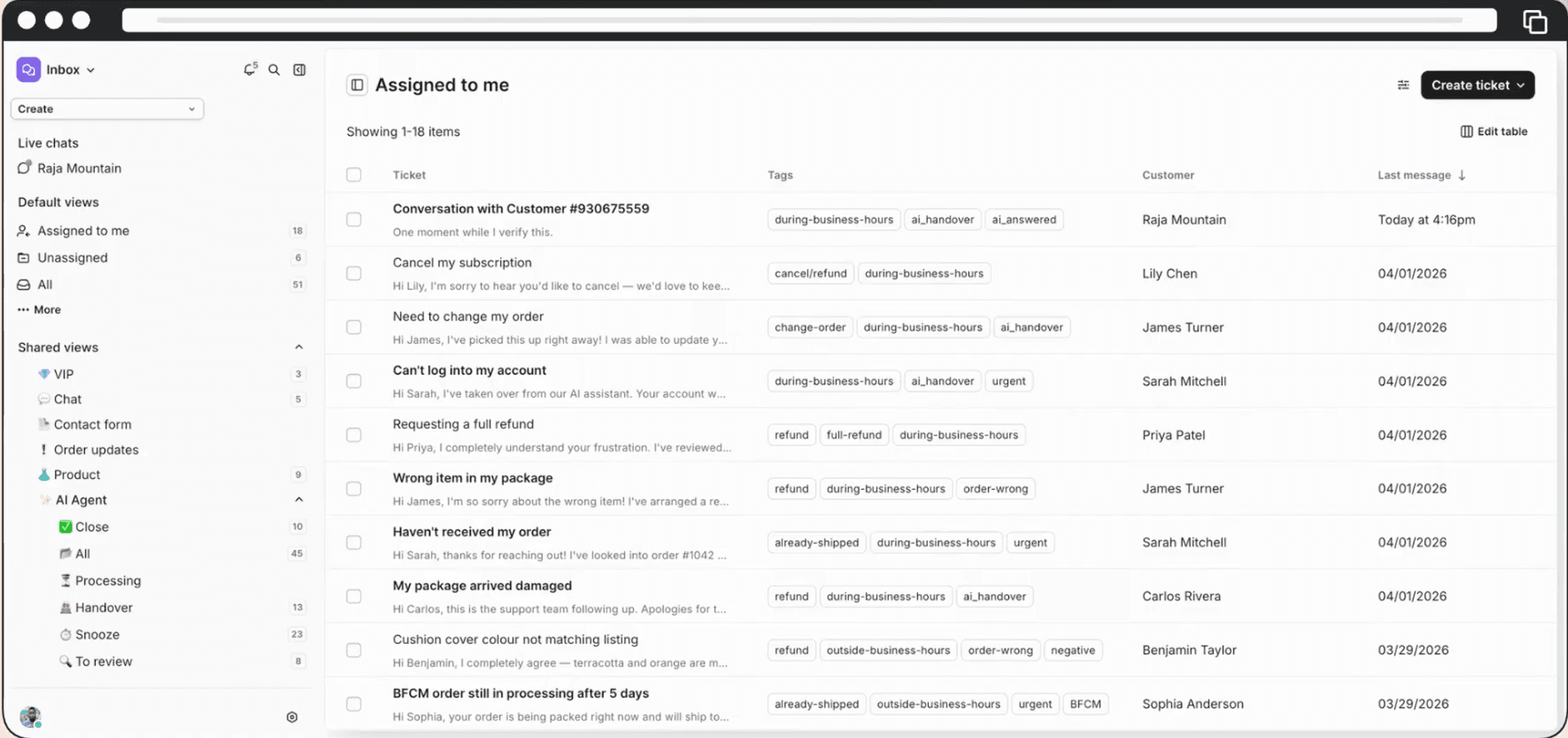
Gorgias is the default ecommerce help desk for Shopify stores, and for good reason. It is built from the ground up for ecommerce, with over 15,000 brands running on it, and is the only Premier Partner for customer experience. So if you search "ecommerce help desk" anywhere, Gorgias is the first name that comes up.
G2 rating: 4.6/5 (from 500+ reviews)
How it handles ecommerce support
The Shopify integration is the deepest on the market. Your agents see a customer's complete order history, shipping status, and lifetime value directly inside the ticket. They can refund, cancel, duplicate, or edit orders without leaving the conversation. No tab switching, no copy-pasting from the Shopify admin. That alone eliminates the single biggest time sink for ecommerce support teams.
The AI Agent handles routine queries autonomously: WISMO, return and refund requests, exchanges, cancellations, and FAQ responses. The AI also includes intent detection, which means it recognizes whether a customer wants a refund, a cancellation, or just a status update before routing the conversation.
For tickets that do reach a human, Gorgias helps there too. Agent Copilot suggests replies, detects customer sentiment, surfaces relevant macros, and recommends next-best actions so agents resolve faster, even on conversations the AI couldn't handle alone.
And then there is revenue attribution, a feature most help desks don't offer. Gorgias tracks interactions that influenced a purchase, turning your support dashboard into something your marketing team actually pays attention to. Many brands report that proactive product recommendations and discount offers during support chats directly increase conversion rates.
Where it lacks
Per-ticket pricing looks simple until your busiest month arrives.
Gorgias bills by ticket volume, not by seat. Plans range from $10/month (50 tickets) to $900/month (5,000 tickets). That sounds fair. But then the AI Agent adds $0.90-$1.00 per resolution on top. And any ticket beyond your plan limit costs $0.32-$0.40 in overage fees. These layers stack.
The other limitation worth noting: the AI Agent is Shopify-only. If your store runs on BigCommerce, WooCommerce, or Magento, you get the help desk but not the full AI resolution capabilities. And voice support is a separate add-on billed per ticket.
Pricing
Starter: $40/month (50 tickets/month)
Basic: $77/month (300 tickets/month)
Pro: $471/month (2,000 tickets/month)
Advanced: $1,227/month (5,000 tickets/month)
Enterprise: Custom pricing
AI Agent: Priced separately with usage-based billing after the included monthly interactions.
Unlimited agent seats
Free trial available (Basic & Pro)
Choose it when
Your store runs on Shopify; ecommerce support is your primary use case, and you want the deepest native integration with AI that can process refunds and edit orders from within the conversation.
Skip it when
You sell across multiple marketplaces like Amazon, eBay, and Walmart, where eDesk is purpose-built. Or your ticket volume is unpredictable, and per-ticket pricing makes your monthly bill hard to forecast. Or your store runs on WooCommerce or Magento, where the AI Agent won't work.
2. WotNot
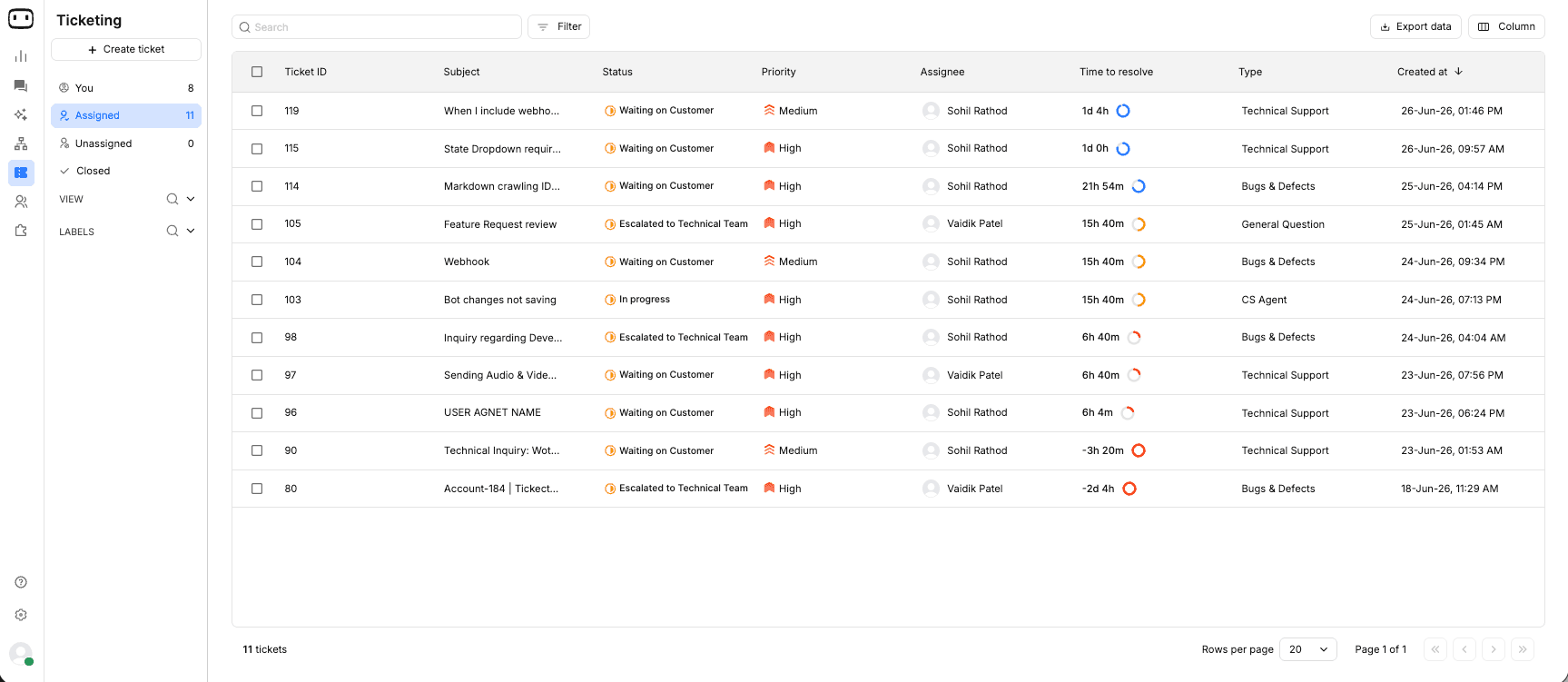
WotNot is the easiest AI agent platform you can find online. It is designed to handle the front layer of customer conversations across every channel, resolving the repetitive queries that would otherwise become tickets for your support team.
The best part? WotNot is built around AI resolution with help desk integrations connected behind it. The platform serves businesses across ecommerce, healthcare, real estate, and SaaS, with multi-channel deployment.
G2 rating: 4.6/5
How it handles e-commerce support
The core differentiator is multi-channel deployment.WotNot deploys across web, WhatsApp, Instagram, Messenger, SMS, and phone from a single no-code builder. For e-commerce, this matters because your customers are not just emailing. They are messaging on Instagram after seeing a product, following up on WhatsApp after placing an order, and calling when a delivery is late. Most e-commerce help desks on this list cover email and chat. WotNot covers the channels where e-commerce conversations actually happen.
AI Studio supports multiple LLMs with RAG to ground every response in your actual product and order data, rather than generating generic replies. When a customer asks, "Where is my order?" the AI pulls from your connected systems and responds with the real status. The same applies to return eligibility, product availability, and FAQ queries. The goal is to resolve the issue within the conversation rather than create a ticket for a human to handle later.
Where WotNot differs most from platforms like Gorgias is in pricing that doesn't scale with ticket volume. There are no per-ticket fees. No per-resolution charges that spike during your busiest sales week.
Live chat comes with unlimited agent seats, which means your human team scales during Black Friday, festivals, or any flash sale without your software bill scaling with it.
For teams that would rather not configure any of this, WotNot offers managed services where their team sets up the AI, connects the integrations, and gets e-commerce support workflows live for you.
Read how TravelXP generated 80L in the sales pipeline by just using Instagram bots.
Where it lacks
WotNot is not a traditional e-commerce help desk. It is important to understand what that means.
It does not have native Shopify order management inside a ticketing interface. Your agents cannot refund, cancel, or edit orders from within WotNot the way they can in Gorgias. There is no built-in revenue attribution dashboard that ties support conversations to purchases. And if your team needs advanced ticketing features like SLA management, ITIL workflows, or deep reporting, WotNot is not built for that.
Pricing
Do It Yourself:
Lite: $29/month (1,000 chats, 1,000 AI credits)
Starter: $99/month (5,000 chats, AI Studio, all LLM models, integrations)
Premium: $299/month (10,000 chats, Live Chat, custom widget)
Enterprise: Custom (unlimited chats, unlimited credits, SSO, priority support)
Done For You:
Subscription + Managed Setup: $12,000/year onwards (20K chats, 20K AI credits, dedicated account manager, 60 hours of managed services)
14-day free trial on all DIY plans, no credit card required.
Choose it when
Your ecommerce customers reach out across multiple channels beyond email and chat.
Your ticket volume spikes during sales and you want predictable pricing that doesn't punish growth.
You already run a help desk like Zendesk or Freshdesk and want to add an AI resolution layer without migrating to a new platform.
Your store runs on WooCommerce, BigCommerce, or a custom platform where Gorgias AI doesn't work.
Or your team would rather have someone build the AI support system for you through managed services.
Skip it when
You run a Shopify-only store and need native in-ticket order actions like refunding and editing orders from within the conversation. Or you need a standalone help desk with SLA management, advanced reporting, and revenue attribution built in. For those needs, Gorgias or Zendesk are purpose-built.
Start building, not just reading
Build AI chatbots and agents with WotNot and see how easily they work in real conversations.

Start building, not just reading
Build AI chatbots and agents with WotNot and see how easily they work in real conversations.
Start building, not just reading
Build AI chatbots and agents with WotNot and see how easily they work in real conversations.

3. eDesk
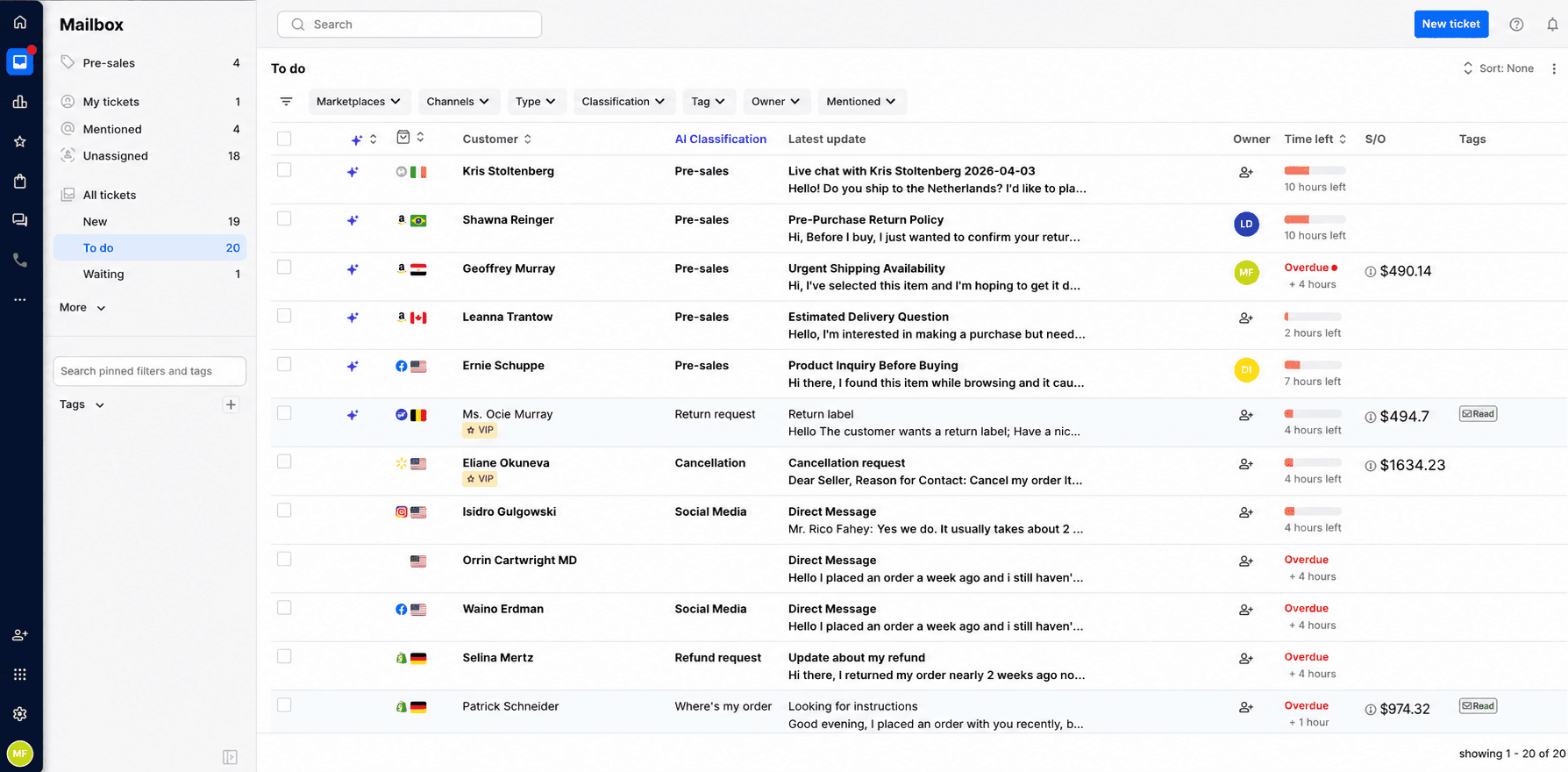
If Gorgias owns the Shopify segment, eDesk owns the marketplace segment. It is purpose-built for ecommerce businesses selling across multiple platforms: Amazon, eBay, Walmart, Etsy, Shopify, BigCommerce, WooCommerce, and more. As of today, eDesk is the only customer support solution that is on both the Amazon and Walmart developer councils. Now this tells you where its integration depth is strongest.
G2 rating: 4.5/5
How it handles e-commerce support
The Smart Inbox is the core product. It consolidates messages from over 250 marketplaces, webstores, social channels, and logistics tools into a single interface with full order data visible right beside each customer message. When a customer contacts you about a delayed Amazon shipment, your agent immediately sees tracking information, order details, shipping carrier, and purchase history without opening a single extra tab.
What makes eDesk especially valuable for marketplace sellers is native SLA management. Amazon enforces a 24-hour response window on all messages. eBay and Walmart have their own compliance rules. eDesk auto-prioritizes tickets based on these marketplace deadlines so your team responds to the most urgent ones first.
The Ava AI Agent handles common queries around the clock: order status, product questions, and return eligibility. It pulls from your connected order data and knowledge base, and escalates to humans when it hits its limit.
For multi-store management, eDesk lets you manage up to 10 stores on the Professional plan or unlimited stores on the Enterprise plan from a single dashboard. If you run three Shopify stores, an Amazon seller account, and an eBay presence, that's one inbox, one team, one set of reporting.
eDesk uses per-agent pricing with unlimited tickets. So your bill stays the same in December as it does in July - no overage fees during the peak season and no ticket counting as well.
Where it lacks
eDesk is built for breadth across marketplaces, not depth on any single platform.
The Shopify integration exists, but is not as deep as Shopify-native help desks. You can't refund or edit orders directly from inside a ticket the way Shopify-focused help desks let you. And there's no built-in dashboard tracking how support conversations lead to sales. If your entire business runs on one store and you don't sell on marketplaces, eDesk is more infrastructure than you need.
The AI resolution rate is lower than that of single-platform competitors. Around 30% across complex multi-marketplace scenarios is honest, but if you need higher automation rates, platforms built for a single ecosystem will outperform.
Some long-term users on review sites also flag price increases over time as a frustration. The product is robust, but check your contract terms for renewal pricing.
Pricing
Essential: $39/agent/month (AI Agent included, billed annually)
Growth: $89/agent/month (AI Agent included, billed annually)
Professional: $119/agent/month (AI Agent included, billed annually)
Enterprise: Tailored pricing (Contact sales)
AI Agent: Included in every plan. Additional automated resolutions are billed at $0.99 per automated resolution.
Free trial: Available on Essential, Growth, and Professional plans.
Choose it when
You sell across multiple marketplaces like Amazon, eBay, Walmart, and Etsy alongside your own store and need one inbox that consolidates everything with order data and SLA compliance built in. Also a strong fit if you want predictable monthly costs with unlimited tickets regardless of volume spikes.
Skip it when
You operate a single-channel store where marketplace SLA management and 250+ integrations are unnecessary overhead. Or if your primary challenge is high-volume repetitive queries across WhatsApp, Instagram, and web chat rather than marketplace ticket management, a platform like WotNot that focuses on AI resolution across those channels is a better fit.
4. Tidio
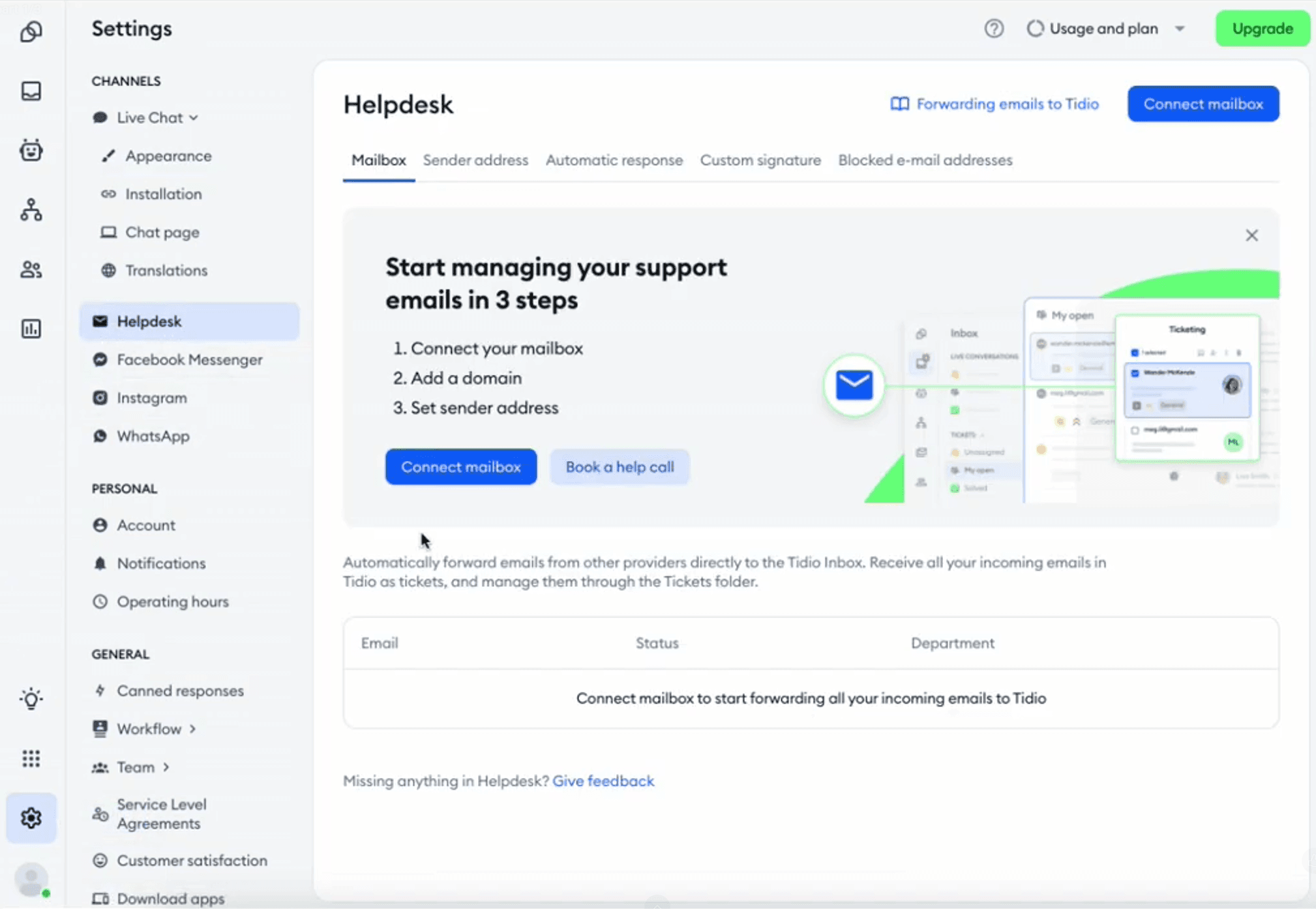
Tidio is another entry point. If you run a small e-commerce store and need live chat, AI automation, and a help desk in one tool without a big budget or a complicated setup, this is a good starting point. It installs as a Shopify app in minutes. No onboarding calls. No configuration projects. You can be live the same afternoon. Over 300,000 businesses use Tidio, and it holds the highest G2 rating on this list at 4.7/5.
How it handles e-commerce support
The standout feature is Lyro AI Agent. It learns from your FAQ pages and support content, then answers customer questions in natural language without scripted flows. Tidio claims Lyro resolves up to 67% of customer queries automatically. For e-commerce stores, that means order status questions, shipping timelines, return policies, and product availability can be handled without human intervention. Every account gets 50 free Lyro conversations to test before committing.
What makes Tidio particularly useful for small stores is real-time visitor monitoring. You can see which product page a customer is browsing while they chat with you. If someone is looking at a winter jacket and asks, "Does this run small?" your agent already knows the context before reading the message. That visibility also powers cart recovery through chat. When a shopper hesitates at checkout, Tidio can trigger a proactive message offering help or a discount code. This turns your support widget into a sales tool.
The Shopify and WooCommerce integrations connect customer conversations to order data. Agents can see past orders, current cart contents, and browsing history alongside the chat. For a small store, this is often enough to answer most questions without leaving the Tidio dashboard.
Setup is genuinely fast. The no-code chatbot builder uses drag-and-drop flows for common scenarios like greeting new visitors, capturing emails, and answering FAQs. You don't need a developer. You don't need a week. Most stores get the basics running in an hour.
Where it lacks
Tidio is built for simplicity. And the bad part is that you hit a ceiling pretty quickly.
Lyro AI conversations are billed separately from your base plan. The base subscription covers human chat and ticketing. Lyro costs extra, starting at $39/month for 50 AI conversations. If your store gets busy, those conversations add up fast on top of your plan cost. A Growth plan at $59/month plus Lyro at $75/month plus Flows at $24/month puts your real cost at $150+/month. Not bad, but not $59 either.
The pricing cliff between Growth and Plus is steep. Growth costs $59/month. Plus jumps to $749/month. There is nothing in between. If you outgrow Growth but don't need enterprise features, you're stuck choosing between limits and a 12x price jump.
Tidio also cannot process refunds or edit orders from inside the conversation. Agents can see order data, but acting on it still requires switching to Shopify or your store admin. And there are no native marketplace integrations for Amazon, eBay, or Walmart.
This is just a single-store tool. If you're already feeling those limits, there are Tidio alternatives worth looking at.
Pricing
Starter: $24.17/month (100 billable conversations/month)
Growth: $49.17/month (250 billable conversations/month)
Plus: $749/month (Custom billable conversations)
Premium: Custom pricing
Free trial: 7-day free trial available on Starter and Growth plans.
Choose it when
You run a small to mid-size ecommerce store
You want AI chat and live chat in one affordable tool, and
You value fast setup over deep customization.
Ideal if you're doing under 2,000 support conversations per month and want to start automating without a big commitment.
Skip it when
You sell on marketplaces like Amazon or eBay because Tidio has no native marketplace support.
Or if your store handles more than 2,000 conversations monthly, the pricing jump to the next tier may push you toward platforms with more predictable scaling.
If your primary need is AI resolution across WhatsApp, Instagram, and phone rather than website chat, WotNot covers those channels more naturally.
5. Zendesk
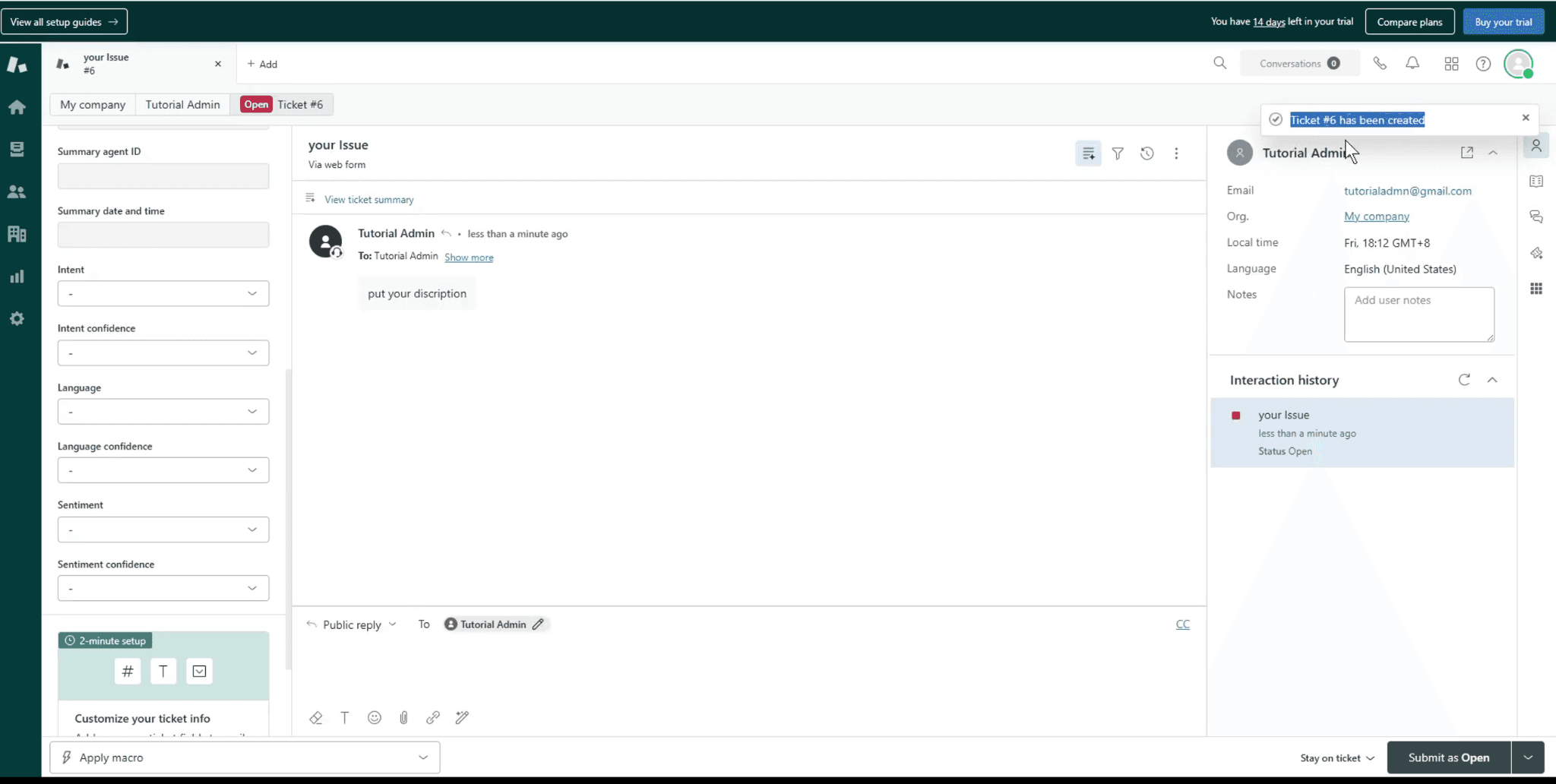
Zendesk is the enterprise option on this list. It is not built specifically for ecommerce. It is a general-purpose help desk that large ecommerce operations adopt when they need advanced routing, SLA management, workforce reporting, and a platform that scales to hundreds of agents across multiple teams. Over 16,500 Shopify stores use the Zendesk Shopify integration.
G2 rating: 4.3/5
How it handles ecommerce support
The Shopify integration is a free app that pulls customer and order data directly into the ticket sidebar. Agents see order history, shipping status, payment details, and past conversations without leaving Zendesk. They can process refunds and cancellations from within the ticket view. If you run multiple Shopify stores, you can connect them all to one Zendesk dashboard.
AI Agents handle autonomous resolution for common queries. Zendesk restructured its AI pricing in May 2026. Only verified resolutions, where the AI confirms the issue is actually solved, count toward your AI usage. Assisted escalations and contained resolutions are free. That's a fairer model than charging for every AI interaction regardless of outcome.
Where Zendesk earns its premium is advanced reporting and workforce management. You get detailed analytics on agent performance, ticket trends, resolution times, and customer satisfaction. For teams with 10+ agents handling thousands of tickets, this visibility is what keeps operations running smoothly.
The platform supports every channel: email, live chat, social media, WhatsApp, phone, and SMS. Combined with 1,000+ integrations in the Zendesk Marketplace, it connects to virtually any tool your team already uses.
Pricing
Support Team: $19/agent/month (billed annually)
Suite Team: $55/agent/month (billed annually)
Suite Professional: $115/agent/month (billed annually)
Suite Enterprise + Copilot: Contact sales
Free trial: Available on Support Team, Suite Team, and Suite Professional plans.
Where it lacks
Zendesk is powerful. But I can’t deny - it is too complex to use.
It is not ecommerce-native. The Shopify integration surfaces order data well, but setting up autonomous AI actions like refunds or order edits requires custom configuration. Ecommerce-specific platforms handle these natively. Zendesk requires you to build them.
That’s a headache you might want to avoid.
The per-agent pricing adds up fast. Suite Team starts at $55/agent/month. A 10-person support team pays $550/month before any AI add-ons. Add advanced features and AI resolution fees on top, and the total cost for a mid-size ecommerce operation can climb quickly.
For small teams, Zendesk is too much platform. The setup takes time. The configuration has a learning curve. And many features like workforce management and advanced routing only matter once your team reaches a certain size.
Choose it when
Your ecommerce operation has 10+ agents, needs enterprise-level reporting and SLA management, and runs complex multi-team workflows. Also a strong fit if your business goes beyond ecommerce and you need one help desk across support, sales, and internal teams.
Skip it when
You run a small to mid-size store and don't need enterprise features.
The setup time and per-agent cost are hard to justify when simpler platforms solve the same ecommerce problems with less overhead.
If your primary need is AI-first ticket deflection across channels like WhatsApp, Instagram, and web.
6. Hiver
Most help desks ask your team to learn a new platform, but this one doesn’t.
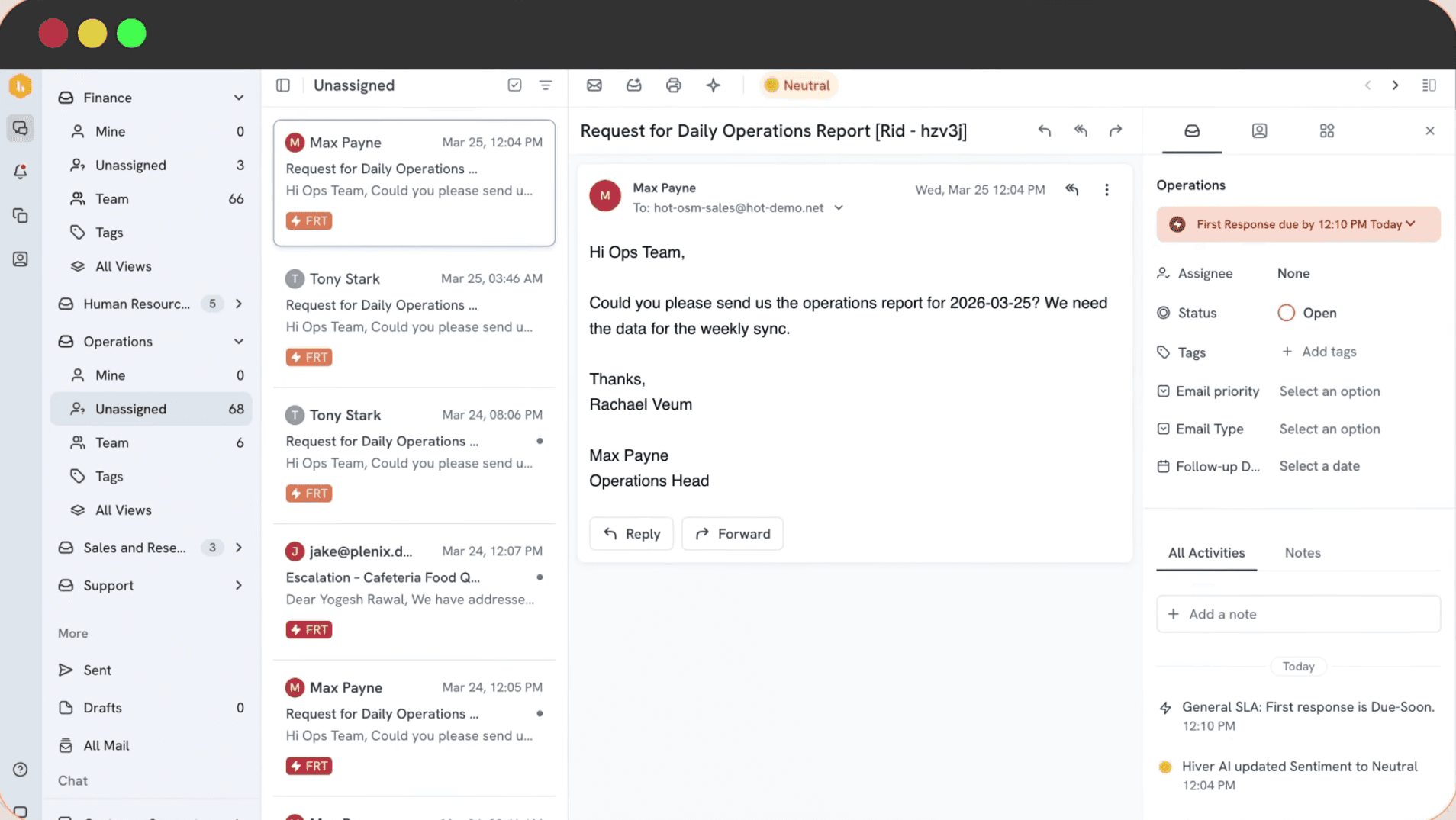
Hiver turns Gmail into a help desk. If your ecommerce support team already lives in Google Workspace, Hiver adds shared inboxes, ticket assignment, SLA tracking, and AI directly inside the Gmail interface they already know. No new tool to learn. No migration project. That's genuinely appealing for small teams who just want to get organized without disrupting how they already work.
G2 rating: 4.6/5.
How it handles ecommerce support
The Shopify and WooCommerce integrations pull order data directly into the Gmail sidebar. When a customer emails about a return, your agent sees their order history, shipping status, and purchase details right next to the email thread. No tab switching required.
AI Agents handle repetitive ecommerce queries like order status, shipping updates, and return policies. AI Copilot drafts replies, suggests answers from your knowledge base, and summarizes long threads so agents can catch up on a conversation in seconds.
One thing I appreciate about Hiver's pricing approach: AI is included in the plan price. There is no separate per-resolution fee. What you see on the pricing page is what you actually pay. After seeing how per-resolution and per-ticket fees add up on other platforms, that kind of simplicity is refreshing.
The platform also supports live chat, WhatsApp, and voice alongside email. So while it started as a Gmail tool, it has grown into a proper multi-channel help desk. Your team manages everything from one interface they are already comfortable with.
Setup is fast. Most teams are live within a day. That speed matters for small ecommerce teams who need results this week, not next quarter.
Where it lacks
Hiver is great at making Gmail smarter. But Gmail is still Gmail.
There are no native marketplace integrations. If you sell on Amazon, eBay, or Walmart, Hiver cannot pull those order conversations into your inbox the way eDesk can. It is built for direct-to-consumer stores, not multi-marketplace sellers.
The Shopify integration surfaces order data but agents cannot process refunds or edit orders from inside Hiver. You still need to open the Shopify admin for those actions. It shows you the information, but doesn't let you act on it.
And while Hiver works well for small and mid-size teams, advanced reporting and routing are limited compared to platforms built for larger operations. If your team grows beyond 15-20 agents, you might start feeling the ceiling.
Pricing
Free: $0/user/month
Growth: $25/user/month
Pro: $55/user/month
Elite: $85/user/month
Free trial: Available on the Growth plan.
Choose it when
Your ecommerce team runs on Gmail and you want a help desk that fits into your existing workflow without a learning curve. Strong pick if you value pricing simplicity with AI included and your primary channels are email and live chat.
Skip it when
You sell on marketplaces. Hiver has no Amazon, eBay, or Walmart integrations. Or if you need in-ticket order actions like processing refunds without leaving the help desk. Instead, you can go for Gorgias or WotNot.
7. Help Scout
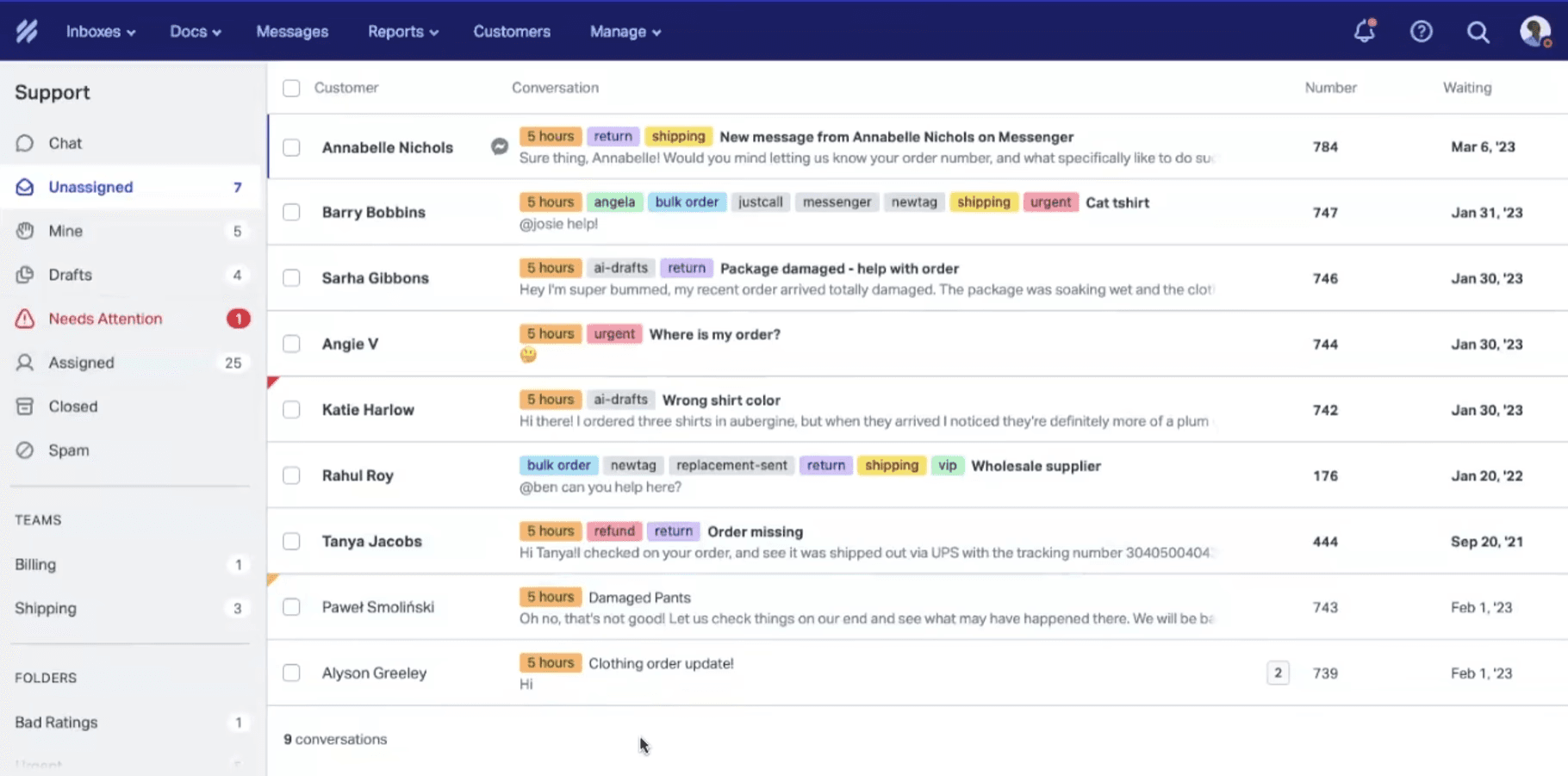
Help Scout is a shared inbox help desk built for small and mid-size teams. The differentiator is that it doesn't feel like a help desk. It feels like email. That simplicity is intentional. For small ecommerce teams that want to deliver personal, thoughtful support without learning a complex platform, Help Scout keeps things clean. Shared inbox, knowledge base, live chat, AI drafts, and Shopify integration. Everything you need, nothing you don't. A clean, well-designed tool that gets out of your team's way. Help Scout is also a Shopify Plus Certified App Partner, one of only 86.
G2 rating: 4.4/5.
How it handles ecommerce support
The Shopify integration pulls order details, shipping status, tracking information, and customer history directly into the conversation sidebar. Agents can process refunds and cancel orders from inside Help Scout without opening the Shopify admin.
For WooCommerce and Magento stores, similar integrations are available. And here is where Help Scout stands out: if you have a custom order management system, the robust API and webhooks let you connect it to your help desk in ways that plug-and-play integrations simply can't.
Most tools on this list assume you use Shopify. Help Scout assumes you might not.
AI Drafts write replies based on your team's past responses and your knowledge base content. Agents review, tweak, and send. AI Summarize condenses long conversation threads into a quick brief. For autonomous resolution, AI Answers powers a chatbot that handles common questions from your Docs knowledge base, though this is billed separately at $0.75 per resolution.
The Beacon widget adds live chat and self-service to your storefront. Customers can search your knowledge base, start a chat, or send an email without leaving your store.
Something I find underrated about Help Scout: emails sent from it carry no Help Scout branding. No ticket numbers. No "powered by" footer. Your customer sees a normal, personal email from your brand. For ecommerce, where the relationship between brand and buyer matters, that small detail counts.
Where it lacks
Help Scout prioritizes simplicity. That means it consciously leaves some things out.
The Shopify integration is solid but not as action-rich as ecommerce-native platforms. You can refund and cancel orders, but you can't edit orders, create discount codes, or get product recommendations inside the ticket. For stores where support drives revenue through upselling, that gap is noticeable.
AI Answers costs $0.75 per resolution. That's higher than most alternatives on this list. At 500 resolutions per month, you're paying $375 on top of your plan just for AI. The AI helps agents draft better replies, but autonomous resolution comes at a premium.
And there are no marketplace integrations. Again, this is a loss as no Amazon, no eBay, no Walmart. Help Scout is built for direct-to-consumer stores that own their customer relationships through their own channels.
Pricing
Standard: $25/user/month
Plus: $45/user/month
Pro: $75/user/month
AI Answers (add-on): $0.75 per resolution
Free plan: Available for up to 5 users, including 1 inbox and 1 Docs site.
Free trial: Available on Standard and Plus plans
Choose it when
You run a small to mid-size ecommerce store and want a clean, simple help desk that your team can learn in an hour. Especially strong if you have a custom order management system that needs API-level integration rather than a Shopify-only plug-and-play setup. Also a great pick if brand experience matters to you and you want support emails that feel personal, not automated.
Skip it when
You need deep ecommerce-specific features like revenue attribution, in-ticket product recommendations, or discount code creation. Or if your AI resolution volume is high enough that $0.75 per resolution makes the cost hard to justify compared to platforms that include AI in the base price. If that's where you land, there are Help Scout alternatives better suited to those needs.
Let’s build your chatbot today!
Launch a no-code WotNot agent and reclaim your hours.
Let’s build your chatbot today!
Launch a no-code WotNot agent and reclaim your hours.
The Pricing Reality During Your Busiest Month
Most ecommerce teams track revenue per order and conversion rate down to the cent. But the cost of answering one customer question? Almost nobody knows. And yet, our research on chatbot adoption shows that service leaders expect AI to reduce support costs and resolution times by 20% on average. You can't capture that saving if you don't know what you're spending in the first place.
That blind spot gets expensive fast when you pick the wrong pricing model.
Here is what the same 1,500 tickets per month actually costs across three models:
Per-ticket pricing:
Gorgias Pro at 2,000 tickets = $471/month. The AI Agent comes with a monthly allowance of automated interactions, but anything beyond that is billed at $1.50 per additional AI interaction.
And if your total tickets cross 2,000, overages kick in at $0.36 per ticket. During Black Friday, when volume doubles to 3,000+, the base plan plus AI overages plus ticket overages stack into a bill that looks nothing like $471.Per-agent pricing:
Zendesk Suite Team at $55/agent/month. Five agents = $275/month. That's predictable. But the moment you add AI Copilot at $50/agent/month, your five-agent team jumps to $525/month.
Need a sixth agent for the holiday rush? That's another $105/month permanently. The seat cost is stable. Everything around it isn't.Flat-rate with AI resolution built in:
WotNot Starter at $99/month.
But why is this a deal breaker? I'll tell you: instead of charging you more because more customers need help, it focuses on increasing the number of conversations AI can resolve before they ever reach your support team through AI Studio, which lets you plug in multiple LLMs, ground them in your actual product data, and build resolution flows visually.
Your human agents still get unlimited live chat seats for the conversations that genuinely need them, while AI handles the repetitive workload across channels. And when your sales double during a holiday campaign, your support volume may double too.
The goal isn't for your software bill to double with it.
The math is simple, but most teams never do it. They compare starting prices on pricing pages and pick the lowest number. Then the first busy month arrives, and the invoice tells a different story.
Mark my words: The best e-commerce help desk isn't the cheapest on the pricing page. It's the one that doesn't punish you for having a successful sales week.
When You Don't Need an E-commerce Help Desk
Don’t fall for the misconception that every e-commerce business needs a dedicated help desk software right now. And I'd rather you hear that from me than figure it out after paying for three months of a tool your team barely uses.
If your store handles fewer than 100 tickets a month, a shared Gmail inbox or Shopify Inbox does the job. The overhead of configuring a help desk, training your team, and maintaining it simply isn't worth it at that volume. Your time is better spent on the product.
If your support queries are mostly pre-sale questions like "Does this come in blue?" or "What's the shipping time to Germany?", you don't need a help desk. You need a good FAQ page and a simple chatbot on your storefront. That alone will answer 80% of these without any human involvement.
If your knowledge base doesn't exist yet, pause before buying anything. Every AI feature on every platform in this guide pulls from your support content to generate responses. If that content is outdated, incomplete, or nonexistent, the AI will confidently give wrong answers. That's worse than no AI at all. Build the knowledge base first. The help desk can wait.
If you're a one-person operation wearing every hat, adding another software tool to manage will take more time than it saves. At this stage, your personal touch is your competitive advantage. Don't automate it away.
For those of you who fall into any of these categories, here's what I'd actually recommend doing instead:
Track your ticket volume for 30 days. Count every customer message across every channel. If the number surprises you, revisit this guide.
Write your top 20 FAQs. Not for a help desk. For yourself. This exercise alone will show you which questions are worth automating and which ones are not.
Set up a free tool first. Tidio has a free plan. Help Scout has a free plan. Shopify Inbox is free. Test the waters before you commit to the budget.
Revisit in 90 days. Your store is growing. What doesn't make sense today might make perfect sense next quarter.
Choosing the Right E-Commerce Help Desk
Repeat after me:
The right platform depends on three things:
where your customers reach out,
how many tickets you handle, and
whether you need the help desk to manage those tickets or resolve them.
If your store runs on Shopify and you want the deepest native integration, Gorgias is built for that. If you sell across marketplaces, eDesk is purpose-built for the complexity of your business. If you want a clean, simple tool your team can learn in an hour, Help Scout and Hiver are strong starting points.
And if you want AI handling the repetitive queries across WhatsApp, Instagram, web, and phone before they ever become tickets, while your human team focuses on the conversations that actually need them, that's what we built WotNot to do. We didn't build it to replace your help desk. We built it to make sure your help desk only sees the tickets worth reviewing.
You can start a 14-day free trial and test it with your actual customer queries. No credit card. No sales call. Just your questions, your channels, and an honest look at what AI resolves and what it doesn't.
FAQs
FAQs
FAQs
What is an e-commerce help desk?
What is the best e-commerce help desk software?
How much does e-commerce help desk software cost?
Can an e-commerce help desk handle returns and refunds?
ABOUT AUTHOR
Hardik Makadia
Co-founder & CEO, WotNot
Hardik leads the company with a focus on sales, innovation, and customer-centric solutions. Passionate about problem-solving, he drives business growth by delivering impactful and scalable solutions for clients.

Start building your chatbots today!
Curious to know how WotNot can help you? Let’s talk.
Start building your chatbots today!
Curious to know how WotNot can help you? Let’s talk.